

β-actin Monoclonal Antibody [5B7], AbFluor 350 Conjugated
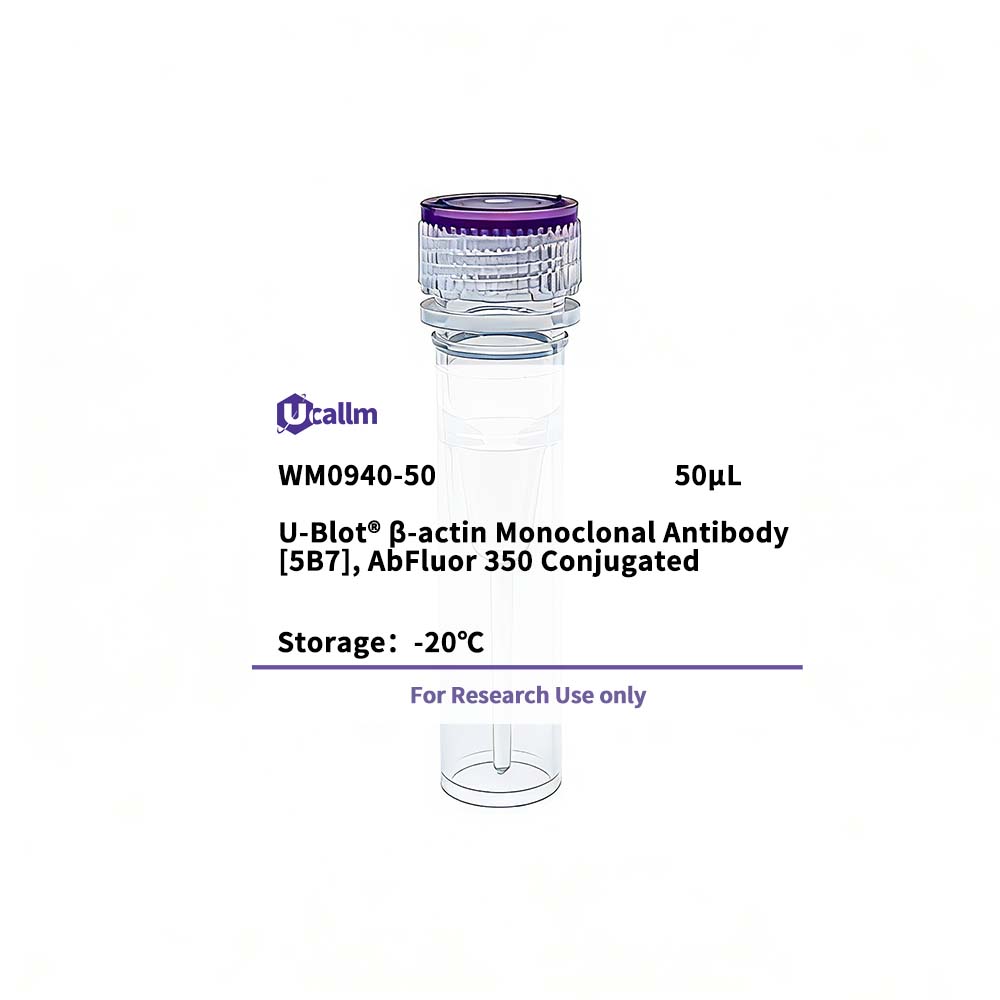
Ucallm_WM0940-50
Price range: $268.00 through $328.00
Product details
Background:
This gene encodes one of six different actin proteins. Actins are highly conserved proteins that are involved in cell motility, structure, and integrity. This actin is a major constituent of the contractile apparatus and one of the two nonmuscle cytoskeletal actins. [provided by RefSeq, Jul 2008],
Specifications
| Size | 50μL/100μL |
| Target | Actin β |
| Reactivity | Human, Mouse, Rat, Mk, Dg, Ch, Hamster, Insect |
| Applications | WB, IHC, IF |
| MW(Calculated) | |
| MW(Observed) | |
| Host Species | Mouse |
| Isotype | IgG1 |
| Conjugate/Modification | AbFluor 350 |
| Recommended Dilution Ratio | Optimal working dilutions should be determined experimentally by the investigator; Suggested starting dilutions are as follows:IHC 1:200; IF 1:200. / Note: For IHC, we suggest antigen retrieval with TE buffer pH 9.0 (Cat#WT1004) |
| Formulation | Liquid in PBS, pH 7.4, containing 0.02% sodium azide as preservative and 50% Glycerol. |
| Purification | The antibody was affinity-purified from mouse ascites by affinity-chromatography using specific immunogen. |
| Storage | Stable for one year at -15°C to -25°C from date of shipment. For maximum recovery of product, centrifuge the original vial after thawing and prior to removing the cap. Aliquot to avoid repeated freezing and thawing. Store in dark. |
| Concentration | 1mg/ml |
| Clonality | Monoclonal |
| Clone Number | 5B7 |
| Immunogen | The specific immunogen used to produce this antibody is proprietary information. |
| Specificity | β-actin Monoclonal Antibody(5B7) AbFluor™ 350 Conjugated specially designed for your Immunofluorescence analysis. |
| Gene Name | ACTB |
| Protein Name | Actin cytoplasmic 1 |
| Other Name | ACTB; / Actin; / cytoplasmic 1; / Beta-actin; / Actin β; / β-Actin; / Beta actin; / B actin; / actin Beta |
| Species | Human |
| Gene ID | 60 |
| Uniprot | P60709, |
| Species.1 | Mouse |
| Gene ID.1 | 11461 |
| Uniprot.1 | P60710, |
| Species.2 | Rat |
| Gene ID.2 | 81822 |
| Uniprot.2 | P60711 |
| Cellular Localization | Cytoplasm, cytoskeleton . Nucleus . Localized in cytoplasmic mRNP granules containing untranslated mRNAs. . |
| Tissue Expression | B-cell lymphoma,Brain,Cajal-Retzius cell,Eye,Fetal brain cortex,Foreskin,Hepatocellular car |
| Signaling_pathway | Cellular Processes >> Transport and catabolism >> Phagosome;Cellular Processes >> Cell growth and death >> Apoptosis;Cellular Processes >> Cellular community - eukaryotes >> Focal adhesion;Cellular Processes >> Cellular community - eukaryotes >> Adherens junction;Cellular Processes >> Cellular community - eukaryotes >> Tight junction;Cellular Processes >> Cell motility >> Regulation of actin cytoskeleton;Organismal Systems >> Immune system >> Platelet activation;Organismal Systems >> Immune system >> Neutrophil extracellular trap formation;Organismal Systems >> Immune system >> Leukocyte transendothelial migration;Organismal Systems >> Endocrine system >> Oxytocin signaling pathway;Organismal Systems >> Endocrine system >> Thyroid hormone signaling pathway;Human Diseases >> Cancer: specific types >> Hepatocellular carcinoma;Human Diseases >> Neurodegenerative disease >> Amyotrophic lateral sclerosis;Environmental Information Processing >> Signal transduction >> Rap1 signaling pathway;Environmental Information Processing >> Signal transduction >> Hippo signaling pathway;Genetic Information Processing >> Chromosome >> ATP-dependent chromatin remodeling |
| Research Areas | >>Rap1 signaling pathway; / >>Phagosome; / >>Apoptosis; / >>Hippo signaling pathway; / >>Focal adhesion; / >>Adherens junction; / >>Tight junction; / >>Platelet activation; / >>Neutrophil extracellular trap formation; / >>Leukocyte transendothelial migration; / >>Thermogenesis; / >>Regulation of actin cytoskeleton; / >>Thyroid hormone signaling pathway; / >>Oxytocin signaling pathway; / >>Gastric acid secretion; / >>Amyotrophic lateral sclerosis; / >>Bacterial invasion of epithelial cells; / >>Vibrio cholerae infection; / >>Pathogenic Escherichia coli infection; / >>Shigellosis; / >>Salmonella infection; / >>Yersinia infection; / >>Influenza A; / >>Proteoglycans in cancer; / >>Hepatocellular carcinoma; / >>Hypertrophic cardiomyopathy; / >>Arrhythmogenic right ventricular cardiomyopathy; / >>Dilated cardiomyopathy; / >>Viral myocarditis; / >>Fluid shear stress and atherosclerosis |
| Function | Disease:Defects in ACTB are a cause of dystonia juvenile-onset (DYTJ) [MIM:607371]. DYTJ is a form of dystonia with juvenile onset. Dystonia is defined by the presence of sustained involuntary muscle contraction, often leading to abnormal postures. DYTJ patients manifest progressive, generalized, dopa-unresponsive dystonia, developmental malformations and sensory hearing loss.,Function:Actins are highly conserved proteins that are involved in various types of cell motility and are ubiquitously expressed in all eukaryotic cells.,miscellaneous:In vertebrates 3 main groups of actin isoforms, alpha, beta and gamma have been identified. The alpha actins are found in muscle tissues and are a major constituent of the contractile apparatus. The beta and gamma actins coexist in most cell types as components of the cytoskeleton and as mediators of internal cell motility.,similarity:Belongs to the actin family.,subunit:Polymerization of globular actin (G-actin) leads to a structural filament (F-actin) in the form of a two-stranded helix. Each actin can bind to 4 others. Component of the BAF complex, which includes at least actin (ACTB), ARID1A, ARID1B/BAF250, SMARCA2, SMARCA4/BRG1, ACTL6A/BAF53, ACTL6B/BAF53B, SMARCE1/BAF57 SMARCC1/BAF155, SMARCC2/BAF170, SMARCB1/SNF5/INI1, and one or more of SMARCD1/BAF60A, SMARCD2/BAF60B, or SMARCD3/BAF60C. In muscle cells, the BAF complex also contains DPF3. Found in a complex with XPO6, Ran, ACTB and PFN1. Interacts with XPO6., |
Please login to post questions
Related products





