SKU: WP10848 Categories: ,

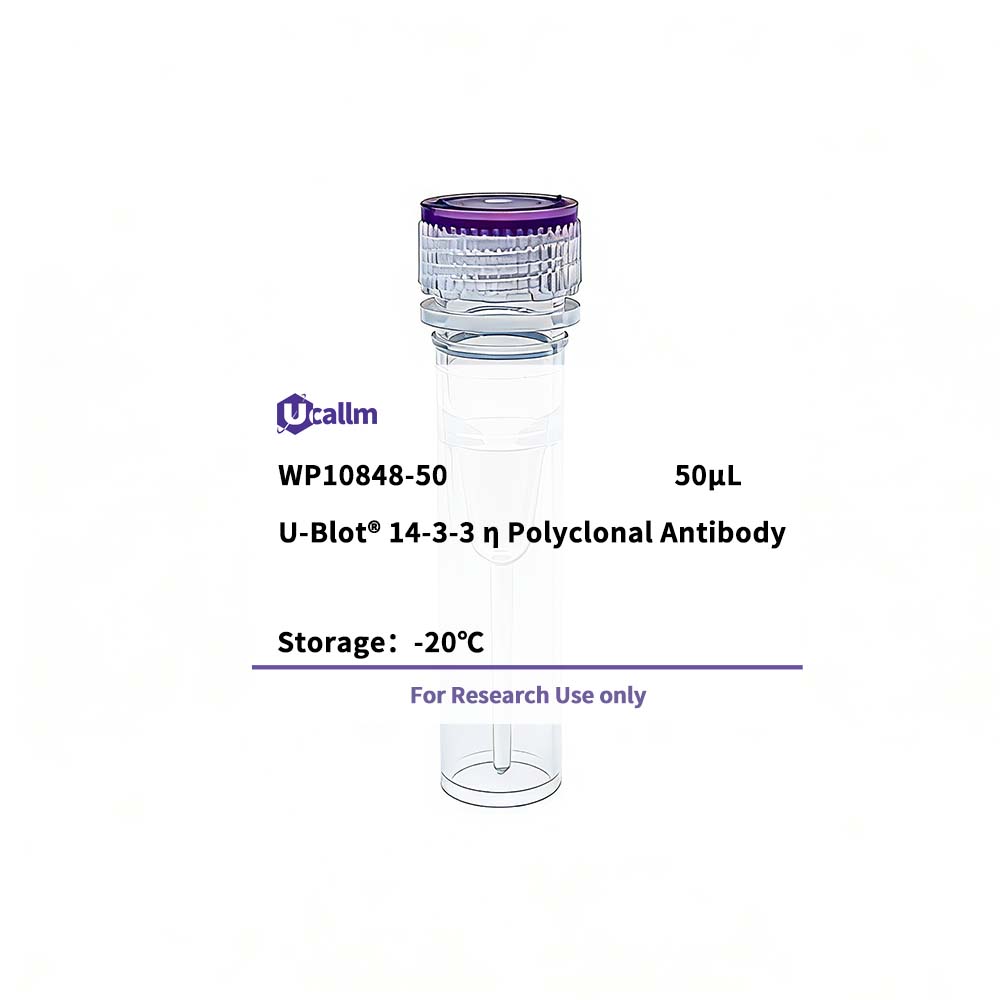
14-3-3 η Polyclonal Antibody

Price range: $268.00 through $328.00

SKU: WP10848-100
Enter the quantity you would like, or drag the panel to find the quantity and price that best for you
Bulk QuoteAuthorize OEM & ODM

Product details

Background:

This gene product belongs to the 14-3-3 family of proteins which mediate signal transduction by binding to phosphoserine-containing proteins. This highly conserved protein family is found in both plants and mammals, and this protein is 99% identical to the mouse, rat and bovine orthologs. This gene contains a 7 bp repeat sequence in its 5' UTR, and changes in the number of this repeat have been associated with early-onset schizophrenia and psychotic bipolar disorder. [provided by RefSeq, Jun 2009],

Specifications

Size50μL/100μL
Target14-3-3 eta
ReactivityHuman, Mouse, Rat
ApplicationsWB, IHC, IF, ELISA
MW(Calculated)
MW(Observed)42kD
Host SpeciesRabbit
IsotypeIgG
Conjugate/ModificationUnmodified
Recommended Dilution RatioWB 1:500-1:2000; IHC 1:100-1:300; IF 1:200-1:1000; ELISA 1:5000; Not yet tested in other applications. / Note: For IHC, we suggest antigen retrieval with TE buffer pH 9.0 (Cat#WT1004)
FormulationLiquid in PBS containing 50% glycerol, 0.5% BSA and 0.02% sodium azide.
PurificationThe antibody was affinity-purified from rabbit antiserum by affinity-chromatography using epitope-specific immunogen.
Storage-15°C to -25°C/1 year(Do not lower than -25°C)
Concentration1 mg/ml
ClonalityPolyclonal
Clone Number
ImmunogenThe antiserum was produced against synthesized peptide derived from human 14-3-3 eta. AA range:51-100
Specificity14-3-3 η Polyclonal Antibody detects endogenous levels of 14-3-3 η protein.
Gene NameYWHAH YWHA1
Protein Name14-3-3 protein eta
Other NameYWHAH; / YWHA1; / 14-3-3 protein eta; / Protein AS1
SpeciesHuman
Gene ID7533
UniprotQ04917,
Species.1Mouse
Gene ID.122629
Uniprot.1P68510,
Species.2Rat
Gene ID.225576
Uniprot.2P68511
Cellular Localizationcytoplasm,mitochondrion,cytosol,plasma membrane,intercalated disc,cytoplasmic vesicle membrane,extracellular exosome,
Tissue ExpressionExpressed mainly in the brain and present in other tissues albeit at lower levels.
Signaling_pathwayCellular Processes >> Cell growth and death >> Cell cycle;Environmental Information Processing >> Signal transduction >> Hippo signaling pathway;Environmental Information Processing >> Signal transduction >> PI3K-Akt signaling pathway
Research Areas>>Cell cycle; / >>Oocyte meiosis; / >>PI3K-Akt signaling pathway; / >>Hippo signaling pathway; / >>Hepatitis C; / >>Viral carcinogenesis
FunctionFunction:Adapter protein implicated in the regulation of a large spectrum of both general and specialized signaling pathway. Binds to a large number of partners, usually by recognition of a phosphoserine or phosphothreonine motif. Binding generally results in the modulation of the activity of the binding partner.,similarity:Belongs to the 14-3-3 family.,subunit:Homodimer (By similarity). Interacts with many nuclear hormone receptors and cofactors including AR, ESR1, ESR2, MC2R, NR3C1, NRIP1, PPARBP and THRA. Interacts with ABL1 (phosphorylated form); the interaction retains it in the cytoplasm. Interacts with RGNEF and PCTK1 (By similarity). Weakly interacts with CDKN1B.,tissue specificity:Expressed mainly in the brain and present in other tissues albeit at lower levels.,
Please login to post questions
Back to Top
Product has been added to your cart