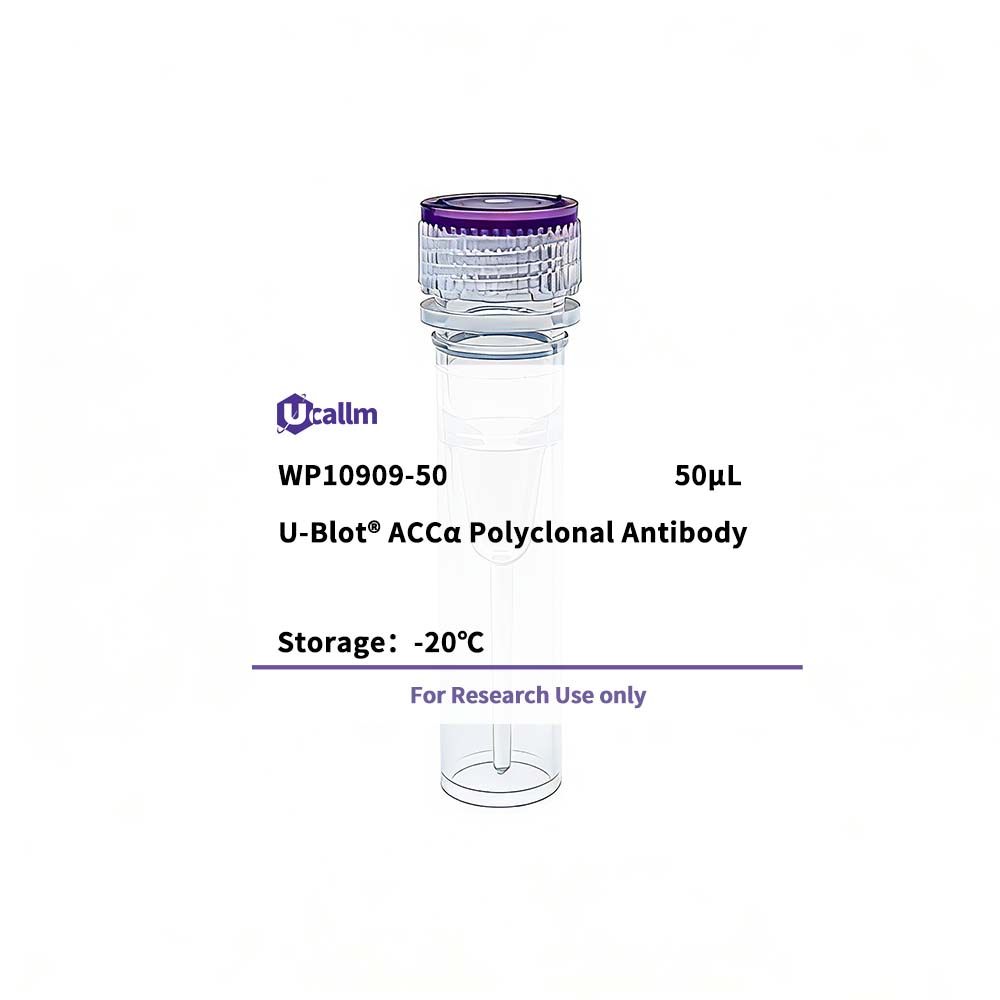
SKU: WP10909 Categories: ,

ACCα Polyclonal Antibody

Price range: $268.00 through $328.00

SKU: WP10909-100
Enter the quantity you would like, or drag the panel to find the quantity and price that best for you
Bulk QuoteAuthorize OEM & ODM

Product details

Background:

Acetyl-CoA carboxylase (ACC) is a complex multifunctional enzyme system. ACC is a biotin-containing enzyme which catalyzes the carboxylation of acetyl-CoA to malonyl-CoA, the rate-limiting step in fatty acid synthesis. There are two ACC forms, alpha and beta, encoded by two different genes. ACC-alpha is highly enriched in lipogenic tissues. The enzyme is under long term control at the transcriptional and translational levels and under short term regulation by the phosphorylation/dephosphorylation of targeted serine residues and by allosteric transformation by citrate or palmitoyl-CoA. Multiple alternatively spliced transcript variants divergent in the 5' sequence and encoding distinct isoforms have been found for this gene. [provided by RefSeq, Jul 2008],

Specifications

Size50μL/100μL
TargetACC-alpha
ReactivityHuman, Mouse, Rat, Bovine, Canine
ApplicationsWB, IHC, IF, ELISA
MW(Calculated)
MW(Observed)265kD
Host SpeciesRabbit
IsotypeIgG
Conjugate/ModificationUnmodified
Recommended Dilution RatioWB 1:500-1:2000; IHC 1:100-1:300; ELISA 1:5000; IF 1:50-200 / Note: For IHC, we suggest antigen retrieval with TE buffer pH 9.0 (Cat#WT1004)
FormulationLiquid in PBS containing 50% glycerol, 0.5% BSA and 0.02% sodium azide.
PurificationThe antibody was affinity-purified from rabbit antiserum by affinity-chromatography using epitope-specific immunogen.
Storage-15°C to -25°C/1 year(Do not lower than -25°C)
Concentration1 mg/ml
ClonalityPolyclonal
Clone Number
ImmunogenThe antiserum was produced against synthesized peptide derived from human Acetyl-CoA Carboxylase. AA range:46-95
SpecificityACCα Polyclonal Antibody detects endogenous levels of ACCα protein.
Gene NameACACA
Protein NameAcetyl-CoA carboxylase 1; ACC1; Acetyl-Coenzyme A carboxylase alpha; ACC-alpha
Other NameACACA; / ACAC; / ACC1; / ACCA; / Acetyl-CoA carboxylase 1; / ACC-alpha
SpeciesHuman
Gene ID31
UniprotQ13085,
Species.1Mouse
Gene ID.1107476
Uniprot.1Q5SWU9,
Species.2Rat
Gene ID.260581
Uniprot.2P11497
Cellular LocalizationCytoplasm, cytosol .
Tissue ExpressionExpressed in brain, placenta, skeletal muscle, renal, pancreatic and adipose tissues; expressed at low level in pulmonary tissue; not detected in the liver.
Signaling_pathwayOrganismal Systems >> Endocrine system >> Insulin signaling pathway;Organismal Systems >> Endocrine system >> Glucagon signaling pathway;Environmental Information Processing >> Signal transduction >> AMPK signaling pathway
Research Areas>>Fatty acid biosynthesis; / >>Pyruvate metabolism; / >>Propanoate metabolism; / >>Metabolic pathways; / >>Fatty acid metabolism; / >>AMPK signaling pathway; / >>Insulin signaling pathway; / >>Glucagon signaling pathway; / >>Alcoholic liver disease
FunctionCatalytic activity:ATP + acetyl-CoA + HCO(3)(-) = ADP + phosphate + malonyl-CoA.,Catalytic activity:ATP + biotin-carboxyl-carrier protein + CO(2) = ADP + phosphate + carboxybiotin-carboxyl-carrier protein.,cofactor:Binds 2 manganese ions per subunit.,cofactor:Biotin.,Disease:Defects in ACACA are a cause of ACACA deficiency [MIM:200350]; also called ACAC or ACC deficiency. ACACA deficiency is an inborn error of de novo fatty acid synthesis. The disorder is associated with severe brain damage, persistent myopathy and poor growth.,enzyme regulation:By phosphorylation.,Function:Catalyzes the rate-limiting reaction in the biogenesis of long-chain fatty acids. Carries out three functions: biotin carboxyl carrier protein, biotin carboxylase and carboxyltransferase.,online information:Acetyl-CoA carboxylase entry,pathway:Lipid metabolism; malonyl-CoA biosynthesis; malonyl-CoA from acetyl-CoA: step 1/1.,PTM:Phosphorylation on Ser-1263 is required for interaction with BRCA1.,similarity:Contains 1 ATP-grasp domain.,similarity:Contains 1 biotin carboxylation domain.,similarity:Contains 1 biotinyl-binding domain.,similarity:Contains 1 carboxyltransferase domain.,subunit:Interacts in its inactive phosphorylated form with the BRCT domains of BRCA1 which prevents ACACA dephosphorylation and inhibits lipid synthesis.,tissue specificity:Expressed in brain, placental, skeletal muscle, renal, pancreatic and adipose tissues; expressed at low level in pulmonary tissue; not detected in the liver.,
Please login to post questions
Back to Top
Product has been added to your cart

