

Actin-pan rabbit pAb
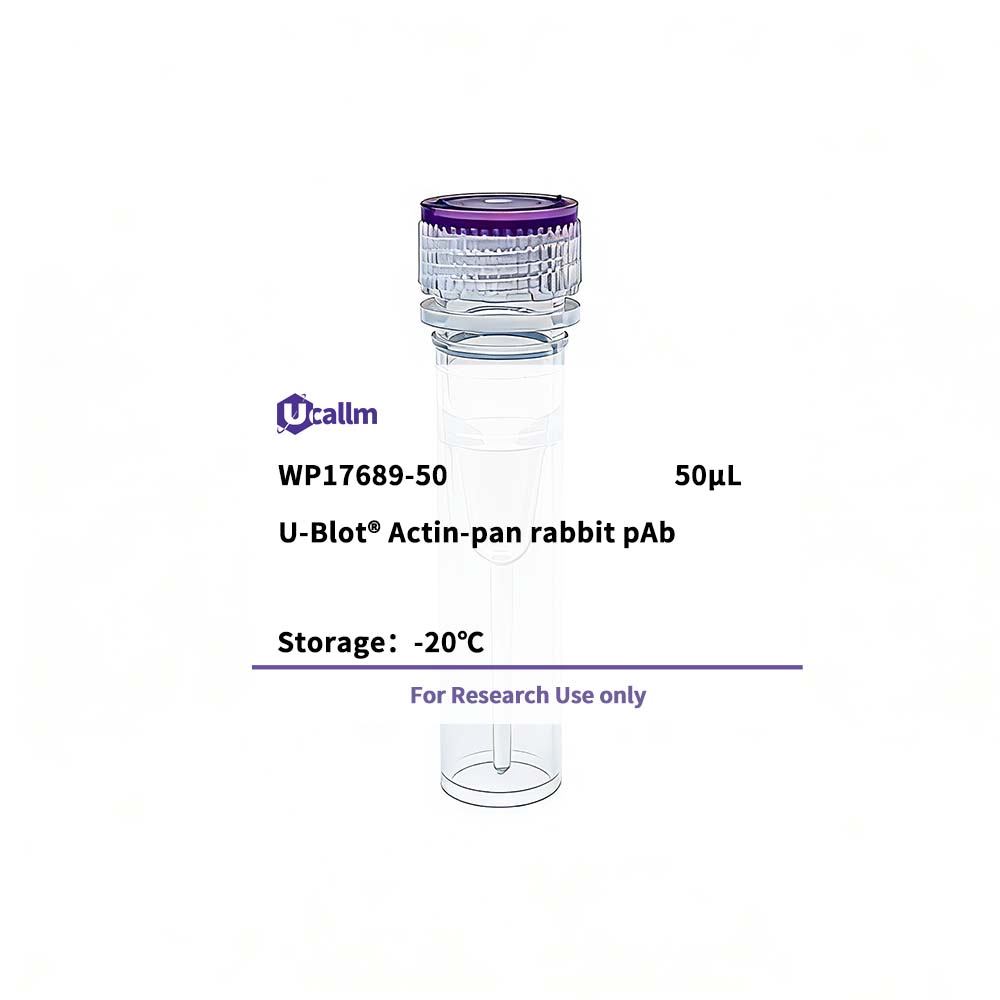
Ucallm_WP17689-50
Price range: $268.00 through $328.00
Product details
Background:
The protein encoded by this gene belongs to the actin family of proteins, which are highly conserved proteins that play a role in cell motility, structure and integrity. Alpha, beta and gamma actin isoforms have been identified, with alpha actins being a major constituent of the contractile apparatus, while beta and gamma actins are involved in the regulation of cell motility. This actin is an alpha actin that is found in skeletal muscle. Defects in this gene cause aortic aneurysm familial thoracic type 6. Multiple alternatively spliced variants, encoding the same protein, have been identified. [provided by RefSeq, Nov 2008],
Specifications
| Size | 50μL/100μL |
| Target | Actin pan |
| Reactivity | Human, Mouse, Rat |
| Applications | WB, ELISA |
| MW(Calculated) | 41kD |
| MW(Observed) | |
| Host Species | Rabbit |
| Isotype | IgG |
| Conjugate/Modification | Unmodified |
| Recommended Dilution Ratio | WB 1:1000-2000; ELISA 1:5000-20000 |
| Formulation | Liquid in PBS containing 50% glycerol, 0.5% BSA and 0.02% sodium azide. |
| Purification | The antibody was affinity-purified from rabbit antiserum by affinity-chromatography using epitope-specific immunogen. |
| Storage | -15°C to -25°C/1 year(Do not lower than -25°C) |
| Concentration | 1 mg/ml |
| Clonality | Polyclonal |
| Clone Number | |
| Immunogen | Synthesized peptide derived from human Actin-pan |
| Specificity | This antibody detects endogenous levels of Human,Mouse,Rat Actin-pan |
| Gene Name | ACTC1; ACTA1; ACTA2; ACTB; ACTG1; ACTG2 |
| Protein Name | Actin pan |
| Other Name | Actin, aortic smooth muscle; / Alpha-actin-2; / Cell growth-inhibiting gene 46 protein |
| Species | Human |
| Gene ID | 70;58;59;60;71;72 |
| Uniprot | P62736;P60709;P68032;P63261;P63267;P68133, |
| Species.1 | Mouse |
| Gene ID.1 | 11475;11464;11465;11468;11459;11461, |
| Uniprot.1 | |
| Species.2 | Rat |
| Gene ID.2 | 81633 |
| Uniprot.2 | P62738 |
| Cellular Localization | Cytoplasm, cytoskeleton. |
| Tissue Expression | |
| Signaling_pathway | Cellular Processes >> Transport and catabolism >> Phagosome;Cellular Processes >> Cell growth and death >> Apoptosis;Cellular Processes >> Cellular community - eukaryotes >> Focal adhesion;Cellular Processes >> Cellular community - eukaryotes >> Adherens junction;Cellular Processes >> Cellular community - eukaryotes >> Tight junction;Cellular Processes >> Cell motility >> Regulation of actin cytoskeleton;Organismal Systems >> Immune system >> Platelet activation;Organismal Systems >> Immune system >> Neutrophil extracellular trap formation;Organismal Systems >> Immune system >> Leukocyte transendothelial migration;Organismal Systems >> Endocrine system >> Oxytocin signaling pathway;Organismal Systems >> Endocrine system >> Relaxin signaling pathway;Organismal Systems >> Endocrine system >> Thyroid hormone signaling pathway;Organismal Systems >> Circulatory system >> Cardiac muscle contraction;Organismal Systems >> Circulatory system >> Adrenergic signaling in cardiomyocytes;Organismal Systems >> Circulatory system >> Vascular smooth muscle contraction;Human Diseases >> Cancer: specific types >> Hepatocellular carcinoma;Human Diseases >> Neurodegenerative disease >> Amyotrophic lateral sclerosis;Environmental Information Processing >> Signal transduction >> Rap1 signaling pathway;Environmental Information Processing >> Signal transduction >> Hippo signaling pathway;Environmental Information Processing >> Signal transduction >> Apelin signaling pathway;Genetic Information Processing >> Chromosome >> ATP-dependent chromatin remodeling |
| Research Areas | >>Vascular smooth muscle contraction; / >>Apelin signaling pathway; / >>Relaxin signaling pathway |
| Function | Disease:Defects in ACTA2 are the cause of aortic aneurysm familial thoracic type 6 (AAT6) [MIM:611788]. AATs are characterized by permanent dilation of the thoracic aorta usually due to degenerative changes in the aortic wall. They are primarily associated with a characteristic histologic appearance known as 'medial necrosis' or 'Erdheim cystic medial necrosis' in which there is degeneration and fragmentation of elastic fibers, loss of smooth muscle cells, and an accumulation of basophilic ground substance.,Function:Actins are highly conserved proteins that are involved in various types of cell motility and are ubiquitously expressed in all eukaryotic cells.,miscellaneous:In vertebrates 3 main groups of actin isoforms, alpha, beta and gamma have been identified. The alpha actins are found in muscle tissues and are a major constituent of the contractile apparatus. The beta and gamma actins coexist in most cell types as components of the cytoskeleton and as mediators of internal cell motility.,similarity:Belongs to the actin family.,subunit:Polymerization of globular actin (G-actin) leads to a structural filament (F-actin) in the form of a two-stranded helix. Each actin can bind to 4 others., |
Please login to post questions
Related products




