

AES Polyclonal Antibody
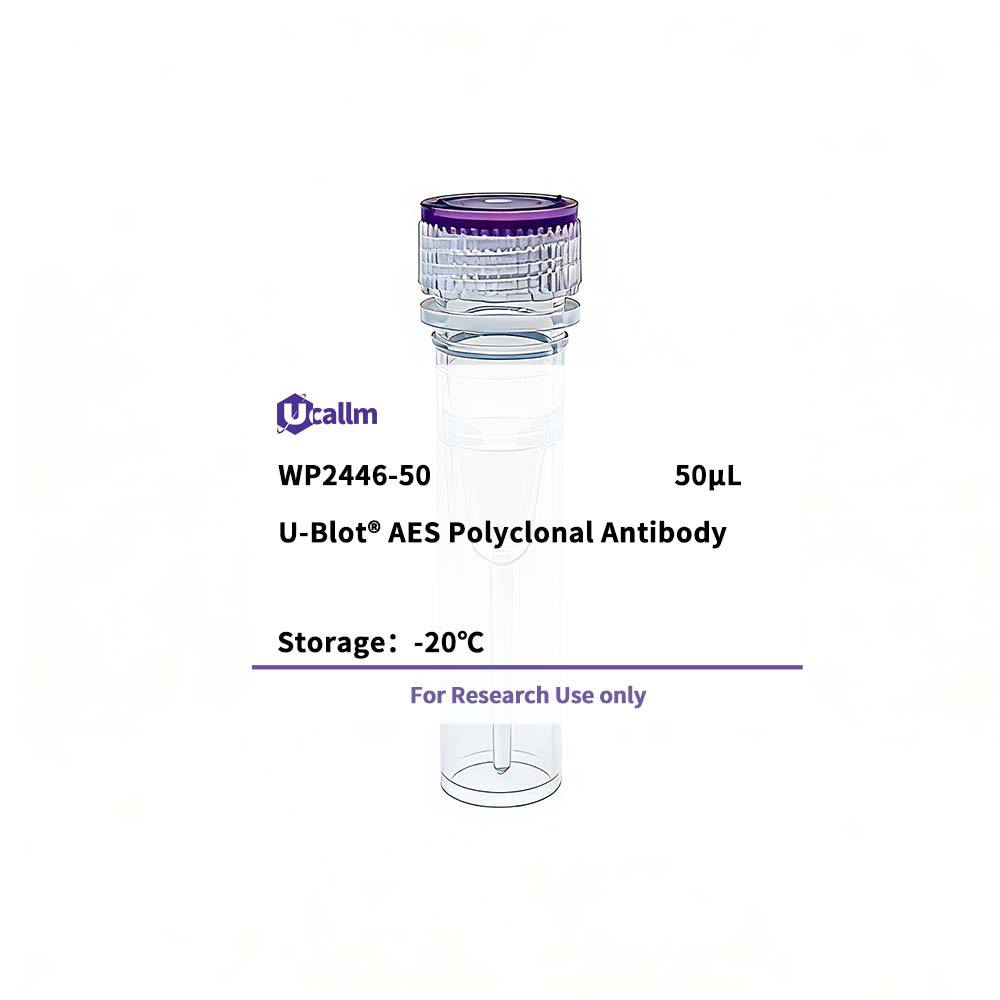
Ucallm_WP2446-50
Price range: $268.00 through $328.00
Product details
Background:
The protein encoded by this gene is similar in sequence to the amino terminus of Drosophila enhancer of split groucho, a protein involved in neurogenesis during embryonic development. The encoded protein, which belongs to the groucho/TLE family of proteins, can function as a homooligomer or as a heteroologimer with other family members to dominantly repress the expression of other family member genes. Three transcript variants encoding different isoforms have been found for this gene. [provided by RefSeq, Jul 2008],
Specifications
| Size | 50μL/100μL |
| Target | AES |
| Reactivity | Human, Mouse, Rat |
| Applications | WB, ELISA |
| MW(Calculated) | |
| MW(Observed) | 21kD |
| Host Species | Rabbit |
| Isotype | IgG |
| Conjugate/Modification | Unmodified |
| Recommended Dilution Ratio | WB 1:500-2000; ELISA 1:5000-20000 |
| Formulation | Liquid in PBS containing 50% glycerol,0.5% BSA and 0.02% sodium azide. |
| Purification | The antibody was affinity-purified from rabbit antiserum by affinity-chromatography using epitope-specific immunogen. |
| Storage | -15°C to -25°C/1 year(Do not lower than -25°C) |
| Concentration | 1 mg/ml |
| Clonality | Polyclonal |
| Clone Number | |
| Immunogen | Synthesized peptide derived from part region of human protein |
| Specificity | AES Polyclonal Antibody detects endogenous levels of protein. |
| Gene Name | AES GRG |
| Protein Name | Amino-terminal enhancer of split (Amino enhancer of split) (Gp130-associated protein GAM) (Protein ESP1) (Protein GRG) |
| Other Name | |
| Species | Human |
| Gene ID | 166 |
| Uniprot | Q08117, |
| Species.1 | Mouse |
| Gene ID.1 | |
| Uniprot.1 | P63002, |
| Species.2 | Rat |
| Gene ID.2 | |
| Uniprot.2 | P63003 |
| Cellular Localization | Nucleus . |
| Tissue Expression | Found predominantly in muscle, heart and Placenta. In fetal tissues, abundantly expressed in the heart, lung, kidney, brain and liver. |
| Signaling_pathway | |
| Research Areas | |
| Function | Domain:Lacks the C-terminal WD repeats.,Function:Acts as dominant repressor towards other family members. Inhibits NF-kappa-B-regulated gene expression. May be required for the initiation and maintenance of the differentiated state.,similarity:Belongs to the WD repeat Groucho/TLE family.,subunit:Homooligomer and heterooligomer with other family members. Binds TCF7 (By similarity). Binds the NF-kappa-B subunit RELA. Interacts with PHF12.,tissue specificity:Found predominantly in muscle, heart and Placenta. In fetal tissues, abundantly expressed in the heart, lung, kidney, brain and liver., |
Please login to post questions
Related products





