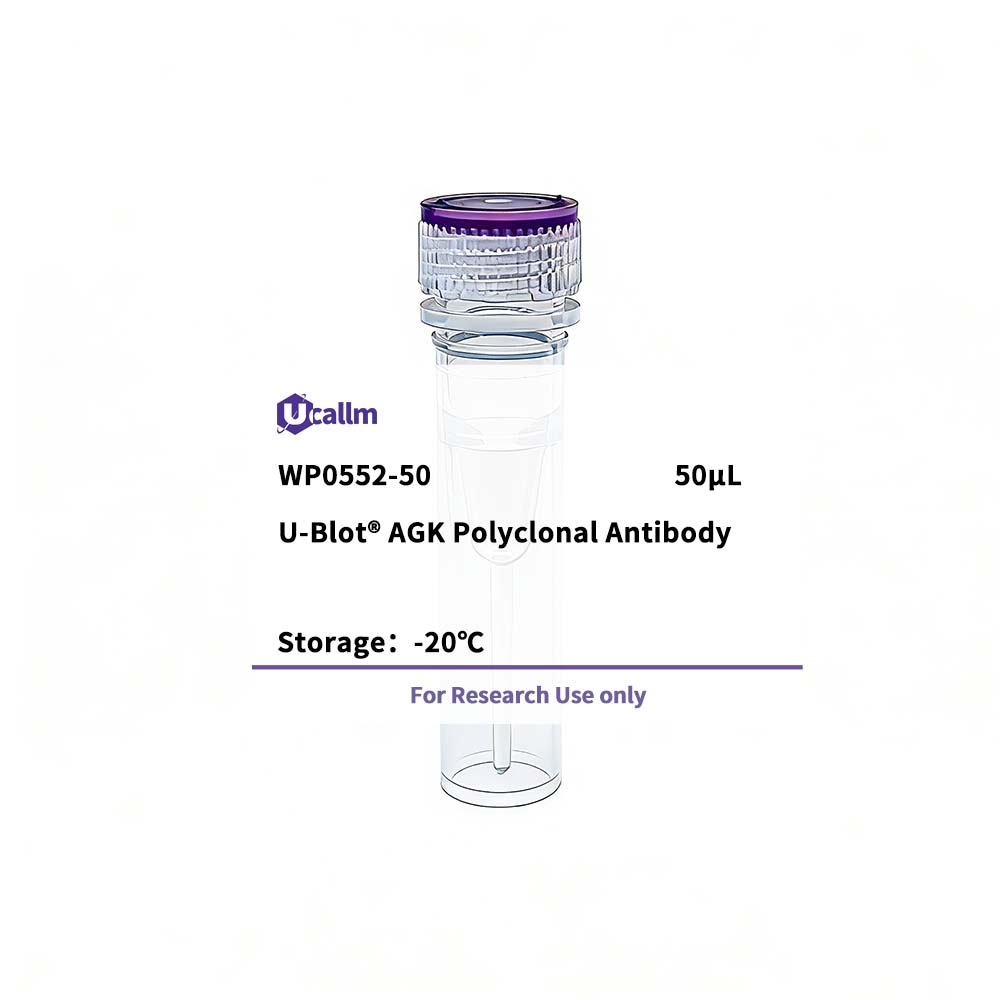
SKU: WP0552 Categories: ,

AGK Polyclonal Antibody

Price range: $268.00 through $328.00

SKU: WP0552-100
Enter the quantity you would like, or drag the panel to find the quantity and price that best for you
Bulk QuoteAuthorize OEM & ODM

Product details

Background:

The protein encoded by this gene is a mitochondrial membrane protein involved in lipid and glycerolipid metabolism. The encoded protein is a lipid kinase that catalyzes the formation of phosphatidic and lysophosphatidic acids. Defects in this gene have been associated with mitochondrial DNA depletion syndrome 10. [provided by RefSeq, Feb 2012],

Specifications

Size50μL/100μL
TargetAGK
ReactivityHuman, Mouse
ApplicationsWB, ELISA
MW(Calculated)
MW(Observed)46kD
Host SpeciesRabbit
IsotypeIgG
Conjugate/ModificationUnmodified
Recommended Dilution RatioWB 1:500-2000; ELISA 1:5000-20000
FormulationLiquid in PBS containing 50% glycerol,0.5% BSA and 0.02% sodium azide.
PurificationThe antibody was affinity-purified from rabbit antiserum by affinity-chromatography using epitope-specific immunogen.
Storage-15°C to -25°C/1 year(Do not lower than -25°C)
Concentration1 mg/ml
ClonalityPolyclonal
Clone Number
ImmunogenSynthesized peptide derived from human protein . at AA range: 330-410
SpecificityAGK Polyclonal Antibody detects endogenous levels of protein.
Gene NameAGK MULK
Protein NameAcylglycerol kinase, mitochondrial (hAGK) (Multiple substrate lipid kinase) (HsMuLK) (MuLK) (Multi-substrate lipid kinase)
Other Name
SpeciesHuman
Gene ID55750
UniprotQ53H12,
Species.1Mouse
Gene ID.1
Uniprot.1Q9ESW4
Species.2
Gene ID.2
Uniprot.2
Cellular LocalizationMitochondrion inner membrane; Peripheral membrane protein . Mitochondrion intermembrane space . Localizes in the mitochondrion intermembrane space, where it associates with the inner membrane (PubMed:28712724). It is unclear whether the N-terminal hydrophobic region forms a transmembrane region or associates with the membrane without crossing it (PubMed:28712724, PubMed:28712726). .
Tissue ExpressionHighly expressed in muscle, heart, kidney and brain.
Signaling_pathway
Research Areas>>Glycerolipid metabolism; / >>Metabolic pathways
FunctionCatalytic activity:ATP + 1,2-diacylglycerol = ADP + 1,2-diacyl-sn-glycerol 3-phosphate.,Catalytic activity:ATP + acylglycerol = ADP + acyl-sn-glycerol 3-phosphate.,cofactor:Magnesium.,Function:Lipid kinase that can phosphorylate both monoacylglycerol and diacylglycerol to form lysophosphatidic acid (LPA) and phosphatidic acid (PA), respectively. Does not phosphorylate sphingosine. Overexpression increases the formation and secretion of LPA, resulting in transactivation of EGFR and activation of the downstream MAPK signaling pathway, leading to increased cell growth.,miscellaneous:Overexpressed in prostate cancer, suggesting that it may play a role in initiation and progression of prostate cancer, processes in which LPA plays key roles.,pathway:Lipid metabolism; glycerolipid metabolism.,similarity:Contains 1 DAGKc domain.,tissue specificity:Highly expressed in muscle, heart, kidney and brain.,
Please login to post questions
Back to Top
Product has been added to your cart
