

AMGO2 Polyclonal Antibody
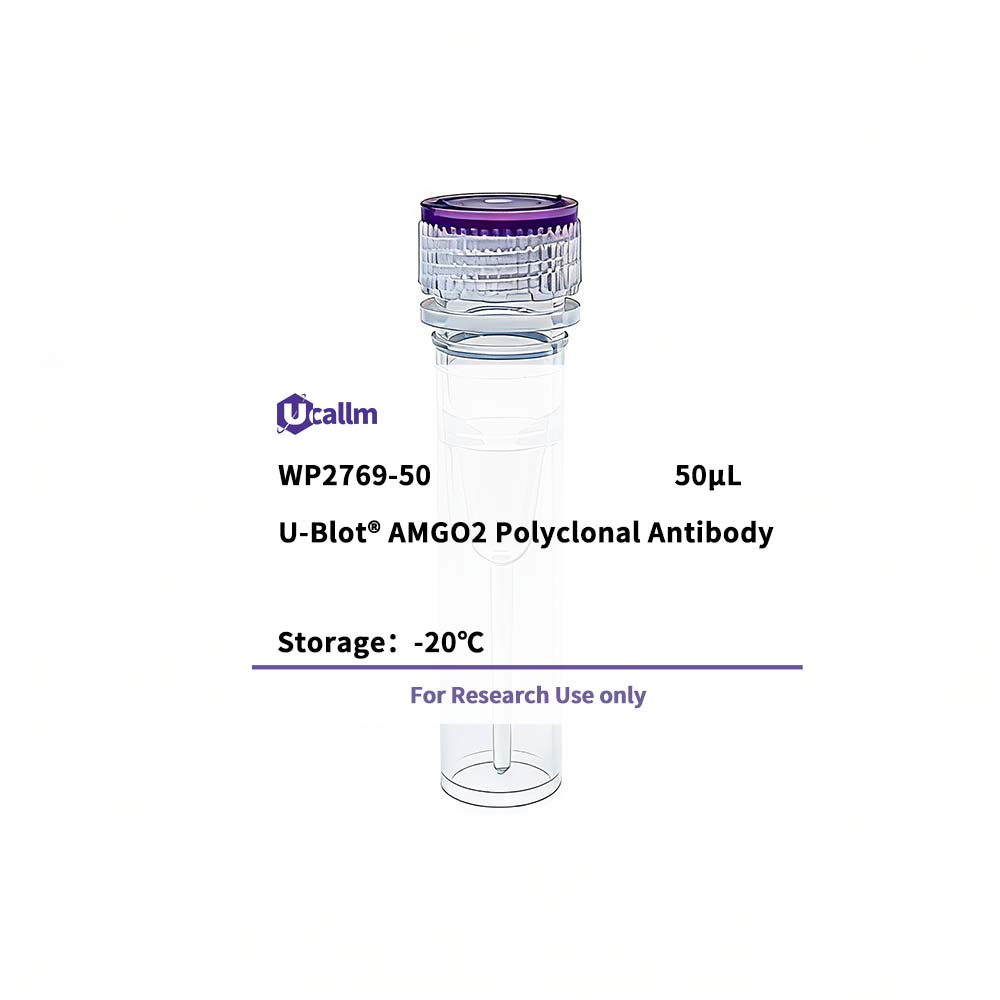
Ucallm_WP2769-50
Price range: $268.00 through $328.00
Product details
Background:
function:Required for depolarization-dependent survival of cultured cerebellar granule neurons. May mediate homophilic as well as heterophilic cell-cell interaction with AMIGO1 or AMIGO3. May contribute to signal transduction through its intracellular domain. May be required for tumorigenesis of a subset of gastric adenocarcinomas., similarity:Belongs to the immunoglobulin superfamily. AMIGO family., similarity:Contains 1 Ig-like C2-type (immunoglobulin-like) domain., similarity:Contains 6 LRR (leucine-rich) repeats., subcellular location:Associated with nucleus as well as plasma membrane. Restricted to somata of cerebellar as well as hippocampal neurons., subunit:Binds itself as well as AMIGO1 and AMIGO3., tissue specificity:Highest levels in breast, ovary, cervix, and uterus. Lower levels in lung, colon, and rectum. Differentially expressed in 56% of thyroid, 57% of pancreatic and 45% of stomach cancers.,
Specifications
| Size | 50μL/100μL |
| Target | AMGO2 |
| Reactivity | Human, Mouse, Rat |
| Applications | WB, ELISA |
| MW(Calculated) | |
| MW(Observed) | 57kD |
| Host Species | Rabbit |
| Isotype | IgG |
| Conjugate/Modification | Unmodified |
| Recommended Dilution Ratio | WB 1:500-2000; ELISA 1:5000-20000 |
| Formulation | Liquid in PBS containing 50% glycerol,0.5% BSA and 0.02% sodium azide. |
| Purification | The antibody was affinity-purified from rabbit antiserum by affinity-chromatography using epitope-specific immunogen. |
| Storage | -15°C to -25°C/1 year(Do not lower than -25°C) |
| Concentration | 1 mg/ml |
| Clonality | Polyclonal |
| Clone Number | |
| Immunogen | Synthesized peptide derived from human protein . at AA range: 270-350 |
| Specificity | AMGO2 Polyclonal Antibody detects endogenous levels of protein. |
| Gene Name | AMIGO2 ALI1 |
| Protein Name | Amphoterin-induced protein 2 (AMIGO-2) (Alivin-1) (Differentially expressed in gastric adenocarcinomas) (DEGA) |
| Other Name | |
| Species | Human |
| Gene ID | 347902 |
| Uniprot | Q86SJ2, |
| Species.1 | Mouse |
| Gene ID.1 | |
| Uniprot.1 | Q80ZD9, |
| Species.2 | Rat |
| Gene ID.2 | |
| Uniprot.2 | Q7TNJ4 |
| Cellular Localization | Cell membrane; Single-pass type I membrane protein . Nucleus . Associated with nucleus as well as plasma membrane. Restricted to somata of cerebellar as well as hippocampal neurons (By similarity). . |
| Tissue Expression | Highest levels in breast, ovary, cervix, and uterus. Lower levels in lung, colon, and rectum. Differentially expressed in 56% of thyroid, 57% of pancreatic and 45% of stomach cancers. |
| Signaling_pathway | |
| Research Areas | |
| Function | Function:Required for depolarization-dependent survival of cultured cerebellar granule neurons. May mediate homophilic as well as heterophilic cell-cell interaction with AMIGO1 or AMIGO3. May contribute to signal transduction through its intracellular domain. May be required for tumorigenesis of a subset of gastric adenocarcinomas.,similarity:Belongs to the immunoglobulin superfamily. AMIGO family.,similarity:Contains 1 Ig-like C2-type (immunoglobulin-like) domain.,similarity:Contains 6 LRR (leucine-rich) repeats.,subcellular location:Associated with nucleus as well as plasma membrane. Restricted to somata of cerebellar as well as hippocampal neurons.,subunit:Binds itself as well as AMIGO1 and AMIGO3.,tissue specificity:Highest levels in breast, ovary, cervix, and uterus. Lower levels in lung, colon, and rectum. Differentially expressed in 56% of thyroid, 57% of pancreatic and 45% of stomach cancers., |
Please login to post questions
Related products





