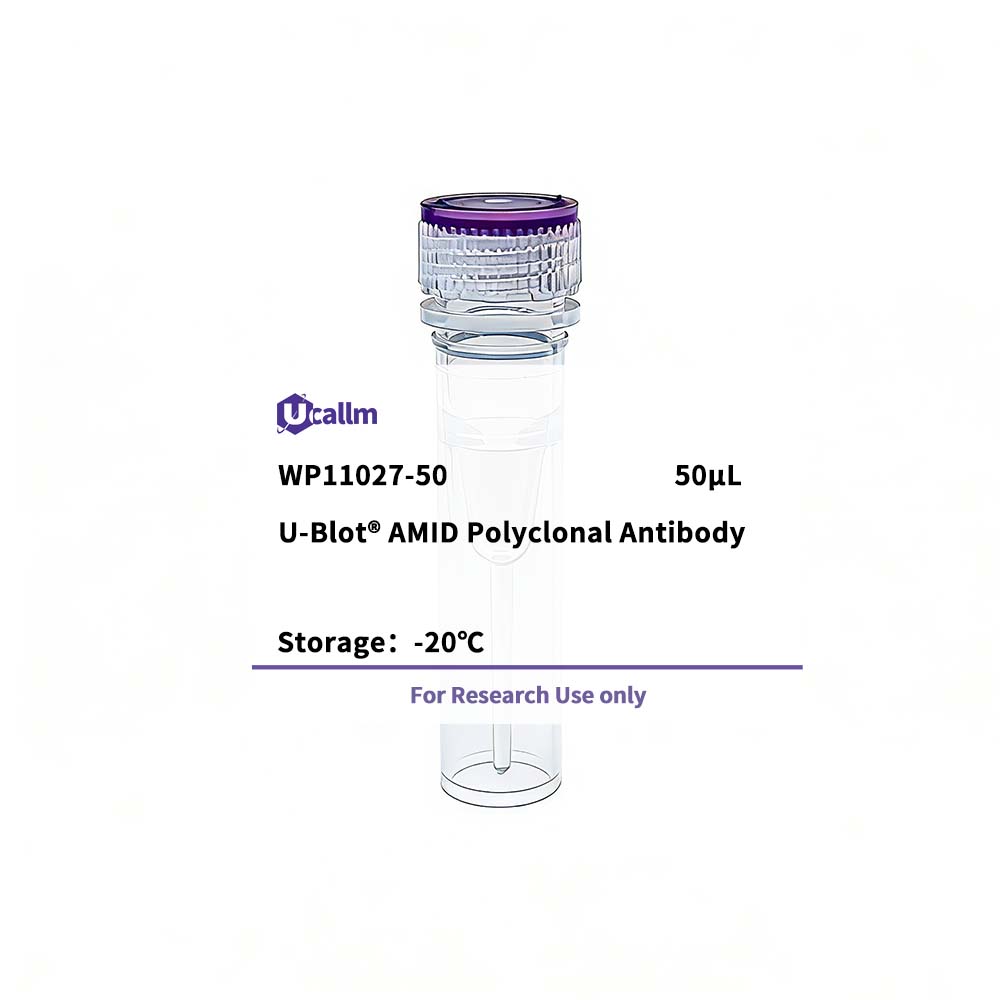
SKU: WP11027 Categories: ,

AMID Polyclonal Antibody

Price range: $268.00 through $328.00

SKU: WP11027-100
Enter the quantity you would like, or drag the panel to find the quantity and price that best for you
Bulk QuoteAuthorize OEM & ODM

Product details

Background:

This gene encodes a flavoprotein oxidoreductase that binds single stranded DNA and is thought to contribute to apoptosis in the presence of bacterial and viral DNA. The expression of this gene is also found to be induced by tumor suppressor protein p53 in colon cancer cells. [provided by RefSeq, Nov 2010],

Specifications

Size50μL/100μL
TargetAMID
ReactivityHuman, Mouse, Monkey
ApplicationsWB, IHC, IF, ELISA
MW(Calculated)
MW(Observed)41kD
Host SpeciesRabbit
IsotypeIgG
Conjugate/ModificationUnmodified
Recommended Dilution RatioWB 1:500-1:2000; IHC 1:100-1:300; IF 1:200-1:1000; ELISA 1:40000; Not yet tested in other applications. / Note: For IHC, we suggest antigen retrieval with TE buffer pH 9.0 (Cat#WT1004)
FormulationLiquid in PBS containing 50% glycerol, 0.5% BSA and 0.02% sodium azide.
PurificationThe antibody was affinity-purified from rabbit antiserum by affinity-chromatography using epitope-specific immunogen.
Storage-15°C to -25°C/1 year(Do not lower than -25°C)
Concentration1 mg/ml
ClonalityPolyclonal
Clone Number
ImmunogenThe antiserum was produced against synthesized peptide derived from human AIFM2. AA range:141-190
SpecificityAMID Polyclonal Antibody detects endogenous levels of AMID protein.
Gene NameAIFM2
Protein NameApoptosis-inducing factor 2
Other NameAIFM2; / AMID; / PRG3; / Apoptosis-inducing factor 2; / Apoptosis-inducing factor homologous mitochondrion-associated inducer of death; / Apoptosis-inducing factor-like mitochondrion-associated inducer of death; / p53-responsive gene 3 protein,FSP1
SpeciesHuman
Gene ID84883
UniprotQ9BRQ8,
Species.1Mouse
Gene ID.171361
Uniprot.1Q8BUE4
Species.2
Gene ID.2
Uniprot.2
Cellular LocalizationLipid droplet . Cell membrane; Lipid-anchor . Cytoplasm . Mitochondrion membrane . Nucleus .
Tissue ExpressionDetected in most normal tissues as two transcripts of 1.8 and 4.0 kb in length, respectively. Highly expressed in heart, moderately in liver and skeletal muscles, and expressed at low levels in placenta, lung, kidney, and pancreas. Both transcripts expressed following p53/TP53 induction. The shorter 1.8 kb transcript seems to be the major transcript in EB1 colon cancer cells.
Signaling_pathwayCellular Processes >> Cell growth and death >> p53 signaling pathway
Research Areas>>p53 signaling pathway
Functioncofactor:FAD. Binds 6-hydroxy-FAD non-covalently.,Function:Oxidoreductase, which may play a role in mediating a TP53/p53-dependent apoptosis response. Probable oxidoreductase that acts as a caspase-independent mitochondrial effector of apoptotic cell death. Binds to DNA in a sequence-independent manner. May contribute to genotoxin-induced growth arrest.,induction:Expression detected at 4 hours after induction by TP53/p53. Down-regulated in a wide range of human tumors.,similarity:Belongs to the FAD-dependent oxidoreductase family.,tissue specificity:Detected in most normal tissues as two transcripts of 1.8 and 4.0 kb in length, respectively. Highly expressed in heart, moderately in liver and skeletal muscles, and expressed at low levels in placenta, lung, kidney, and pancreas. Both transcripts expressed following TP53/p53 induction. The shorter 1.8 kb transcript seems to be the major transcript in EB1 colon cancer cells.,
Please login to post questions
Back to Top
Product has been added to your cart

