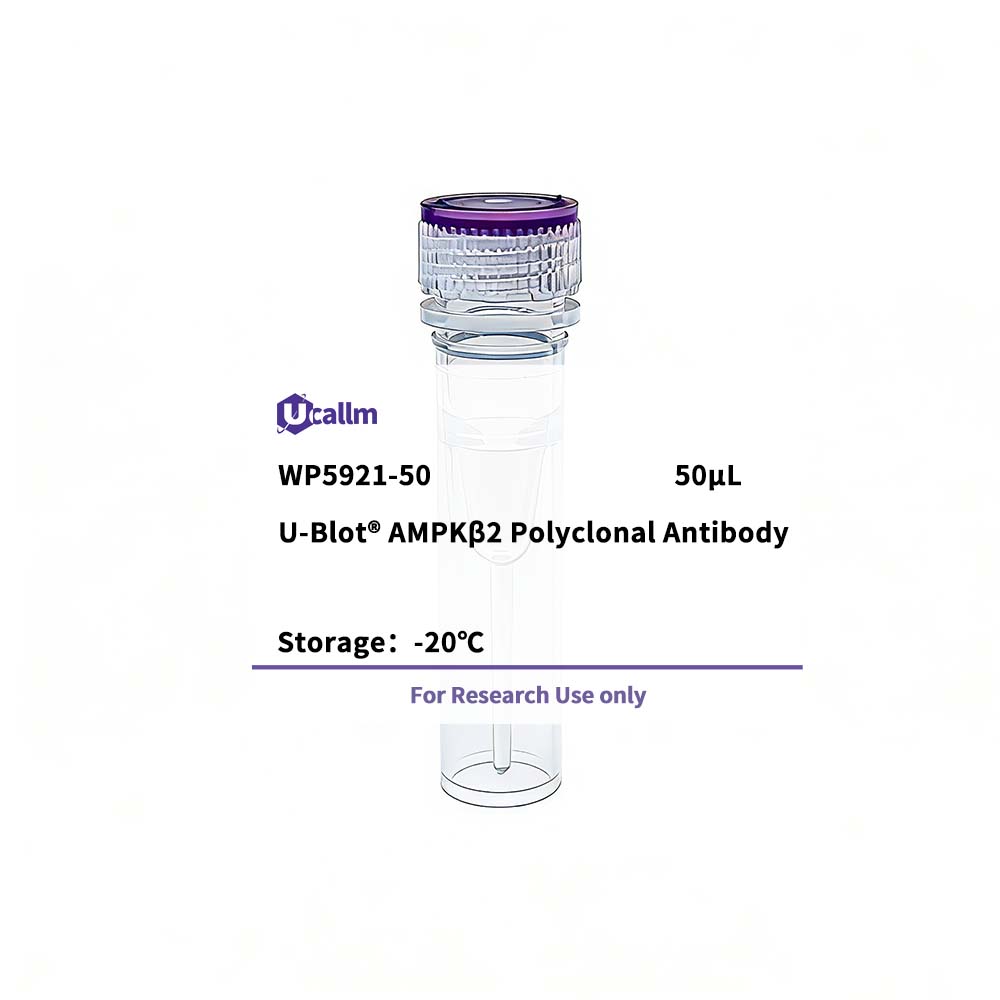
SKU: WP5921 Categories: ,

AMPKβ2 Polyclonal Antibody

Price range: $268.00 through $328.00

SKU: WP5921-100
Enter the quantity you would like, or drag the panel to find the quantity and price that best for you
Bulk QuoteAuthorize OEM & ODM

Product details

Background:

The protein encoded by this gene is a regulatory subunit of the AMP-activated protein kinase (AMPK). AMPK is a heterotrimer consisting of an alpha catalytic subunit, and non-catalytic beta and gamma subunits. AMPK is an important energy-sensing enzyme that monitors cellular energy status. In response to cellular metabolic stresses, AMPK is activated, and thus phosphorylates and inactivates acetyl-CoA carboxylase (ACC) and beta-hydroxy beta-methylglutaryl-CoA reductase (HMGCR), key enzymes involved in regulating de novo biosynthesis of fatty acid and cholesterol. This subunit may be a positive regulator of AMPK activity. It is highly expressed in skeletal muscle and thus may have tissue-specific roles. Multiple alternatively spliced transcript variants have been found for this gene. [provided by RefSeq, Jul 2013],

Specifications

Size50μL/100μL
TargetAMPKβ2
ReactivityHuman, Mouse, Rat
ApplicationsWB
MW(Calculated)
MW(Observed)30kD
Host SpeciesRabbit
IsotypeIgG
Conjugate/ModificationUnmodified
Recommended Dilution RatioWB 1:1000-2000
FormulationPBS, pH 7.4, containing 0.5%BSA, 0.02% sodium azide as Preservative and 50% Glycerol.
PurificationThe antibody was affinity-purified from rabbit antiserum by affinity-chromatography using epitope-specific immunogen.
Storage-15°C to -25°C/1 year(Do not lower than -25°C)
Concentration
ClonalityPolyclonal
Clone Number
ImmunogenRecombinant Protein of AMPKβ2
SpecificityThe antibody detects endogenous AMPKβ2 protein.
Gene NamePRKAB2
Protein Name5'-AMP-activated protein kinase subunit beta-2
Other NamePRKAB2; / 5'-AMP-activated protein kinase subunit beta-2; / AMPK subunit beta-2
SpeciesHuman
Gene ID5565
UniprotO43741,
Species.1Mouse
Gene ID.1108097
Uniprot.1Q6PAM0,
Species.2Rat
Gene ID.264562
Uniprot.2Q9QZH4
Cellular Localizationnucleoplasm,cytosol,nucleotide-activated protein kinase complex,
Tissue ExpressionLiver,Pancreas,
Signaling_pathwayCellular Processes >> Cellular community - eukaryotes >> Tight junction;Organismal Systems >> Endocrine system >> Insulin signaling pathway;Organismal Systems >> Endocrine system >> Glucagon signaling pathway;Organismal Systems >> Endocrine system >> Adipocytokine signaling pathway;Organismal Systems >> Endocrine system >> Oxytocin signaling pathway;Organismal Systems >> Aging >> Longevity regulating pathway;Organismal Systems >> Aging >> Longevity regulating pathway - multiple species;Organismal Systems >> Environmental adaptation >> Circadian rhythm;Environmental Information Processing >> Signal transduction >> Apelin signaling pathway;Environmental Information Processing >> Signal transduction >> FoxO signaling pathway;Environmental Information Processing >> Signal transduction >> AMPK signaling pathway
Research Areas>>FoxO signaling pathway; / >>AMPK signaling pathway; / >>Longevity regulating pathway; / >>Longevity regulating pathway - multiple species; / >>Apelin signaling pathway; / >>Tight junction; / >>Circadian rhythm; / >>Thermogenesis; / >>Insulin signaling pathway; / >>Adipocytokine signaling pathway; / >>Oxytocin signaling pathway; / >>Glucagon signaling pathway; / >>Insulin resistance; / >>Non-alcoholic fatty liver disease; / >>Alcoholic liver disease; / >>Hypertrophic cardiomyopathy
FunctionFunction:AMPK is responsible for the regulation of fatty acid synthesis by phosphorylation of acetyl-CoA carboxylase. Also regulates cholesterol synthesis via phosphorylation and inactivation of hydroxymethylglutaryl-CoA reductase and hormone-sensitive lipase. This is a regulatory subunit, may be a positive regulator of AMPK activity. It may also serve as an adapter molecule for the catalytic alpha-subunit.,PTM:Phosphorylated when associated with the catalytic subunit.,similarity:Belongs to the 5'-AMP-activated protein kinase beta subunit family.,subunit:Heterotrimer of an alpha catalytic subunit, a beta and a gamma non-catalytic regulatory subunits.,
Please login to post questions
Back to Top
Product has been added to your cart