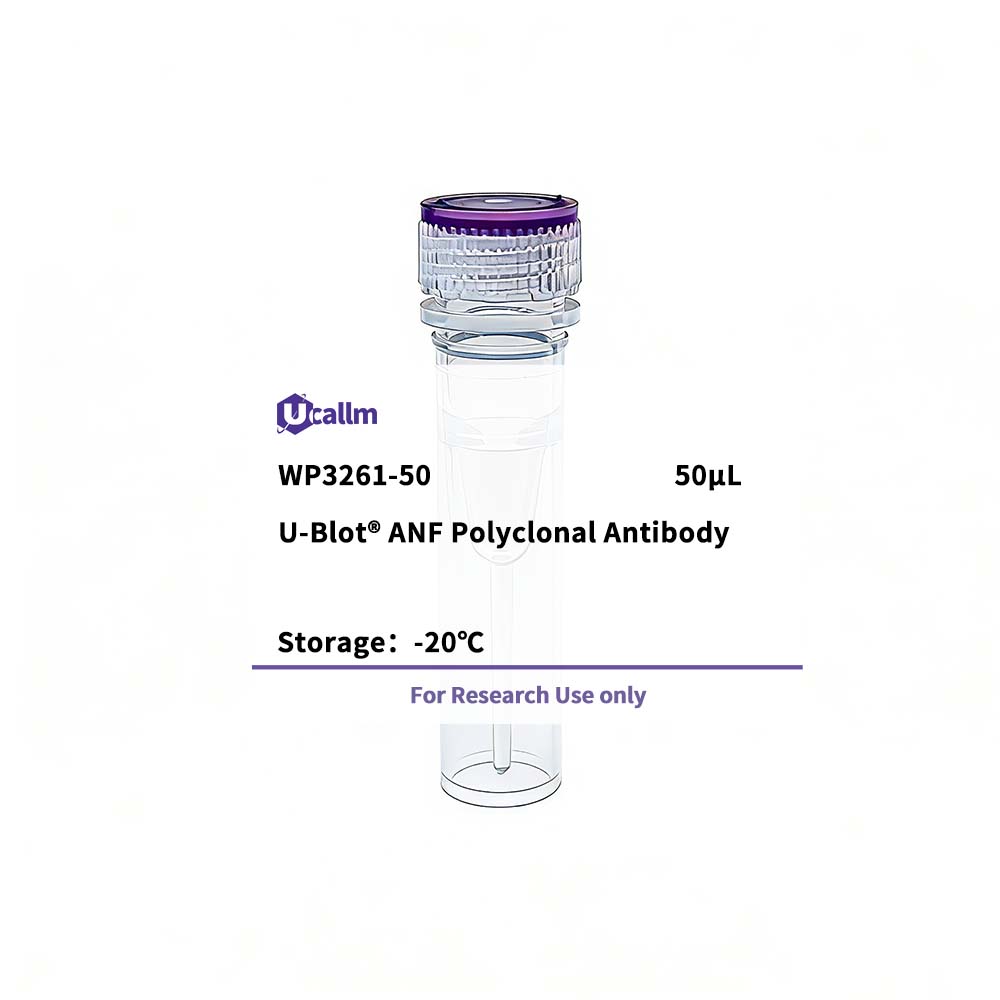
SKU: WP3261 Categories: ,

ANF Polyclonal Antibody

Price range: $268.00 through $328.00

SKU: WP3261-100
Enter the quantity you would like, or drag the panel to find the quantity and price that best for you
Bulk QuoteAuthorize OEM & ODM

Product details

Background:

The protein encoded by this gene belongs to the natriuretic peptide family. Natriuretic peptides are implicated in the control of extracellular fluid volume and electrolyte homeostasis. This protein is synthesized as a large precursor (containing a signal peptide), which is processed to release a peptide from the N-terminus with similarity to vasoactive peptide, cardiodilatin, and another peptide from the C-terminus with natriuretic-diuretic activity. Mutations in this gene have been associated with atrial fibrillation familial type 6. This gene is located adjacent to another member of the natriuretic family of peptides on chromosome 1. [provided by RefSeq, Oct 2015],

Specifications

Size50μL/100μL
TargetANF
ReactivityHuman, Mouse, Rat
ApplicationsWB, ELISA
MW(Calculated)
MW(Observed)16kD
Host SpeciesRabbit
IsotypeIgG
Conjugate/ModificationUnmodified
Recommended Dilution RatioWB 1:500-2000; ELISA 1:5000-20000
FormulationLiquid in PBS containing 50% glycerol,0.5% BSA and 0.02% sodium azide.
PurificationThe antibody was affinity-purified from rabbit antiserum by affinity-chromatography using epitope-specific immunogen.
Storage-15°C to -25°C/1 year(Do not lower than -25°C)
Concentration1 mg/ml
ClonalityPolyclonal
Clone Number
ImmunogenSynthesized peptide derived from part region of human protein
SpecificityANF Polyclonal Antibody detects endogenous levels of protein.
Gene NameNPPA ANP PND
Protein NameNatriuretic peptides A (CDD-ANF) (Prepronatriodilatin) [Cleaved into: Cardiodilatin-related peptide (CDP); Atrial natriuretic factor (ANF) (Atrial natriuretic peptide) (ANP)]
Other Name
SpeciesHuman
Gene ID4878
UniprotP01160,
Species.1Mouse
Gene ID.1
Uniprot.1P05125,
Species.2Rat
Gene ID.2
Uniprot.2P01161
Cellular Localization[Long-acting natriuretic peptide]: Secreted . Detected in blood. .; [Vessel dilator]: Secreted . Detected in blood. .; [Kaliuretic peptide]: Secreted . Detected in blood. .; [Urodilatin]: Secreted . Detected in urine (PubMed:2972874, PubMed:9794555, PubMed:8351194, PubMed:8779891). Not detected in blood (PubMed:8351194). Increased electrolytes, osmolality and intracellular cAMP levels increase peptide secretion/excretion (PubMed:9893117, PubMed:8853410, PubMed:8351194, PubMed:8779891). .; [Atrial natriuretic peptide]: Secreted . Perikaryon . Cell projection . Detected in blood (PubMed:8351194, PubMed:8779891, PubMed:7955907, PubMed:8653797, PubMed:15741263, PubMed:18835931, PubMed:2532366, PubMed:7984506). Detected in urine in one study (PubMed:8351194). However, in another study, was not detected in urine (PubMed:7984506). Detected in cytoplasmic bodies and neuronal processes of pyramidal neurons (layers II-VI) (PubMed:30534047). Increased secretion in response to the vasopressin AVP (By similarity). Likely to be secreted in response to an increase in atrial pressure or atrial stretch (PubMed:2532366). In kidney cells, secretion increases in response to activated guanylyl cyclases and increased intracellular cAMP levels (PubMed:9893117). Plasma levels increase 15 minutes after a high-salt meal, and decrease back to normal plasma levels 1 hr later (PubMed:8779891). .; [Atriopeptin-3]: Secreted . Detected in blood. Slight increase in secretion in response to the vasopressin AVP. .
Tissue Expression[Urodilatin]: Detected in the kidney distal tubular cells (at protein level) (PubMed:9794555, PubMed:8384600). Present in urine (at protein level) (PubMed:2972874, PubMed:9794555, PubMed:8351194, PubMed:8779891).; [Atrial natriuretic peptide]: Detected in atrial and ventricular plasma samples, and in adipocytes (at protein level) (PubMed:22291141, PubMed:21672517). Detected in urine in one study (PubMed:8351194). However, was not detected in urine in another study (PubMed:7984506). In the brain, predominantly expressed in the gray matter with very weak expression in the white matter (at protein level) (PubMed:30534047). Localizes to astrocyte-like structures throughout the white matter, and in the cerebral vessels detected in the leptomeningeal and parenchymal vessels, and endothelium and smooth muscle layers (at protein level) (PubMed:30534047). Relatively low levels of expression in the kidneys compared to urodilatin (at protein level) (PubMed:9794555, PubMed:8384600).
Signaling_pathwayOrganismal Systems >> Endocrine system >> Oxytocin signaling pathway;Organismal Systems >> Endocrine system >> Aldosterone synthesis and secretion;Organismal Systems >> Circulatory system >> Vascular smooth muscle contraction;Environmental Information Processing >> Signal transduction >> HIF-1 signaling pathway;Environmental Information Processing >> Signal transduction >> cAMP signaling pathway;Environmental Information Processing >> Signal transduction >> cGMP-PKG signaling pathway
Research Areas>>cGMP-PKG signaling pathway; / >>cAMP signaling pathway; / >>HIF-1 signaling pathway; / >>Vascular smooth muscle contraction; / >>Thermogenesis; / >>Oxytocin signaling pathway; / >>Regulation of lipolysis in adipocytes; / >>Renin secretion; / >>Aldosterone synthesis and secretion; / >>African trypanosomiasis
FunctionDisease:Defects in NPPA are the cause of atrial fibrillation familial type 6 (ATFB6) [MIM:612201]. Atrial fibrillation is a common disorder of cardiac rhythm that is hereditary in a small subgroup of patients. It is characterized by disorganized atrial electrical activity, progressive deterioration of atrial electromechanical function and ineffective pumping of blood into the ventricles. It can be associated with palpitations, syncope, thromboembolic stroke, and congestive heart failure.,Function:A potent vasoactive substance which is thought to play a key role in cardiovascular homeostasis. Has a cGMP-stimulating activity.,online information:Atrial natriuretic peptide entry,polymorphism:There are two different prepronatriodilatin alleles. One codes for 2 Arg residues at the C-terminus that are cleaved to form the mature peptide, while the other ends in a termination codon immediately after the last codon of the mature peptide.,similarity:Belongs to the natriuretic peptide family.,subunit:Interacts with NPR3.,
Please login to post questions
Back to Top
Product has been added to your cart

