

ANGL2 Polyclonal Antibody
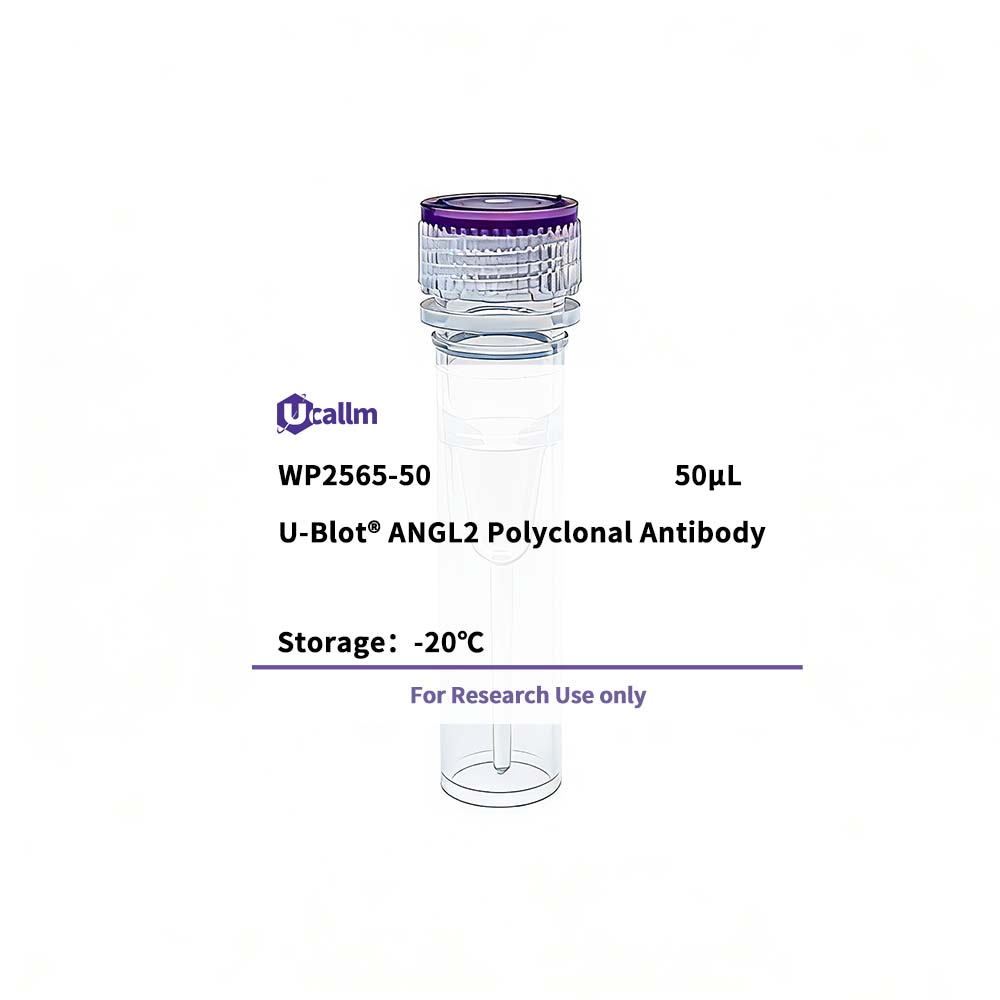
Ucallm_WP2565-50
Price range: $268.00 through $328.00
Product details
Background:
Angiopoietins are members of the vascular endothelial growth factor family and the only known growth factors largely specific for vascular endothelium. Angiopoietin-1, angiopoietin-2, and angiopoietin-4 participate in the formation of blood vessels. ANGPTL2 protein is a secreted glycoprotein with homology to the angiopoietins and may exert a function on endothelial cells through autocrine or paracrine action. [provided by RefSeq, Jul 2008],
Specifications
| Size | 50μL/100μL |
| Target | ANGL2 |
| Reactivity | Human, Mouse |
| Applications | WB, ELISA |
| MW(Calculated) | |
| MW(Observed) | 54kD |
| Host Species | Rabbit |
| Isotype | IgG |
| Conjugate/Modification | Unmodified |
| Recommended Dilution Ratio | WB 1:500-2000; ELISA 1:5000-20000 |
| Formulation | Liquid in PBS containing 50% glycerol,0.5% BSA and 0.02% sodium azide. |
| Purification | The antibody was affinity-purified from rabbit antiserum by affinity-chromatography using epitope-specific immunogen. |
| Storage | -15°C to -25°C/1 year(Do not lower than -25°C) |
| Concentration | 1 mg/ml |
| Clonality | Polyclonal |
| Clone Number | |
| Immunogen | Synthesized peptide derived from part region of human protein |
| Specificity | ANGL2 Polyclonal Antibody detects endogenous levels of protein. |
| Gene Name | ANGPTL2 ARP2 UNQ170/PRO196 |
| Protein Name | Angiopoietin-related protein 2 (Angiopoietin-like protein 2) |
| Other Name | |
| Species | Human |
| Gene ID | 23452 |
| Uniprot | Q9UKU9, |
| Species.1 | Mouse |
| Gene ID.1 | |
| Uniprot.1 | Q9R045 |
| Species.2 | |
| Gene ID.2 | |
| Uniprot.2 | |
| Cellular Localization | Secreted. |
| Tissue Expression | Widely expressed in heart, small intestine, spleen and stomach. Also found in lower levels in colon, ovary, adrenal gland, skeletal muscle and in prostate. |
| Signaling_pathway | |
| Research Areas | |
| Function | Function:Induces sprouting in endothelial cells through an autocrine and paracrine action.,PTM:N-glycosylated.,similarity:Contains 1 fibrinogen C-terminal domain.,tissue specificity:Widely expressed in heart, small intestine, spleen and stomach. Also found in lower levels in colon, ovary, adrenal gland, skeletal muscle and in prostate., |
Please login to post questions
Related products





