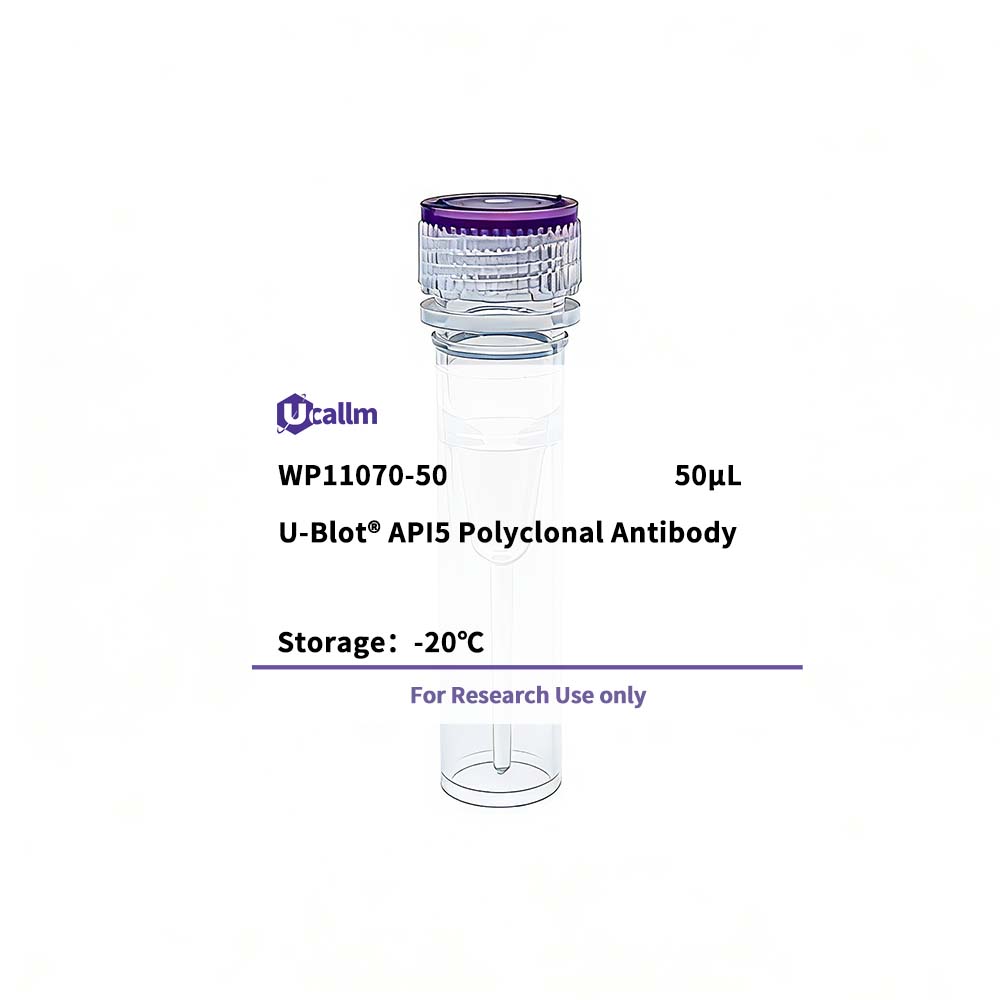
SKU: WP11070 Categories: ,

API5 Polyclonal Antibody

Price range: $268.00 through $328.00

SKU: WP11070-100
Enter the quantity you would like, or drag the panel to find the quantity and price that best for you
Bulk QuoteAuthorize OEM & ODM

Product details

Background:

This gene encodes an apoptosis inhibitory protein whose expression prevents apoptosis after growth factor deprivation. This protein suppresses the transcription factor E2F1-induced apoptosis and also interacts with, and negatively regulates Acinus, a nuclear factor involved in apoptotic DNA fragmentation. Its depletion enhances the cytotoxic action of the chemotherapeutic drugs. Multiple alternatively spliced transcript variants encoding different isoforms have been identified. [provided by RefSeq, Aug 2011],

Specifications

Size50μL/100μL
TargetAPI5
ReactivityHuman, Mouse
ApplicationsWB, IHC, IF, ELISA
MW(Calculated)
MW(Observed)58kD
Host SpeciesRabbit
IsotypeIgG
Conjugate/ModificationUnmodified
Recommended Dilution RatioWB 1:500-1:2000; IHC 1:100-1:300; ELISA 1:20000; IF 1:50-200 / Note: For IHC, we suggest antigen retrieval with TE buffer pH 9.0 (Cat#WT1004)
FormulationLiquid in PBS containing 50% glycerol, 0.5% BSA and 0.02% sodium azide.
PurificationThe antibody was affinity-purified from rabbit antiserum by affinity-chromatography using epitope-specific immunogen.
Storage-15°C to -25°C/1 year(Do not lower than -25°C)
Concentration1 mg/ml
ClonalityPolyclonal
Clone Number
ImmunogenThe antiserum was produced against synthesized peptide derived from human API-5. AA range:421-470
SpecificityAPI5 Polyclonal Antibody detects endogenous levels of API5 protein.
Gene NameAPI5
Protein NameApoptosis inhibitor 5
Other NameAPI5; / MIG8; / Apoptosis inhibitor 5; / API-5; / Antiapoptosis clone 11 protein; / AAC-11; / Cell migration-inducing gene 8 protein; / Fibroblast growth factor 2-interacting factor; / FIF; / Protein XAGL
SpeciesHuman
Gene ID8539
UniprotQ9BZZ5,
Species.1Mouse
Gene ID.111800
Uniprot.1O35841
Species.2
Gene ID.2
Uniprot.2
Cellular LocalizationNucleus . Cytoplasm . Mainly nuclear. Can also be cytoplasmic.; [Isoform 3]: Cytoplasm.
Tissue ExpressionExpressed in all tissues tested, including heart, brain, placenta, lung, liver, skeletal muscle, kidney and pancreas. Highest levels in heart, pancreas and placenta. Highly expressed in several cancers. Preferentially expressed in squamous cell carcinoma versus adenocarcinoma in non-small cell lung cancer.
Signaling_pathway
Research Areas
FunctionAlternative products:Additional isoforms seem to exist,Domain:Two regions, an N-terminal (aa 96-107) and a C-terminal (aa 274-311) are required for binding FGF2.,Function:Antiapoptotic factor that may have a role in protein assembly. Negatively regulates ACIN1. By binding to ACIN1, it suppresses ACIN1 cleavage from CASP3 and ACIN1-mediated DNA fragmentation. Also known to efficiently suppress E2F1-induced apoptosis. Its depletion enhances the cytotoxic action of the chemotherapeutic drugs.,sequence Caution:Translation N-terminally shortened.,similarity:Belongs to the API5 family.,subcellular location:Mainly nuclear. Can also be cytoplasmic.,subunit:Homooligomer. Interacts with FGF2 and ACIN1.,tissue specificity:Expressed in all tissues tested, including heart, brain, placenta, lung, liver, skeletal muscle, kidney and pancreas. Highest levels in heart, pancreas and placenta. Highly expressed in several cancers. Preferentially expressed in squamous cell carcinoma versus adenocarcinoma in non-small cell lung cancer.,
Please login to post questions
Back to Top
Product has been added to your cart


