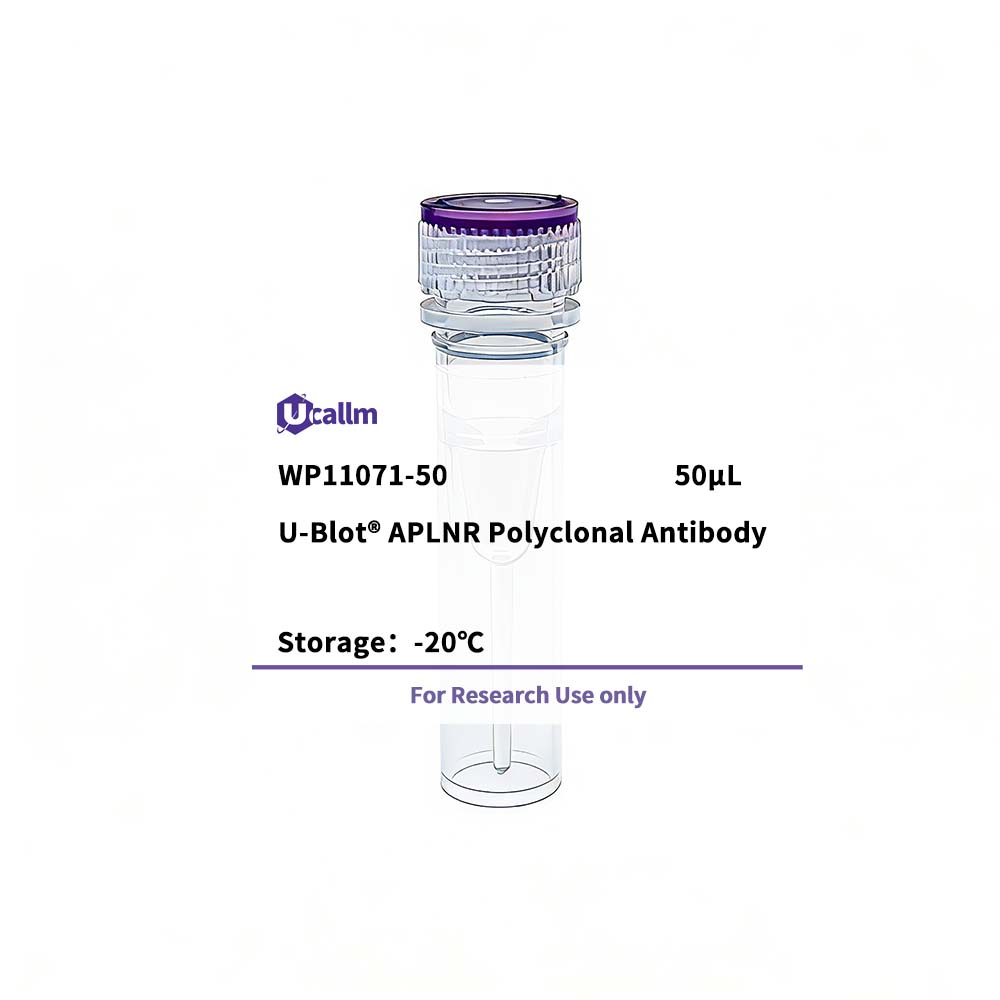
SKU: WP11071 Categories: ,

APLNR Polyclonal Antibody

Price range: $268.00 through $328.00

SKU: WP11071-100
Enter the quantity you would like, or drag the panel to find the quantity and price that best for you
Bulk QuoteAuthorize OEM & ODM

Product details

Background:

This gene encodes a member of the G protein-coupled receptor gene family. The encoded protein is related to the angiotensin receptor, but is actually an apelin receptor that inhibits adenylate cyclase activity and plays a counter-regulatory role against the pressure action of angiotensin II by exerting hypertensive effect. It functions in the cardiovascular and central nervous systems, in glucose metabolism, in embryonic and tumor angiogenesis and as a human immunodeficiency virus (HIV-1) coreceptor. Two transcript variants resulting from alternative splicing have been identified. [provided by RefSeq, Jul 2009],


Specifications

Size50μL/100μL
TargetAPLNR
ReactivityHuman, Mouse, Rat
ApplicationsWB, IHC, IF, ELISA
MW(Calculated)
MW(Observed)43kD
Host SpeciesRabbit
IsotypeIgG
Conjugate/ModificationUnmodified
Recommended Dilution RatioWB 1:500-1:2000; IHC 1:100-1:300; IF 1:200-1:1000; ELISA 1:10000; Not yet tested in other applications. / Note: For IHC, we suggest antigen retrieval with TE buffer pH 9.0 (Cat#WT1004)
FormulationLiquid in PBS containing 50% glycerol, 0.5% BSA and 0.02% sodium azide.
PurificationThe antibody was affinity-purified from rabbit antiserum by affinity-chromatography using epitope-specific immunogen.
Storage-15°C to -25°C/1 year(Do not lower than -25°C)
Concentration1 mg/ml
ClonalityPolyclonal
Clone Number
ImmunogenThe antiserum was produced against synthesized peptide derived from human AGTRL1. AA range:141-190
SpecificityAPLNR Polyclonal Antibody detects endogenous levels of APLNR protein.
Gene NameAPLNR
Protein NameApelin receptor
Other NameAPLNR; / AGTRL1; / APJ; / Apelin receptor; / Angiotensin receptor-like 1; / G-protein coupled receptor APJ; / G-protein coupled receptor HG11
SpeciesHuman
Gene ID187
UniprotP35414,
Species.1Mouse
Gene ID.1
Uniprot.1Q9WV08
Species.2
Gene ID.2
Uniprot.2
Cellular LocalizationCell membrane . After exposure to apelin (APLN), internalized from the cell surface into an endosomal recycling compartment, from where it is recycled to the cell membrane (By similarity). After exposure to apelin receptor early endogenous ligand (APELA), internalized from the cell surface into an endosomal recycling compartment, from where it is recycled to the cell membrane (PubMed:25639753). .
Tissue ExpressionExpressed in heart, brain, kidney, stomach, spleen, thymus, lung, ovary, small intestine and colon, adipose tissues and pancreas (PubMed:8294032, PubMed:25639753). Expressed in glial cells, astrocytes and neuronal subpopulations (PubMed:8294032). Expressed in embryonic (ESCs) and induced (iPSCs) pluripotent stem cells (PubMed:25639753).
Signaling_pathwayEnvironmental Information Processing >> Signal transduction >> Apelin signaling pathway
Research Areas>>Neuroactive ligand-receptor interaction; / >>Apelin signaling pathway
FunctionFunction:Receptor for apelin coupled to G proteins that inhibit adenylate cyclase activity. Alternative coreceptor with CD4 for HIV-1 infection; may be involved in the development of AIDS dementia.,similarity:Belongs to the G-protein coupled receptor 1 family.,tissue specificity:Widely expressed in the brain, in glial cells, astrocytes and neuronal subpopulations, as well as in the spleen, thymus, ovary, small intestine and colon.,
Please login to post questions
Back to Top
Product has been added to your cart
