


APOBEC3A Polyclonal Antibody
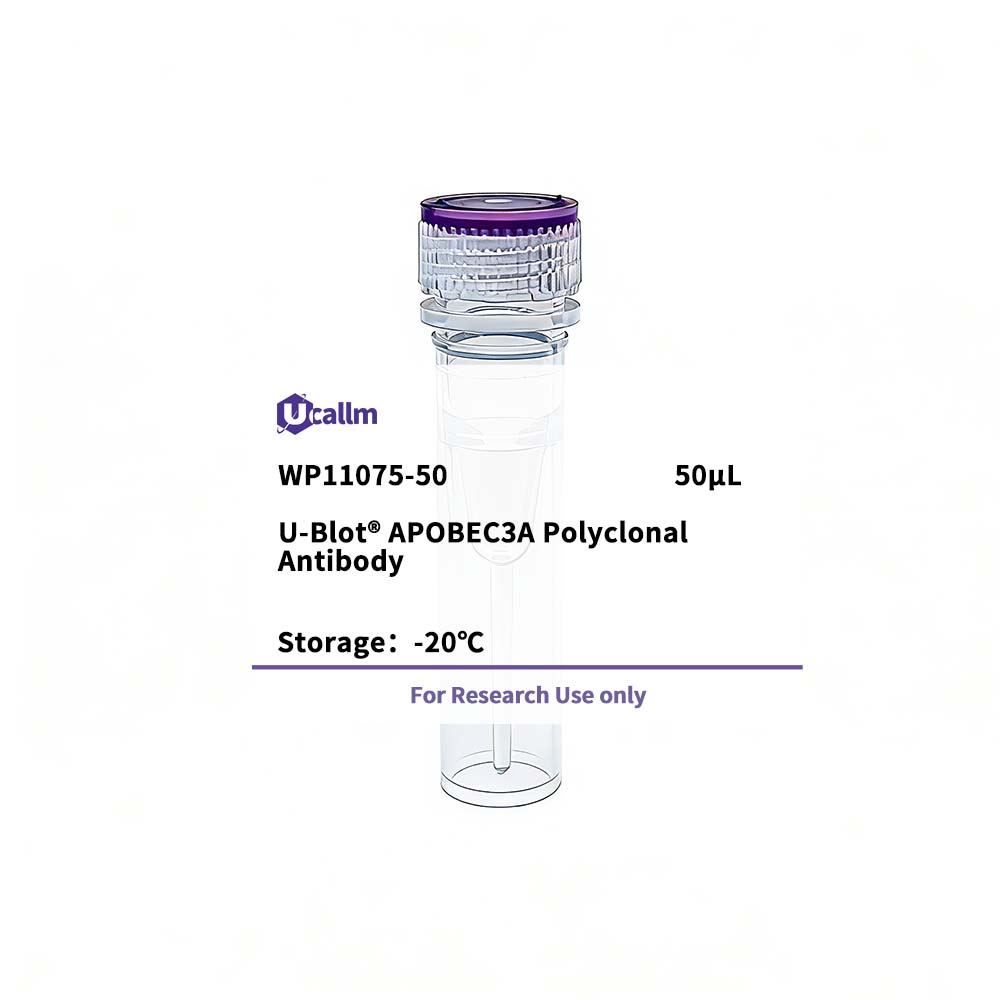
Ucallm_WP11075-50
Price range: $268.00 through $328.00
Product details
Background:
This gene is a member of the cytidine deaminase gene family. It is one of seven related genes or pseudogenes found in a cluster, thought to result from gene duplication, on chromosome 22. Members of the cluster encode proteins that are structurally and functionally related to the C to U RNA-editing cytidine deaminase APOBEC1. The protein encoded by this gene lacks the zinc binding activity of other family members. The protein plays a role in immunity, by restricting transmission of foreign DNA such as viruses. One mechanism of foreign DNA restriction is deamination of foreign double-stranded DNA cytidines to uridines, which leads to DNA degradation. However, other mechanisms are also thought to be involved, as anti-viral effect is not dependent on deaminase activity. Two transcript variants encoding different isoforms have been found for this gene. [provided b
Specifications
| Size | 50μL/100μL |
| Target | APOBEC3A |
| Reactivity | Human |
| Applications | WB, ELISA |
| MW(Calculated) | |
| MW(Observed) | 26kD |
| Host Species | Rabbit |
| Isotype | IgG |
| Conjugate/Modification | Unmodified |
| Recommended Dilution Ratio | WB 1:500-1:2000; ELISA 1:10000; Not yet tested in other applications. |
| Formulation | Liquid in PBS containing 50% glycerol, 0.5% BSA and 0.02% sodium azide. |
| Purification | The antibody was affinity-purified from rabbit antiserum by affinity-chromatography using epitope-specific immunogen. |
| Storage | -15°C to -25°C/1 year(Do not lower than -25°C) |
| Concentration | 1 mg/ml |
| Clonality | Polyclonal |
| Clone Number | |
| Immunogen | The antiserum was produced against synthesized peptide derived from human APOBEC3A. AA range:27-76 |
| Specificity | APOBEC3A Polyclonal Antibody detects endogenous levels of APOBEC3A protein. |
| Gene Name | APOBEC3A |
| Protein Name | Probable DNA dC->dU-editing enzyme APOBEC-3A |
| Other Name | APOBEC3A; / Probable DNA dC->dU-editing enzyme APOBEC-3A; / Phorbolin-1 |
| Species | Human |
| Gene ID | 200315 |
| Uniprot | P31941 |
| Species.1 | |
| Gene ID.1 | |
| Uniprot.1 | |
| Species.2 | |
| Gene ID.2 | |
| Uniprot.2 | |
| Cellular Localization | Nucleus. Cytoplasm. |
| Tissue Expression | Expressed in peripheral leukocytes with higher expression in CD14-positive phagocytic cells. Highly expressed in keratinocytes and in periphery blood monocytes. Also detected in non-lymphoid tissues including lung and adipose tissues. Found at high levels in colorectal adenocarcinoma, Burkitt's lymphoma and chronic myelogenous leukemia. |
| Signaling_pathway | |
| Research Areas | >>Viral life cycle - HIV-1; / >>Human immunodeficiency virus 1 infection |
| Function | cofactor:Zinc.,Function:Lacks cytidine deaminase activity, at least on RNA molecules (monomeric nucleoside substrates or synthetic apoB RNA template). Unable to reduce HIV-1 infectivity in vitro.,miscellaneous:It is one of seven related genes or pseudogenes found in a cluster, thought to result from gene duplication, on chromosome 22.,similarity:Belongs to the cytidine and deoxycytidylate deaminase family.,tissue specificity:Expressed in peripherical leukocytes and keratinocytes., |
Please login to post questions
Related products



