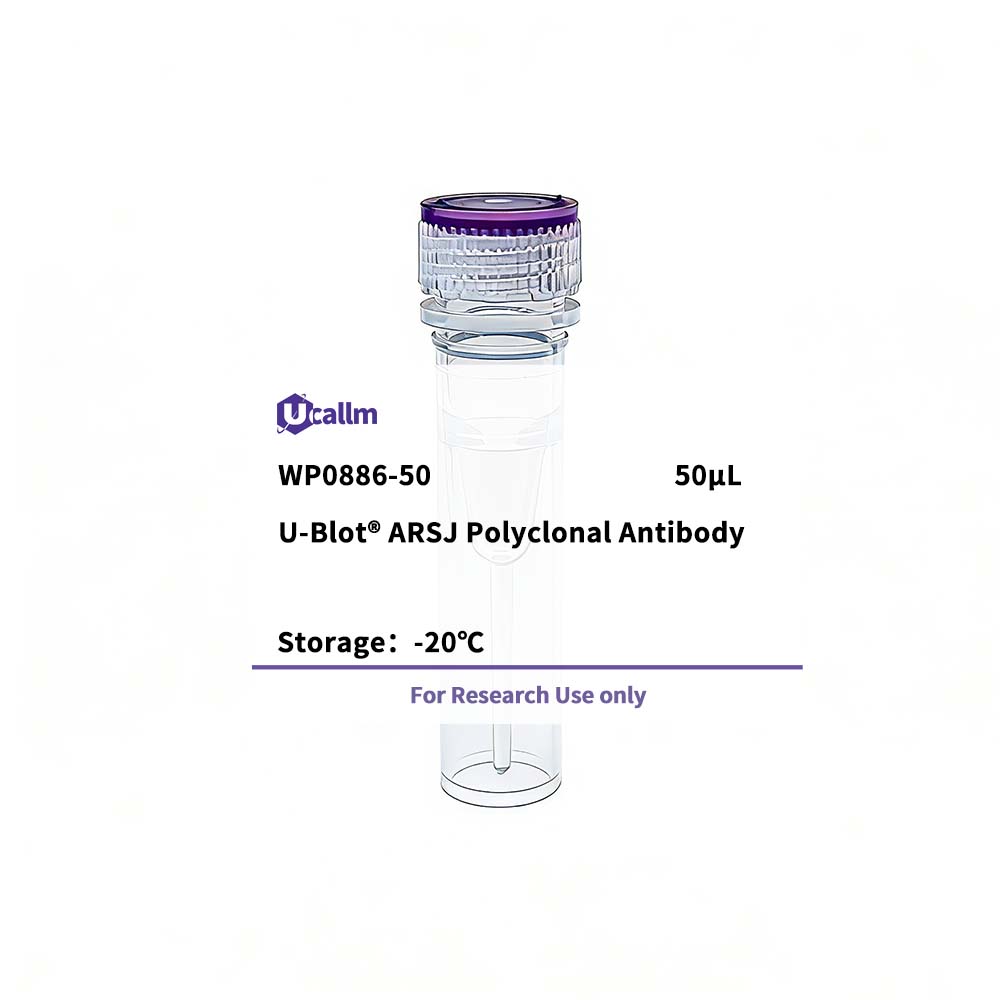
SKU: WP0886 Categories: ,

ARSJ Polyclonal Antibody

Price range: $268.00 through $328.00

SKU: WP0886-100
Enter the quantity you would like, or drag the panel to find the quantity and price that best for you
Bulk QuoteAuthorize OEM & ODM

Product details

Background:

Sulfatases (EC 3.1.5.6), such as ARSJ, hydrolyze sulfate esters from sulfated steroids, carbohydrates, proteoglycans, and glycolipids. They are involved in hormone biosynthesis, modulation of cell signaling, and degradation of macromolecules (Sardiello et al., 2005 [PubMed 16174644]).[supplied by OMIM, Mar 2008],

Specifications

TargetARSJ
ReactivityHuman, Mouse
ApplicationsWB, ELISA
MW(Calculated)
MW(Observed)65kD
Host SpeciesRabbit
IsotypeIgG
Conjugate/ModificationUnmodified
Modification
Recommended Dilution RatioWB 1:500-2000; ELISA 1:5000-20000
FormulationLiquid in PBS containing 50% glycerol,0.5% BSA and 0.02% sodium azide.
Source
PurificationThe antibody was affinity-purified from rabbit antiserum by affinity-chromatography using epitope-specific immunogen.
Purity
Storage-15°C to -25°C/1 year(Do not lower than -25°C)
Concentration1 mg/ml
ClonalityPolyclonal
Clone Number
ImmunogenSynthesized peptide derived from human protein . at AA range: 340-420
Sequence
SpecificityARSJ Polyclonal Antibody detects endogenous levels of protein.
Gene NameARSJ UNQ372/PRO708
Protein NameArylsulfatase J (ASJ) (EC 3.1.6.-)
Other Name
SpeciesHuman
Gene ID-179642
UniprotQ5FYB0,
Species.1Mouse
Gene ID-2
Uniprot.1Q8BM89
Species.2
Gene ID-3
Uniprot.2
Organism-4
Gene ID-4
SwissProt-4
BackgroundSulfatases (EC 3.1.5.6), such as ARSJ, hydrolyze sulfate esters from sulfated steroids, carbohydrates, proteoglycans, and glycolipids. They are involved in hormone biosynthesis, modulation of cell signaling, and degradation of macromolecules (Sardiello et al., 2005 [PubMed 16174644]).[supplied by OMIM, Mar 2008],
Cellular LocalizationSecreted .
Tissue ExpressionChondrosarcoma,Human lung,Skin,
Signaling_pathway
Research Areas
Functioncofactor:Binds 1 calcium ion per subunit.,PTM:The conversion to 3-oxoalanine (also known as C-formylglycine, FGly), of a serine or cysteine residue in prokaryotes and of a cysteine residue in eukaryotes, is critical for catalytic activity.,similarity:Belongs to the sulfatase family.,
RRID
Please login to post questions
Back to Top
Product has been added to your cart