SKU: WM1211 Categories: ,

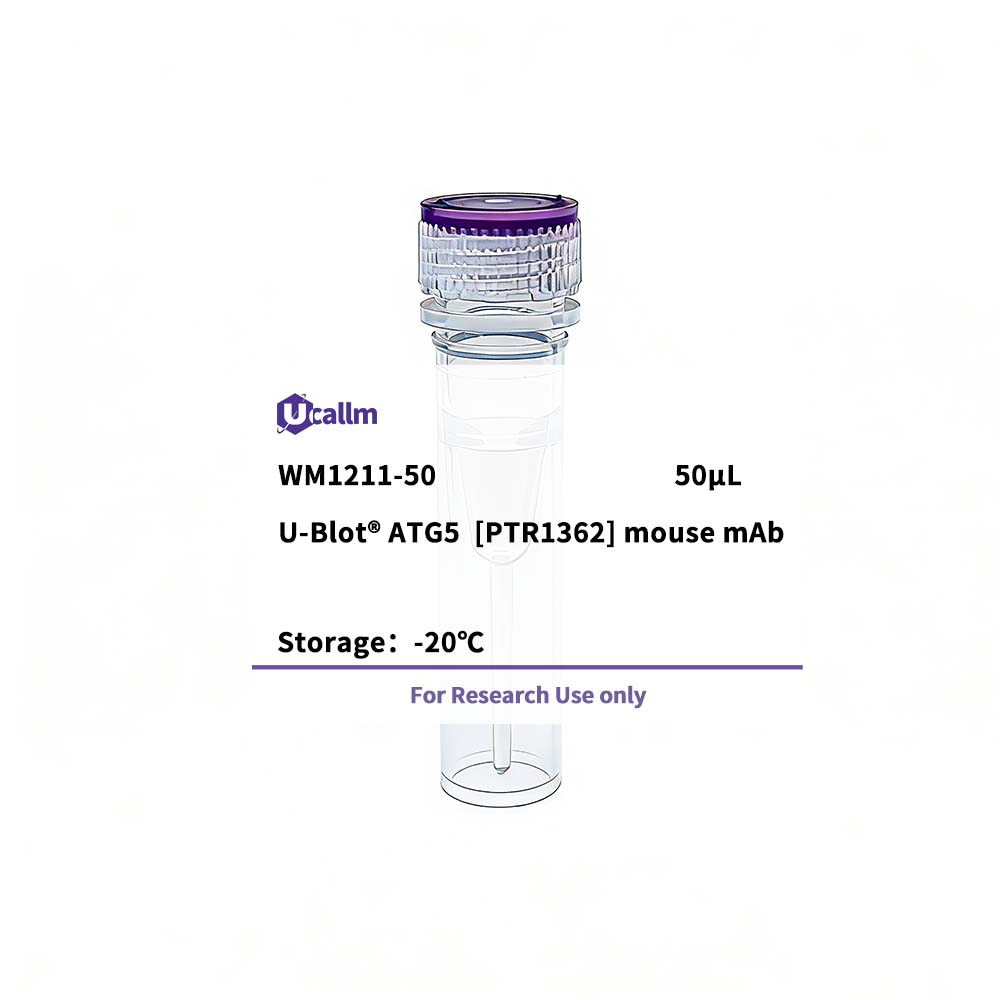
ATG5 [PTR1362] mouse mAb

Price range: $268.00 through $328.00

SKU: WM1211-50
Enter the quantity you would like, or drag the panel to find the quantity and price that best for you
Bulk QuoteAuthorize OEM & ODM

Product details

Background:
The protein encoded by this gene, in combination with autophagy protein 12, functions as an E1-like activating enzyme in a ubiquitin-like conjugating system. The encoded protein is involved in several cellular processes, including autophagic vesicle formation, mitochondrial quality control after oxidative damage, negative regulation of the innate antiviral immune response, lymphocyte development and proliferation, MHC II antigen presentation, adipocyte differentiation, and apoptosis. Several transcript variants encoding different protein isoforms have been found for this gene. [provided by RefSeq, Sep 2015],
Specifications

TargetATG5
ReactivityHuman, Mouse
ApplicationsWB, IHC, IF, IP, ELISA
MW(Calculated)32kD
MW(Observed)55kD
Host SpeciesMouse
IsotypeIgG
Conjugate/ModificationUnmodified
Modification
Recommended Dilution RatioIHC 1:200-1:1000; WB 1:500-2000; IF 1:100-500; ELISA 1:1000-5000; IP 1:50-1:200; / Note: For IHC, we suggest antigen retrieval with TE buffer pH 9.0 (Cat#YS0004)
FormulationPBS, 50% glycerol, 0.05% Proclin 300, 0.05%BSA
Source
PurificationRecombinant Antibody expressed in animal component-free (ACF) media, purified via Protein G affinity chromatography.
Purity
Storage-15°C to -25°C/1 year(Do not lower than -25°C)
Concentration1 mg/ml
ClonalityMonoclonal
Clone NumberPTR1362
ImmunogenRecombinant Protein
Sequence
SpecificityThis antibody detects endogenous levels of ATG5.
Gene NameATG5 APG5L ASP
Protein NameAutophagy protein 5 (APG5-like) (Apoptosis-specific protein)
Other NameAutophagy protein 5; / APG5-like; / Apoptosis-specific protein
SpeciesHuman
Gene ID-19474
UniprotQ9H1Y0,
Species.1Mouse
Gene ID-2
Uniprot.1Q99J83,
Species.2Rat
Gene ID-3
Uniprot.2Q3MQ06
Organism-4
Gene ID-4
SwissProt-4
BackgroundThe protein encoded by this gene, in combination with autophagy protein 12, functions as an E1-like activating enzyme in a ubiquitin-like conjugating system. The encoded protein is involved in several cellular processes, including autophagic vesicle formation, mitochondrial quality control after oxidative damage, negative regulation of the innate antiviral immune response, lymphocyte development and proliferation, MHC II antigen presentation, adipocyte differentiation, and apoptosis. Several transcript variants encoding different protein isoforms have been found for this gene. [provided by RefSeq, Sep 2015],
Cellular Localization
Tissue ExpressionUbiquitous. The mRNA is present at similar levels in viable and apoptotic cells, whereas the protein is dramatically highly expressed in apoptotic cells.
Signaling_pathwayCellular Processes >> Transport and catabolism >> Autophagy - animal;Cellular Processes >> Cell growth and death >> Ferroptosis;Organismal Systems >> Immune system >> NOD-like receptor signaling pathway;Organismal Systems >> Immune system >> RIG-I-like receptor signaling pathway;Organismal Systems >> Aging >> Longevity regulating pathway;Organismal Systems >> Aging >> Longevity regulating pathway - multiple species
Research Areas>>Autophagy - other; / >>Mitophagy - animal; / >>Autophagy - animal; / >>Longevity regulating pathway; / >>Longevity regulating pathway - multiple species; / >>Ferroptosis; / >>NOD-like receptor signaling pathway; / >>RIG-I-like receptor signaling pathway; / >>Shigellosis
FunctionFunction:May play an important role in the apoptotic process, possibly within the modified cytoskeleton. Its expression is a relatively late event in the apoptotic process, occurring downstream of caspase activity.,Function:Required for autophagy. Conjugates to ATG12 and associates with isolation membrane to form cup-shaped isolation membrane and autophagosome. The conjugate detaches from the membrane immediately before or after autophagosome formation is completed.,induction:By apoptotic stimuli.,PTM:Conjugated to ATG12; which is essential for autophagy, but is not required for association with isolation membrane.,similarity:Belongs to the ATG5 family.,subcellular location:Colocalizes with nonmuscle actin.,tissue specificity:Ubiquitous. The mRNA is present at similar levels in viable and apoptotic cells, whereas the protein is dramatically highly expressed in apoptotic cells.,
RRID
Please login to post questions
Back to Top
Product has been added to your cart