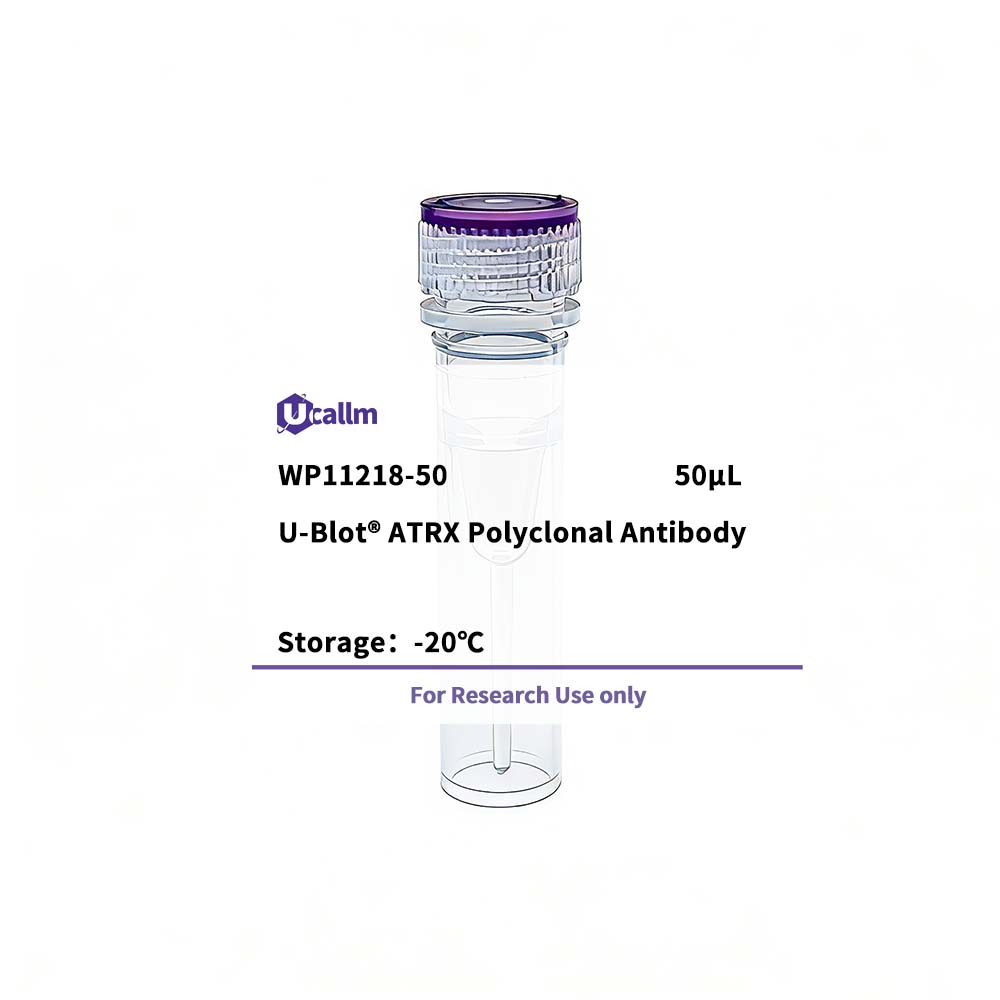
SKU: WP11218 Categories: ,

ATRX Polyclonal Antibody

Price range: $268.00 through $328.00

SKU: WP11218-100
Enter the quantity you would like, or drag the panel to find the quantity and price that best for you
Bulk QuoteAuthorize OEM & ODM

Product details

Background:

ATRX, chromatin remodeler(ATRX) Homo sapiens The protein encoded by this gene contains an ATPase/helicase domain, and thus it belongs to the SWI/SNF family of chromatin remodeling proteins. This protein is found to undergo cell cycle-dependent phosphorylation, which regulates its nuclear matrix and chromatin association, and suggests its involvement in the gene regulation at interphase and chromosomal segregation in mitosis. Mutations in this gene are associated with an X-linked mental retardation (XLMR) syndrome most often accompanied by alpha-thalassemia (ATRX) syndrome. These mutations have been shown to cause diverse changes in the pattern of DNA methylation, which may provide a link between chromatin remodeling, DNA methylation, and gene expression in developmental processes. Multiple alternatively spliced transcript variants encoding distinct isoforms have been reported. [provided by RefSeq, Aug 2013],

Specifications

Size50μL/100μL
TargetATRX
ReactivityHuman, Mouse
ApplicationsIF, ELISA
MW(Calculated)283kD
MW(Observed)
Host SpeciesRabbit
IsotypeIgG
Conjugate/ModificationUnmodified
Recommended Dilution RatioIF 1:200-1:1000; ELISA 1:10000; Not yet tested in other applications;
FormulationLiquid in PBS containing 50% glycerol, 0.5% BSA and 0.02% sodium azide.
PurificationThe antibody was affinity-purified from rabbit antiserum by affinity-chromatography using epitope-specific immunogen.
Storage-15°C to -25°C/1 year(Do not lower than -25°C)
Concentration1 mg/ml
ClonalityPolyclonal
Clone Number
ImmunogenThe antiserum was produced against synthesized peptide derived from human ATRX. AA range:111-160
SpecificityATRX Polyclonal Antibody detects endogenous levels of ATRX protein.
Gene NameATRX
Protein NameTranscriptional regulator ATRX
Other NameATRX; / RAD54L; / XH2; / Transcriptional regulator ATRX; / ATP-dependent helicase ATRX; / X-linked helicase II; / X-linked nuclear protein; / XNP; / Znf-HX
SpeciesHuman
Gene ID546
UniprotP46100,
Species.1Mouse
Gene ID.122589
Uniprot.1Q61687
Species.2
Gene ID.2
Uniprot.2
Cellular LocalizationNucleus. Chromosome, telomere. Nucleus, PML body. Associated with pericentromeric heterochromatin during interphase and mitosis, probably by interacting with CBX5/HP1 alpha. Colocalizes with histone H3.3, DAXX, HIRA and ASF1A at PML-nuclear bodies. Colocalizes with cohesin (SMC1 and SMC3) and MECP2 at the maternal H19 ICR (By similarity). .
Tissue ExpressionUbiquitous.
Signaling_pathwayCellular Processes >> Cell growth and death >> Cell cycle
Research Areas
FunctionDisease:Defects in ATRX are a cause of alpha-thalassemia myelodysplasia syndrome (ATMDS) [MIM:300448]. In this disorder, alpha-thalassemia occurs as an acquired abnormality in association with a multilineage myelodysplasia.,Disease:Defects in ATRX are the cause of mental retardation syndromic X-linked with hypotonic facies syndrome type 1 (MRXSHF1) [MIM:309580]; also called Carpenter-Waziri syndrome (CWS), Juberg-Marsidi syndrome (JMS), Smith-Fineman-Myers syndrome type 1 (SFM1). Clinical features include severe mental retardation, dysmorphic facies, and a highly skewed X-inactivation pattern in carrier women. Other more variable features include hypogonadism, deafness, renal anomalies, and mild skeletal defects.,Disease:Defects in ATRX are the cause of X-linked alpha-thalassemia/mental retardation syndrome (ATR-X) [MIM:301040]. ATR-X is an X-linked disorder comprising severe psychomotor retardation, facial dysmorphism, urogenital abnormalities, and alpha-thalassemia. An essential phenotypic trait are hemoglobin H erythrocyte inclusions.,Domain:Contains one Pro-Xaa-Val-Xaa-Leu (PxVxL) motif, which is required for interaction with chromoshadow domains. This motif requires additional residues -7, -6, +4 and +5 of the central Val which contact the chromoshadow domain.,Function:Could be a global transcriptional regulator. Modifies gene expression by affecting chromatin. May be involved in brain development and facial morphogenesis.,PTM:Phosphorylated upon DNA damage, probably by ATM or ATR.,similarity:Belongs to the SNF2/RAD54 helicase family.,similarity:Contains 1 GATA-type zinc finger.,similarity:Contains 1 helicase ATP-binding domain.,similarity:Contains 1 helicase C-terminal domain.,similarity:Contains 1 PHD-type zinc finger.,subcellular location:Associated with pericentromeric heterochromatin during interphase and mitosis, probably by interacting with HP1.,subunit:Probably binds EZH2. Binds annexin V in a calcium and phosphatidylcholine/phosphatidylserine-dependent manner (By similarity). Interacts directly with CBX5 via the PxVxL motif.,tissue specificity:Ubiquitous.,
Please login to post questions
Back to Top
Product has been added to your cart
