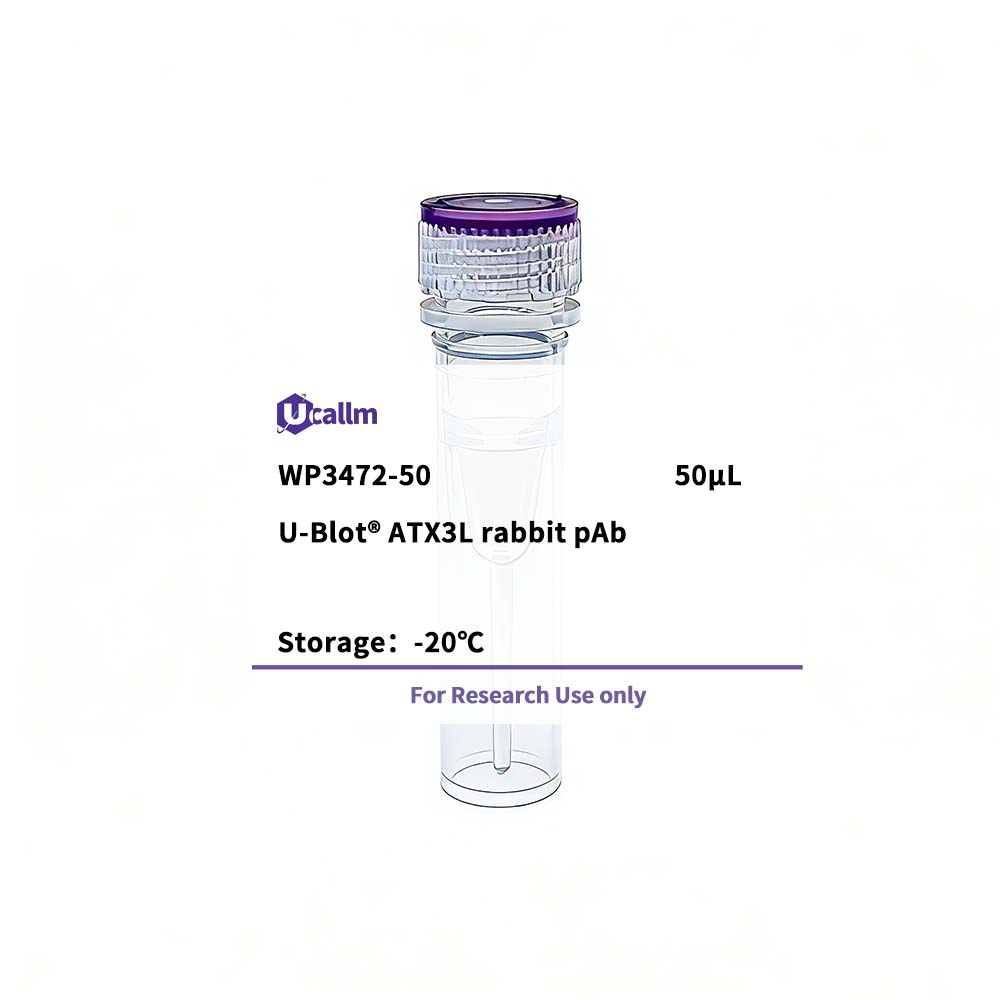
SKU: WP3472 Categories: ,

ATX3L rabbit pAb

Price range: $268.00 through $328.00

SKU: WP3472-100
Enter the quantity you would like, or drag the panel to find the quantity and price that best for you
Bulk QuoteAuthorize OEM & ODM

Product details

Background:

This intronless gene may be a pseudogene (PMID:11450850). This gene is similar to the multi-exon gene which encodes ataxin 3 and contains a coding region which could encode a protein similar to ataxin 3. Mutations in the gene encoding ataxin 3 are associated with Machado-Joseph disease. [provided by RefSeq, Sep 2011],

Specifications

Size50μL/100μL
TargetATX3L
ReactivityHuman
ApplicationsWB
MW(Calculated)
MW(Observed)38kD
Host SpeciesRabbit
IsotypeIgG
Conjugate/ModificationUnmodified
Recommended Dilution RatioWB 1:500-2000
FormulationLiquid in PBS containing 50% glycerol, 0.5% BSA and 0.02% sodium azide.
PurificationThe antibody was affinity-purified from rabbit antiserum by affinity-chromatography using epitope-specific immunogen.
Storage-15°C to -25°C/1 year(Do not lower than -25°C)
Concentration1 mg/ml
ClonalityPolyclonal
Clone Number
ImmunogenSynthesized peptide derived from human ATX3L AA range: 99-149
SpecificityThis antibody detects endogenous levels of ATX3L at Human
Gene NameATXN3L ATX3L MJDL
Protein NameATX3L
Other NamePutative ataxin-3-like protein; / Machado-Joseph disease protein 1-like
SpeciesHuman
Gene ID92552
UniprotQ9H3M9
Species.1
Gene ID.1
Uniprot.1
Species.2
Gene ID.2
Uniprot.2
Cellular LocalizationNucleus .
Tissue ExpressionTestis,
Signaling_pathwayHuman Diseases >> Neurodegenerative disease >> Spinocerebellar ataxia;Human Diseases >> Neurodegenerative disease >> Pathways of neurodegeneration - multiple diseases;Genetic Information Processing >> Folding, sorting and degradation >> Protein processing in endoplasmic reticulum
Research Areas>>Protein processing in endoplasmic reticulum; / >>Spinocerebellar ataxia; / >>Pathways of neurodegeneration - multiple diseases
FunctionCaution:Could be the product of a pseudogene. Suggested by the absence of intron.,Function:May bind to histones and regulate transcription. May act as a deubiquitinating enzyme.,similarity:Contains 1 Josephin domain.,similarity:Contains 2 UIM (ubiquitin-interacting motif) repeats.,
Please login to post questions
Back to Top
Product has been added to your cart

