SKU: WR4134 Categories: ,

U-Blot® Aurora B Rabbit mAb

Price range: $268.00 through $328.00

SKU: WR4134-50
Enter the quantity you would like, or drag the panel to find the quantity and price that best for you
Bulk QuoteAuthorize OEM & ODM

Product details

Background:This gene encodes a member of the aurora kinase subfamily of serine/threonine kinases. The genes encoding the other two members of this subfamily are located on chromosomes 19 and 20. These kinases participate in the regulation of alignment and segregation of chromosomes during mitosis and meiosis through association with microtubules. A pseudogene of this gene is located on chromosome 8. Alternatively spliced transcript variants have been found for this gene. [provided by RefSeq, Sep 2015],


Specifications

Size50μL/100μL
TargetAurB
ReactivityHuman
ApplicationsWB, IHC, IF, IP, ELISA
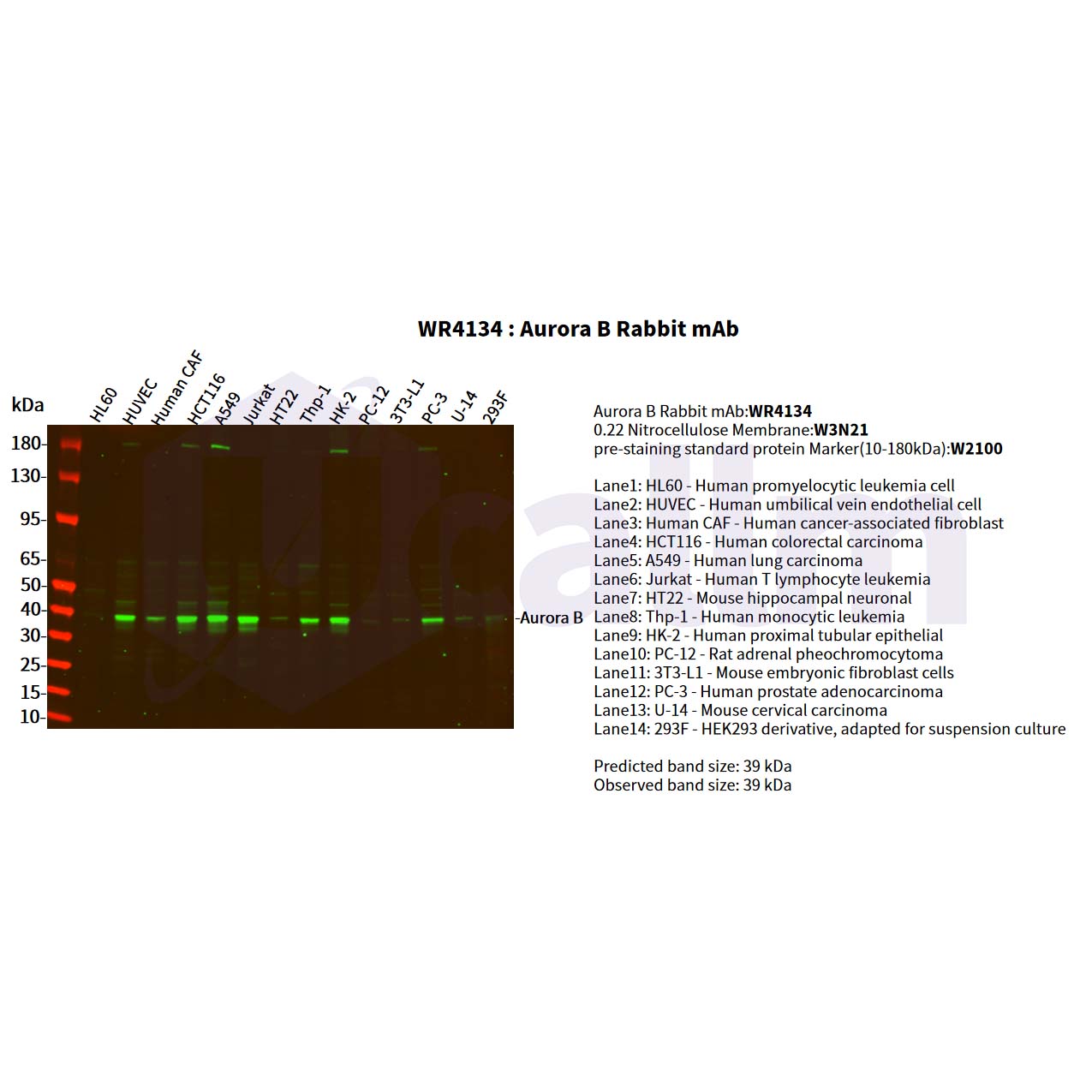
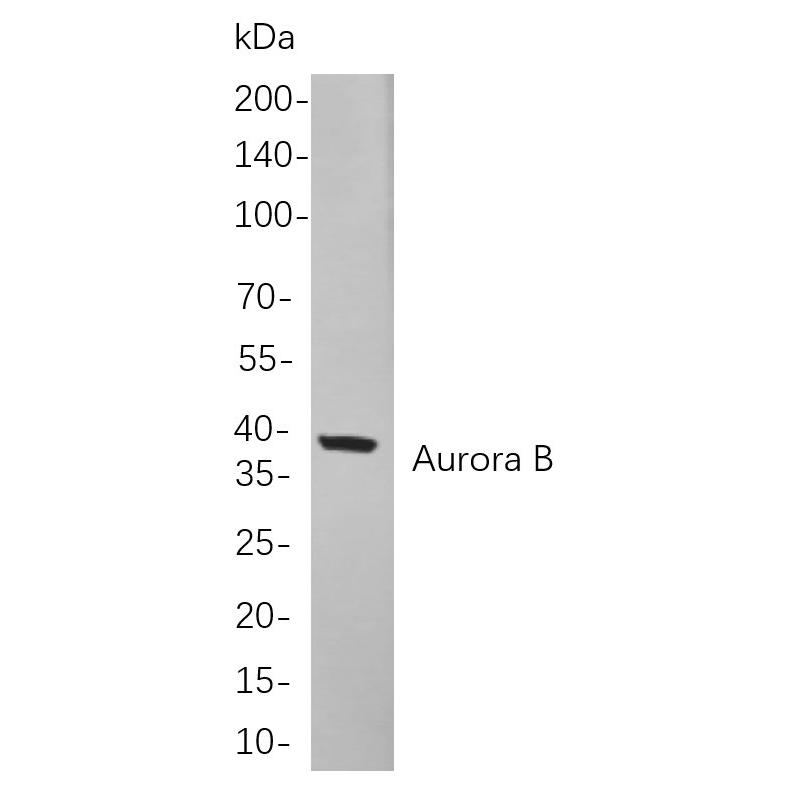
MW(Calculated)39kD
MW(Observed)39kD
Host SpeciesRabbit
IsotypeIgG,Kappa
Conjugate/ModificationUnmodified
Recommended Dilution RatioIHC 1:500-1:1000; WB 1:1000-1:5000; IF 1:200-1:1000; ELISA 1:5000-1:20000; IP 1:50-1:200; / Note: For IHC, we suggest antigen retrieval with TE buffer pH 9.0 (Cat#WT1004)
FormulationPBS, 50% glycerol, 0.05% Proclin 300, 0.05%BSA
PurificationRecombinant Antibody expressed in animal component-free (ACF) media, purified via Protein A affinity chromatography.
Storage-15°C to -25°C/1 year(Do not lower than -25°C)
Concentration
ClonalityMonoclonal
Clone NumberRM0246R
ImmunogenThe specific immunogen used to produce this antibody is proprietary information.
SpecificityEndogenous
Gene NameAURKB
Protein NameAurora kinase B,Aurora B
Other NameAURKB; / AIK2; / AIM1; / AIRK2; / ARK2; / STK1; / STK12; / STK5; / Aurora kinase B; / Aurora 1; / Aurora- and IPL1-like midbody-associated protein 1; / AIM-1; / Aurora/IPL1-related kinase 2; / ARK-2; / Aurora-related kinase 2; / STK-1; / Serine/threonine-protein kinase 12
SpeciesHuman
Gene ID9212
UniprotQ96GD4,
Species.1Mouse
Gene ID.120877
Uniprot.1O70126,
Species.2Rat
Gene ID.2114592
Uniprot.2O55099
Cellular LocalizationNucleus
Tissue ExpressionHigh level expression seen in the thymus. It is also expressed in the spleen, lung, testis, colon, placenta and fetal liver. Expressed during S and G2/M phase and expression is up-regulated in cancer cells during M phase.; [Isoform 3]: Not expressed in normal liver, high expression in metastatic liver.
Signaling_pathwayCellular Processes >> Cell growth and death >> Cell cycle
Research Areas
FunctionCatalytic activity:ATP + a protein = ADP + a phosphoprotein.,cofactor:Magnesium.,Disease:Disruptive regulation of expression is a possibile mechanism of the perturbation of chromosomal integrity in cancer cells through its dominant-negative effect on cytokinesis.,Function:May be directly involved in regulating the cleavage of polar spindle microtubules and is a key regulator for the onset of cytokinesis during mitosis. Component of the chromosomal passenger complex (CPC), a complex that acts as a key regulator of mitosis. The CPC complex has essential functions at the centromere in ensuring correct chromosome alignment and segregation and is required for chromatin-induced microtubule stabilization and spindle assembly. Phosphorylates 'Ser-10' and 'Ser-28' of histone H3 during mitosis.,similarity:Belongs to the protein kinase superfamily. Ser/Thr protein kinase family. Aurora subfamily.,similarity:Contains 1 protein kinase domain.,subcellular location:Localizes on chromosome arms and inner centromeres from prophase through metaphase and then transferring to the spindle midzone and midbody from anaphase through cytokinesis. Colocalized with gamma tubulin in the mid-body.,subunit:Interacts with TACC1. Associates with RACGAP1 during M phase. Component of the CPC at least composed of BIRC5/survivin CDCA8/borealin, INCENP and AURKB/Aurora-B. Interacts with CDCA1 and NDC80. Interacts with EVI5.,tissue specificity:High level expression seen in the thymus. It is also expressed in the spleen, lung, testis, colon, placenta and fetal liver. Expressed during S and G2/M phase and expression is up-regulated in cancer cells during M phase.,
Please login to post questions

Back to Top
Product has been added to your cart
