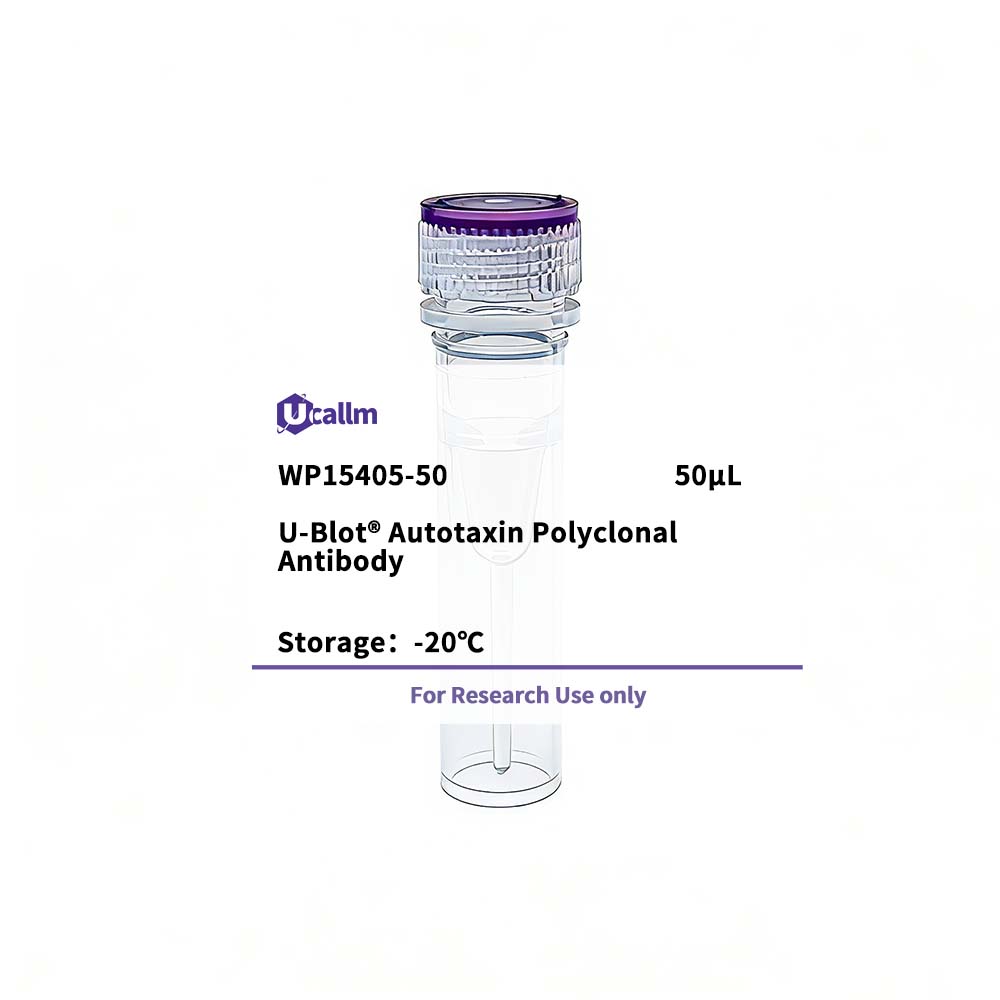
SKU: WP15405 Categories: ,

Autotaxin Polyclonal Antibody

Price range: $268.00 through $328.00

SKU: WP15405-100
Enter the quantity you would like, or drag the panel to find the quantity and price that best for you
Bulk QuoteAuthorize OEM & ODM

Product details

Background:

The protein encoded by this gene functions as both a phosphodiesterase, which cleaves phosphodiester bonds at the 5' end of oligonucleotides, and a phospholipase, which catalyzes production of lysophosphatidic acid (LPA) in extracellular fluids. LPA evokes growth factor-like responses including stimulation of cell proliferation and chemotaxis. This gene product stimulates the motility of tumor cells and has angiogenic properties, and its expression is upregulated in several kinds of carcinomas. The gene product is secreted and further processed to make the biologically active form. Several alternatively spliced transcript variants encoding different isoforms have been identified. [provided by RefSeq, Aug 2008],

Specifications

Size50μL/100μL
TargetAutotaxin
ReactivityHuman, Mouse, Rat
ApplicationsWB, ELISA
MW(Calculated)
MW(Observed)98kD
Host SpeciesRabbit
IsotypeIgG
Conjugate/ModificationUnmodified
Recommended Dilution RatioWB 1:500-1:2000; ELISA 1:20000; Not yet tested in other applications.
FormulationLiquid in PBS containing 50% glycerol, 0.5% BSA and 0.02% sodium azide.
PurificationThe antibody was affinity-purified from rabbit antiserum by affinity-chromatography using epitope-specific immunogen.
Storage-15°C to -25°C/1 year(Do not lower than -25°C)
Concentration1 mg/ml
ClonalityPolyclonal
Clone Number
ImmunogenThe antiserum was produced against synthesized peptide derived from the Internal region of human ENPP2. AA range:401-450
SpecificityAutotaxin Polyclonal Antibody detects endogenous levels of Autotaxin protein.
Gene NameENPP2
Protein NameEctonucleotide pyrophosphatase/phosphodiesterase family member 2
Other NameENPP2; / ATX; / PDNP2; / Ectonucleotide pyrophosphatase/phosphodiesterase family member 2; / E-NPP 2; / Autotaxin; / Extracellular lysophospholipase D; / LysoPLD
SpeciesHuman
Gene ID5168
UniprotQ13822,
Species.1Mouse
Gene ID.118606
Uniprot.1Q9R1E6,
Species.2Rat
Gene ID.284050
Uniprot.2Q64610
Cellular LocalizationSecreted .
Tissue ExpressionDetected in blood plasma (at protein level) (PubMed:12176993, PubMed:26371182). Predominantly expressed in brain, placenta, ovary, and small intestine. Expressed in a number of carcinomas such as hepatocellular and prostate carcinoma, neuroblastoma and non-small-cell lung cancer. Expressed in body fluids such as plasma, cerebral spinal fluid (CSF), saliva, follicular and amniotic fluids. Not detected in leukocytes. Isoform 1 is more highly expressed in peripheral tissues than in the central nervous system (CNS). Adipocytes only express isoform 1. Isoform 3 is more highly expressed in the brain than in peripheral tissues.
Signaling_pathway
Research Areas>>Ether lipid metabolism; / >>Metabolic pathways
FunctionCatalytic activity:1-alkyl-sn-glycero-3-phosphoethanolamine + H(2)O = 1-alkyl-sn-glycerol 3-phosphate + ethanolamine.,cofactor:Binds 2 divalent metal cations per subunit.,enzyme regulation:Inhibited by lysophosphatidic acid (LPA) and sphingosine-1-phosphate (S1P). Inhibited by EDTA and EGTA. Activated by cobalt and nickel, inhibited by zinc and manganese.,Function:Hydrolyzes lysophospholipids to produce lysophosphatidic acid (LPA) in extracellular fluids. Major substrate is lysophosphatidylcholine. Also can act on sphingosylphosphphorylcholine producing sphingosine-1-phosphate, a modulator of cell motility. Can hydrolyze, in vitro, bis-pNPP, to some extent pNP-TMP, and barely ATP. Involved in several motility-related processes such as angiogenesis and neurite outgrowth. Acts as an angiogenic factor by stimulating migration of smooth muscle cells and microtubule formation. Stimulates migration of melanoma cells, probably via a pertussis toxin-sensitive G protein. May have a role in induction of parturition. Possible involvement in cell proliferation and adipose tissue development. Tumor cell motility-stimulating factor.,induction:Up-regulated in massively obese subjects with glucose intolerance, and during adipogenesis.,PTM:It has been suggested that the active SMB domain may be permitted considerable disulfide bond heterogeneity or variability, thus two alternate disulfide patterns based on 3D structures are described with 1 disulfide bond conserved in both.,PTM:N-glycosylation, but not furin-cleavage, plays a critical role on secretion and on lysoPLD activity.,similarity:Belongs to the nucleotide pyrophosphatase/phosphodiesterase family.,similarity:Contains 2 SMB (somatomedin-B) domains.,subcellular location:Secreted by most body fluids including serum and CSF. Also by adipocytes and numerous cancer cells.,tissue specificity:Predominantly expressed in brain, placenta, ovary, and small intestine. Expressed in a number of carcinomas such as hepatocellular and prostate carcinoma, neuroblastoma and non-small-cell lung cancer. Expressed in body fluids such as plasma, cerebral spinal fluid (CSF), saliva, follicular and amniotic fluids. Not detected in leukocytes. Levels of isoform 1 expression are higher in peripheral tissues than in the central nervous system (CNS). Adipocytes only express isoform 1. Levels of isoform 3 expression are higher in the brain than in peripheral tissues.,
Please login to post questions
Back to Top
Product has been added to your cart

