SKU: WM1186 Categories: ,

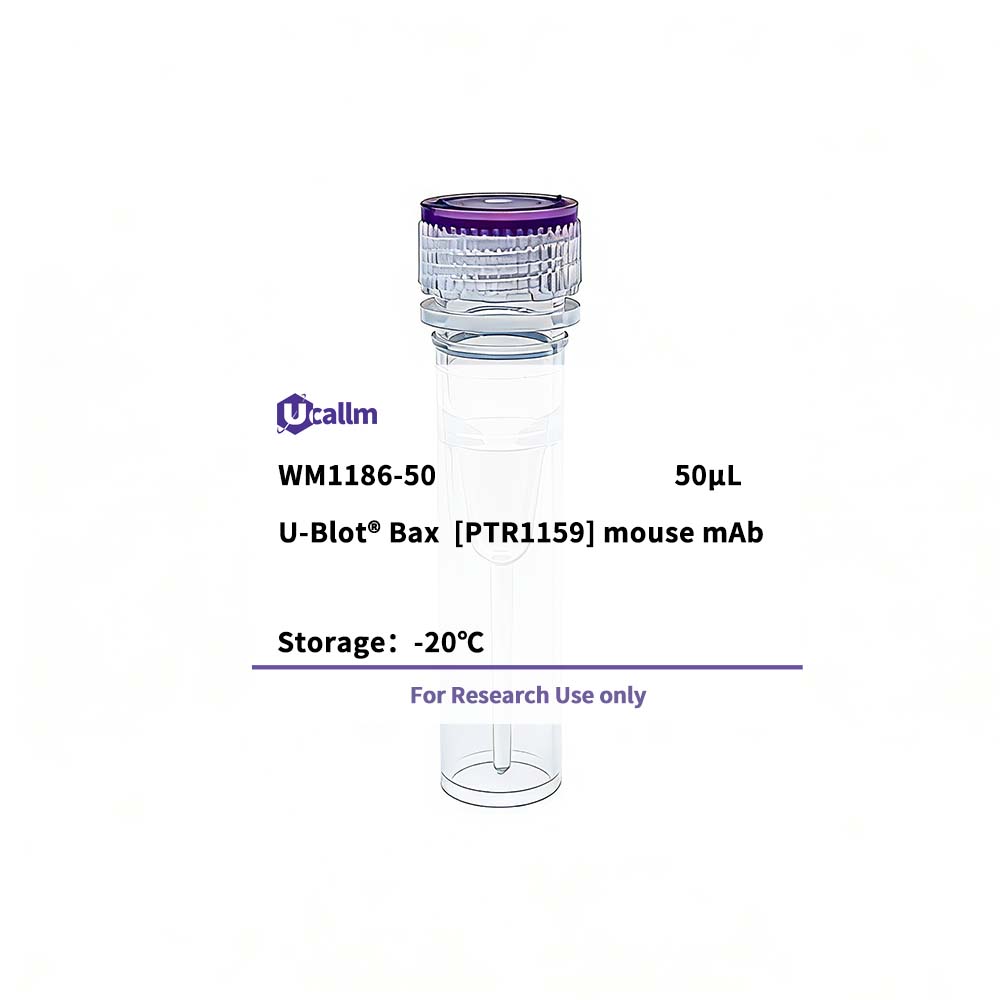
Bax [PTR1159] mouse mAb

Price range: $268.00 through $328.00

SKU: WM1186-50
Enter the quantity you would like, or drag the panel to find the quantity and price that best for you
Bulk QuoteAuthorize OEM & ODM

Product details

Background:
The protein encoded by BAX (BCL2 associated X, apoptosis regulator) belongs to the BCL2 protein family. BCL2 family members form hetero- or homodimers and act as anti- or pro-apoptotic regulators that are involved in a wide variety of cellular activities. This protein forms a heterodimer with BCL2, and functions as an apoptotic activator. This protein is reported to interact with, and increase the opening of, the mitochondrial voltage-dependent anion channel (VDAC), which leads to the loss in membrane potential and the release of cytochrome c. The expression of this gene is regulated by the tumor suppressor P53 and has been shown to be involved in P53-mediated apoptosis. Multiple alternatively spliced transcript variants, which encode different isoforms, have been reported for BAX.


Specifications

Size50μL/100μL
TargetBax
ReactivityHuman
ApplicationsWB, IF, ELISA
MW(Calculated)21kD
MW(Observed)21kD
Host SpeciesMouse
IsotypeIgG1,Kappa
Conjugate/ModificationUnmodified
Recommended Dilution RatioWB 1:500-2000; IF 1:100-500; ELISA 1:1000-5000
FormulationPBS, 50% glycerol, 0.05% Proclin 300, 0.05%BSA
PurificationRecombinant Antibody expressed in animal component-free (ACF) media, purified via Protein G affinity chromatography.
Storage-15°C to -25°C/1 year(Do not lower than -25°C)
Concentration
ClonalityMonoclonal
Clone NumberRMMR1159
ImmunogenSynthesized peptide derived from human Bax AA range: 50-150
SpecificityThis antibody detects endogenous levels of bax.
Gene NameBAX
Protein NameBAX
Other NameBAX; / BCL2L4
SpeciesHuman
Gene ID581
UniprotQ07812
Species.1
Gene ID.1
Uniprot.1
Species.2
Gene ID.2
Uniprot.2
Cellular LocalizationCytoplasmic
Tissue ExpressionExpressed in a wide variety of tissues. Isoform Psi is found in glial tumors. Isoform Alpha is expressed in spleen, breast, ovary, testis, colon and brain, and at low levels in skin and lung. Isoform Sigma is expressed in spleen, breast, ovary, testis, lung, colon, brain and at low levels in skin. Isoform Alpha and isoform Sigma are expressed in pro-myelocytic leukemia, histiocytic lymphoma, Burkitt's lymphoma, T-cell lymphoma, lymphoblastic leukemia, breast adenocarcinoma, ovary adenocarcinoma, prostate carcinoma, prostate adenocarcinoma, lung carcinoma, epidermoid carcinoma, small cell lung carcinoma and colon adenocarcinoma cell lines.
Signaling_pathwayCellular Processes >> Cell growth and death >> Apoptosis;Cellular Processes >> Cell growth and death >> Apoptosis - multiple species;Cellular Processes >> Cell growth and death >> Necroptosis;Cellular Processes >> Cell growth and death >> p53 signaling pathway;Organismal Systems >> Nervous system >> Neurotrophin signaling pathway;Organismal Systems >> Aging >> Longevity regulating pathway;Human Diseases >> Cancer: overview >> Pathways in cancer;Human Diseases >> Cancer: overview >> Transcriptional misregulation in cancer;Human Diseases >> Cancer: specific types >> Colorectal cancer;Human Diseases >> Cancer: specific types >> Pancreatic cancer;Human Diseases >> Cancer: specific types >> Hepatocellular carcinoma;Human Diseases >> Cancer: specific types >> Gastric cancer;Human Diseases >> Cancer: specific types >> Glioma;Human Diseases >> Cancer: specific types >> Thyroid cancer;Human Diseases >> Cancer: specific types >> Chronic myeloid leukemia;Human Diseases >> Cancer: specific types >> Basal cell carcinoma;Human Diseases >> Cancer: specific types >> Melanoma;Human Diseases >> Cancer: specific types >> Endometrial cancer;Human Diseases >> Cancer: specific types >> Breast cancer;Human Diseases >> Cancer: specific types >> Small cell lung cancer;Human Diseases >> Cancer: specific types >> Non-small cell lung cancer;Human Diseases >> Neurodegenerative disease >> Parkinson disease;Human Diseases >> Neurodegenerative disease >> Amyotrophic lateral sclerosis;Human Diseases >> Neurodegenerative disease >> Huntington disease;Human Diseases >> Neurodegenerative disease >> Prion disease;Human Diseases >> Neurodegenerative disease >> Pathways of neurodegeneration - multiple diseases;Environmental Information Processing >> Signal transduction >> Sphingolipid signaling pathway
Research Areas>>EGFR tyrosine kinase inhibitor resistance; / >>Endocrine resistance; / >>Platinum drug resistance; / >>Sphingolipid signaling pathway; / >>p53 signaling pathway; / >>Protein processing in endoplasmic reticulum; / >>Apoptosis; / >>Longevity regulating pathway; / >>Apoptosis - multiple species; / >>Necroptosis; / >>Neurotrophin signaling pathway; / >>Non-alcoholic fatty liver disease; / >>AGE-RAGE signaling pathway in diabetic complications; / >>Parkinson disease; / >>Amyotrophic lateral sclerosis; / >>Huntington disease; / >>Prion disease; / >>Pathways of neurodegeneration - multiple diseases; / >>Pathogenic Escherichia coli infection; / >>Shigellosis; / >>Salmonella infection; / >>Tuberculosis; / >>Hepatitis C; / >>Hepatitis B; / >>Measles; / >>Human cytomegalovirus infection; / >>Influenza A; / >>Human papillomavirus infection; / >>Human T-cell leukemia virus 1 infection; / >>Kaposi sarcoma-associated herpesvirus infection; / >>Herpes simplex virus 1 infection; / >>Epstein-Barr virus infection; / >>Human immunodeficiency virus 1 infection; / >>Pathways in cancer; / >>Transcriptional misregulation in cancer; / >>Viral carcinogenesis; / >>Colorectal cancer; / >>Pancreatic cancer; / >>Endometrial cancer; / >>Glioma; / >>Thyroid cancer; / >>Basal cell carcinoma; / >>Melanoma; / >>Chronic myeloid leukemia; / >>Small cell lung cancer; / >>Non-small cell lung cancer; / >>Breast cancer; / >>Hepatocellular carcinoma; / >>Gastric cancer; / >>Lipid and atherosclerosis
FunctionDisease:Defects in BAX are found in some cell lines from hematopoietic malignancies as T-cell acute lymphoblastic leukemia, Burkitt lymphoma, and plasmacytoma.,Domain:Intact BH3 motif is required by BIK, BID, BAK, BAD and BAX for their pro-apoptotic activity and for their interaction with anti-apoptotic members of the Bcl-2 family.,Function:Accelerates programmed cell death by binding to, and antagonizing the apoptosis repressor BCL2 or its adenovirus homolog E1B 19k protein. Induces the release of cytochrome c, activation of CASP3, and thereby apoptosis.,similarity:Belongs to the Bcl-2 family.,subcellular location:Colocalizes with 14-3-3 proteins in the cytoplasm. Under stress conditions, redistributes to the mitochondrion membrane through the release from JNK-phosphorylated 14-3-3 proteins.,subunit:Homodimer. Forms heterodimers with BCL2, E1B 19K protein, BCL2L1 isoform Bcl-X(L), MCL1 and A1. Interacts with SH3GLB1 and HN. Interacts with SFN and YWHAZ; the interaction occurs in the cytoplasm. Under stress conditions, JNK-mediated phosphorylation of SFN and YWHAZ, releases BAX to mitochondria. Isoform Sigma interacts with BCL2A1 and BCL2L1 isoform Bcl-X(L).,tissue specificity:Expressed in a wide variety of tissues. Isoform Psi is found in glial tumors. Isoform Alpha is expressed in spleen, breast, ovary, testis, colon and brain, and at low levels in skin and lung. Isoform Sigma is expressed in spleen, breast, ovary, testis, lung, colon, brain and at low levels in skin. Isoform Alpha and isoform Sigma are expressed in pro-myelocytic leukemia, histyocytic lymphoma, Burkitt's lymphoma, T-cell lymphoma, lymphoblastic leukemia, breast adenocarcinoma, ovary adenocarcinoma, prostate carcinoma, prostate adenocarcinoma, lung carcinoma, epidermoid carcinoma, small cell lung carcinoma and colon adenocarcinoma cell lines.,
Please login to post questions
Back to Top
Product has been added to your cart

