


BGAT rabbit pAb
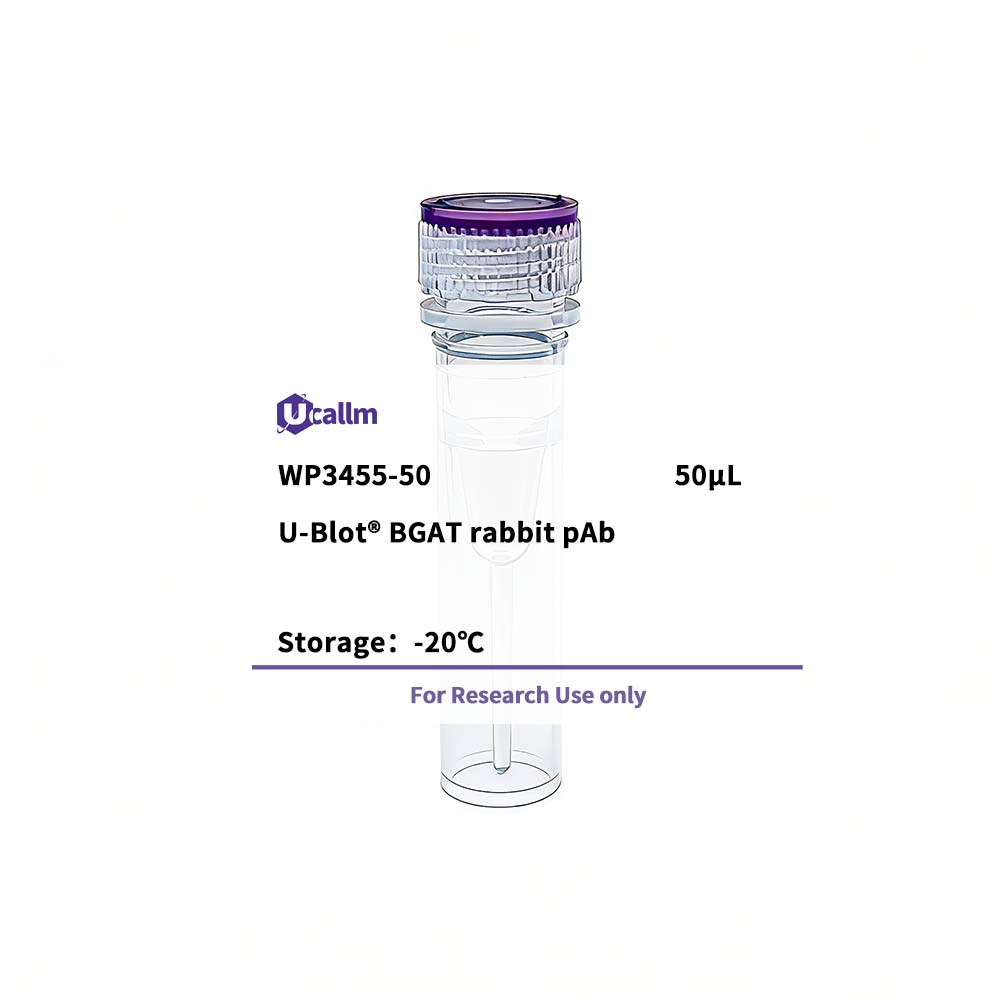
Ucallm_WP3455-50
Price range: $268.00 through $328.00
Product details
Background:
This gene encodes proteins related to the first discovered blood group system, ABO. Which allele is present in an individual determines the blood group. The 'O' blood group is caused by a deletion of guanine-258 near the N-terminus of the protein which results in a frameshift and translation of an almost entirely different protein. Individuals with the A, B, and AB alleles express glycosyltransferase activities that convert the H antigen into the A or B antigen. Other minor alleles have been found for this gene. [provided by RefSeq, Jul 2008],
Specifications
| Size | 50μL/100μL |
| Target | BGAT |
| Reactivity | Human, Mouse |
| Applications | WB |
| MW(Calculated) | |
| MW(Observed) | 38kD |
| Host Species | Rabbit |
| Isotype | IgG |
| Conjugate/Modification | Unmodified |
| Recommended Dilution Ratio | WB 1:500-2000 |
| Formulation | Liquid in PBS containing 50% glycerol, 0.5% BSA and 0.02% sodium azide. |
| Purification | The antibody was affinity-purified from rabbit antiserum by affinity-chromatography using epitope-specific immunogen. |
| Storage | -15°C to -25°C/1 year(Do not lower than -25°C) |
| Concentration | 1 mg/ml |
| Clonality | Polyclonal |
| Clone Number | |
| Immunogen | Synthesized peptide derived from human BGAT AA range: 222-272 |
| Specificity | This antibody detects endogenous levels of BGAT at Human/Mouse |
| Gene Name | ABO |
| Protein Name | BGAT |
| Other Name | Histo-blood group ABO system transferase; / Fucosylglycoprotein 3-alpha-galactosyltransferase; / Fucosylglycoprotein alpha-N-acetylgalactosaminyltransferase; / Glycoprotein-fucosylgalactoside alpha-N-acetylgalactosaminyltransferase; / Glycoprotein-fucosylgalactoside alpha-galactosyltransferase; / Histo-blood group A transferase; / A transferase; / Histo-blood group B transferase; / B transferase; / NAGAT; / [Cleaved into: Fucosylglycoprotein alpha-N-acetylgalactosaminyltransferase soluble form] |
| Species | Human |
| Gene ID | 28 |
| Uniprot | P16442, |
| Species.1 | Mouse |
| Gene ID.1 | 80908 |
| Uniprot.1 | P38649 |
| Species.2 | |
| Gene ID.2 | |
| Uniprot.2 | |
| Cellular Localization | Golgi apparatus, Golgi stack membrane; Single-pass type II membrane protein. Secreted. Membrane-bound form in trans cisternae of Golgi. Secreted into the body fluid. |
| Tissue Expression | Blood,Human adenocarcinoma,PCR rescued clones,Peripheral,Peripheral blood,Peripheral lymphocytes, |
| Signaling_pathway | |
| Research Areas | >>Glycosphingolipid biosynthesis - lacto and neolacto series; / >>Metabolic pathways |
| Function | Catalytic activity:UDP-galactose + alpha-L-fucosyl-(1->2)-D-galactosyl-R = UDP + alpha-D-galactosyl-(1->3)-(alpha-L-fucosyl-(1->2))-D-galactosyl-R.,Catalytic activity:UDP-N-acetyl-D-galactosamine + glycoprotein-alpha-L-fucosyl-(1->2)-D-galactose = UDP + glycoprotein-N-acetyl-alpha-D-galactosaminyl-(1->3)-(alpha-L-fucosyl-(1->2))-D-galactose.,cofactor:Binds 1 manganese ion per subunit.,Domain:The conserved DXD motif is involved in cofactor binding. The manganese ion interacts with the beta-phosphate group of UDP and may also have a role in catalysis.,Function:This protein is the basis of the ABO blood group system. The histo-blood group ABO involves three carbohydrate antigens: A, B, and H. A, B, and AB individuals express a glycosyltransferase activity that converts the H antigen to the A antigen (by addition of UDP-GalNAc) or to the B antigen (by addition of UDP-Gal), whereas O individuals lack such activity.,online information:GlycoGene database,online information:Histo-blood group ABO system transferase,pathway:Protein modification; protein glycosylation.,polymorphism:The sequence shown is that of the A transferase. The B form differs by a few residues substitutions. The O phenotype results from a single base frameshift in the N-terminal extremity of the gene, resulting in a severly truncated protein without catalytic activity.,PTM:The soluble form derives from the membrane form by proteolytic processing.,similarity:Belongs to the glycosyltransferase 6 family.,subcellular location:Membrane-bound form in trans cisternae of Golgi. Secreted into the body fluid., |
Please login to post questions
Related products





