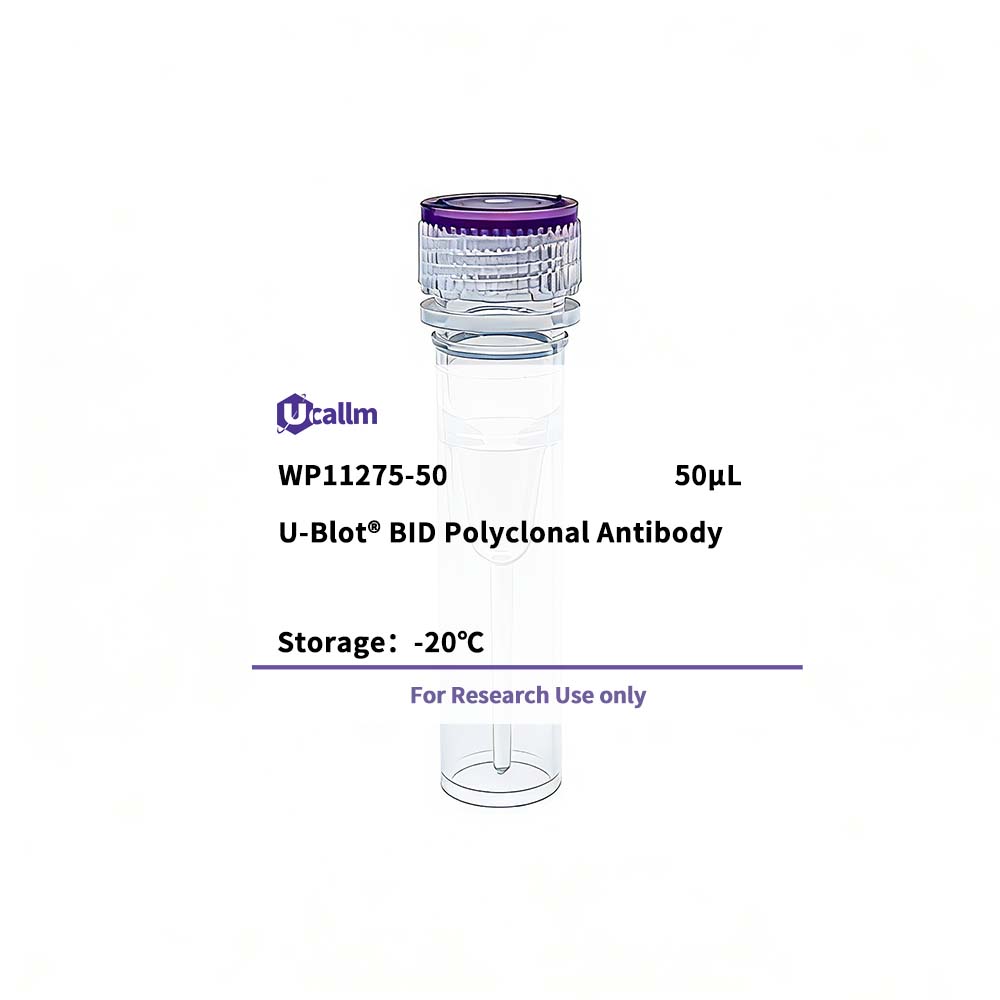
SKU: WP11275 Categories: ,

BID Polyclonal Antibody

Price range: $268.00 through $328.00

SKU: WP11275-100
Enter the quantity you would like, or drag the panel to find the quantity and price that best for you
Bulk QuoteAuthorize OEM & ODM

Product details

Background:

This gene encodes a death agonist that heterodimerizes with either agonist BAX or antagonist BCL2. The encoded protein is a member of the BCL-2 family of cell death regulators. It is a mediator of mitochondrial damage induced by caspase-8 (CASP8); CASP8 cleaves this encoded protein, and the COOH-terminal part translocates to mitochondria where it triggers cytochrome c release. Multiple alternatively spliced transcript variants have been found, but the full-length nature of some variants has not been defined. [provided by RefSeq, Jul 2008],


Specifications

Size50μL/100μL
TargetBID
ReactivityHuman, Mouse, Rat
ApplicationsWB, IHC, IF, ELISA
MW(Calculated)
MW(Observed)25kD
Host SpeciesRabbit
IsotypeIgG
Conjugate/ModificationUnmodified
Recommended Dilution RatioWB 1:500-1:2000; IHC 1:100-1:300; ELISA 1:10000; IF 1:50-200 / Note: For IHC, we suggest antigen retrieval with TE buffer pH 9.0 (Cat#WT1004)
FormulationLiquid in PBS containing 50% glycerol, 0.5% BSA and 0.02% sodium azide.
PurificationThe antibody was affinity-purified from rabbit antiserum by affinity-chromatography using epitope-specific immunogen.
Storage-15°C to -25°C/1 year(Do not lower than -25°C)
Concentration1 mg/ml
ClonalityPolyclonal
Clone Number
ImmunogenThe antiserum was produced against synthesized peptide derived from human BID. AA range:44-93
SpecificityBID Polyclonal Antibody detects endogenous levels of BID protein.
Gene NameBID
Protein NameBH3-interacting domain death agonist
Other NameBID; / BH3-interacting domain death agonist; / p22 BID; / BID
SpeciesHuman
Gene ID637
UniprotP55957,
Species.1Mouse
Gene ID.112122
Uniprot.1P70444,
Species.2Rat
Gene ID.264625
Uniprot.2Q9JLT6
Cellular LocalizationCytoplasm . Mitochondrion membrane . Mitochondrion outer membrane . When uncleaved, it is predominantly cytoplasmic. .; [BH3-interacting domain death agonist p15]: Mitochondrion membrane . Translocates to mitochondria as an integral membrane protein. .; [BH3-interacting domain death agonist p13]: Mitochondrion membrane . Associated with the mitochondrial membrane. .; [Isoform 1]: Cytoplasm .; [Isoform 3]: Cytoplasm .; [Isoform 2]: Mitochondrion membrane . A significant proportion of isoform 2 localizes to mitochondria, it may be cleaved constitutively. .
Tissue Expression[Isoform 2]: Expressed in spleen, pancreas and placenta (at protein level).; [Isoform 3]: Expressed in lung, pancreas and spleen (at protein level).; [Isoform 4]: Expressed in lung and pancreas (at protein level).
Signaling_pathwayCellular Processes >> Cell growth and death >> Apoptosis;Cellular Processes >> Cell growth and death >> Apoptosis - multiple species;Cellular Processes >> Cell growth and death >> Necroptosis;Cellular Processes >> Cell growth and death >> p53 signaling pathway;Organismal Systems >> Immune system >> Natural killer cell mediated cytotoxicity;Human Diseases >> Cancer: overview >> Pathways in cancer;Human Diseases >> Neurodegenerative disease >> Alzheimer disease;Human Diseases >> Neurodegenerative disease >> Amyotrophic lateral sclerosis;Human Diseases >> Neurodegenerative disease >> Pathways of neurodegeneration - multiple diseases;Environmental Information Processing >> Signal transduction >> Sphingolipid signaling pathway
Research Areas>>Platinum drug resistance; / >>Sphingolipid signaling pathway; / >>p53 signaling pathway; / >>Apoptosis; / >>Apoptosis - multiple species; / >>Necroptosis; / >>Natural killer cell mediated cytotoxicity; / >>Non-alcoholic fatty liver disease; / >>Alzheimer disease; / >>Amyotrophic lateral sclerosis; / >>Pathways of neurodegeneration - multiple diseases; / >>Tuberculosis; / >>Hepatitis C; / >>Hepatitis B; / >>Measles; / >>Human cytomegalovirus infection; / >>Influenza A; / >>Kaposi sarcoma-associated herpesvirus infection; / >>Herpes simplex virus 1 infection; / >>Epstein-Barr virus infection; / >>Human immunodeficiency virus 1 infection; / >>Pathways in cancer; / >>Viral myocarditis; / >>Lipid and atherosclerosis
FunctionDomain:Intact BH3 motif is required by BIK, BID, BAK, BAD and BAX for their pro-apoptotic activity and for their interaction with anti-apoptotic members of the Bcl-2 family.,Function:The major proteolytic product p15 BID allows the release of cytochrome c (By similarity). Isoform 1, isoform 2 and isoform 4 induce ICE-like proteases and apoptosis. Isoform 3 does not induce apoptosis. Counters the protective effect of Bcl-2.,PTM:Phosphorylated upon DNA damage, probably by ATM or ATR.,PTM:TNF-alpha induces a caspase-mediated cleavage of p22 BID into a major p15 and minor p13 and p11 products.,subcellular location:A significant proportion of isoform 2 localizes to mitochondria, it may be cleaved constitutively.,subcellular location:Associated with the mitochondrial membrane.,subcellular location:Translocates to mitochondria as an integral membrane protein.,subcellular location:When uncleaved, it is predominantly cytoplasmic.,subunit:Forms heterodimers either with the pro-apoptotic protein BAX or the anti-apoptotic protein Bcl-2.,tissue specificity:Isoforms 2 and 3 are expressed in spleen, bone marrow, cerebral and cerebellar cortex. Isoform 2 is expressed in spleen, pancreas and placenta (at protein level). Isoform 3 is expressed in lung, pancreas and spleen (at protein level). Isoform 4 is expressed in lung and pancreas (at protein level).,
Please login to post questions
Back to Top
Product has been added to your cart

