SKU: WR4476 Categories: ,

U-Blot® BMAL1 Rabbit mAb

Price range: $268.00 through $328.00

SKU: WR4476-50
Enter the quantity you would like, or drag the panel to find the quantity and price that best for you
Bulk QuoteAuthorize OEM & ODM

Product details

Background:The protein encoded by this gene is a basic helix-loop-helix protein that forms a heterodimer with CLOCK. This heterodimer binds E-box enhancer elements upstream of Period (PER1, PER2, PER3) and Cryptochrome (CRY1, CRY2) genes and activates transcription of these genes. PER and CRY proteins heterodimerize and repress their own transcription by interacting in a feedback loop with CLOCK/ARNTL complexes. Defects in this gene have been linked to infertility, problems with gluconeogenesis and lipogenesis, and altered sleep patterns. Several transcript variants encoding different isoforms have been found for this gene. [provided by RefSeq, Jul 2014],

Specifications

Size50μL/100μL
TargetBMAL1
ReactivityHuman, Mouse, Rat
ApplicationsWB, IHC, IF, IP, ELISA
MW(Calculated)69kD
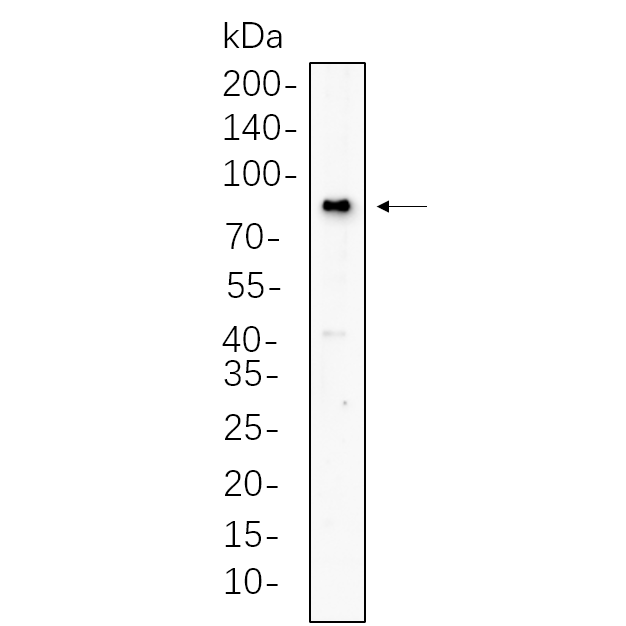
MW(Observed)78kD
Host SpeciesRabbit
IsotypeIgG,Kappa
Conjugate/ModificationUnmodified
Recommended Dilution RatioIHC 1:200-1:1000; WB 1:2000-1:10000; IF 1:200-1:1000; ELISA 1:5000-1:20000; IP 1:50-1:200; / Note: For IHC, we suggest antigen retrieval with TE buffer pH 9.0 (Cat#WT1004)
FormulationPBS, 50% glycerol, 0.05% Proclin 300, 0.05%BSA
PurificationRecombinant Antibody expressed in animal component-free (ACF) media, purified via Protein A affinity chromatography.
Storage-15°C to -25°C/1 year(Do not lower than -25°C)
Concentration
ClonalityMonoclonal
Clone NumberRM0696R
ImmunogenThe specific immunogen used to produce this antibody is proprietary information.
SpecificityEndogenous
Gene NameARNTL
Protein NameAryl hydrocarbon receptor nuclear translocator-like protein 1
Other NameARNTL; / BHLHE5; / BMAL1; / MOP3; / PASD3; / Aryl hydrocarbon receptor nuclear translocator-like protein 1; / Basic-helix-loop-helix-PAS protein MOP3; / Brain and muscle ARNT-like 1Class E basic helix-loop-helix protein 5; / bHLHe5; / Member of PAS protein 3; / PAS domain-containing protein 3; / bHLH-PAS protein JAP3
SpeciesHuman
Gene ID406
UniprotO00327,
Species.1Mouse
Gene ID.111865
Uniprot.1Q9WTL8,
Species.2Rat
Gene ID.229657
Uniprot.2Q9EPW1
Cellular LocalizationNucleus
Tissue ExpressionHair follicles (at protein level). Highly expressed in the adult brain, skeletal muscle and heart.
Signaling_pathwayOrganismal Systems >> Nervous system >> Dopaminergic synapse;Organismal Systems >> Environmental adaptation >> Circadian rhythm
Research Areas>>Circadian rhythm; / >>Dopaminergic synapse
FunctionAlternative products:Additional isoforms seem to exist,Function:ARNTL-CLOCK heterodimers activate E-box element (3'-CACGTG-5') transcription of a number of proteins of the circadian clock. This transcription is inhibited in a feedback loop by PER, and also by CRY proteins.,miscellaneous:CLOCK-ARNTL double mutations within the PAS domains result in syngernistic desensitization to high levels of CRY on repression of CLOCK-ARNTL transcriptional activity of PER1 and, disrupt circadian rhythmicity.,PTM:Acetylated on Lys-538 upon dimerization with CLOCK. Acetylation facilitates CRY1-mediated repression.,PTM:Phosphorylated upon dimerization with CLOCK.,PTM:Sumoylated on Lys-259 upon dimerization with CLOCK.,similarity:Contains 1 basic helix-loop-helix (bHLH) domain.,similarity:Contains 1 PAC (PAS-associated C-terminal) domain.,similarity:Contains 2 PAS (PER-ARNT-SIM) domains.,subunit:Component of the circadian clock oscillator which includes the CRY proteins, CLOCK or NPAS2, ARNTL or ARNTL2, CSNK1D and/or CSNK1E, TIMELESS and the PER proteins. Efficient DNA binding requires dimerization with another bHLH protein. Heterodimerization with CLOCK is required for E-box-dependent transactivation, for CLOCK nuclear translocation and degradation, and, for phosphorylation of both CLOCK and ARNTL. Interaction with PER and CRY proteins requires translocation to the nucleus. Interaction of the CLOCK-ARNTL heterodimer with PER or CRY inhibits transcription activation. Interacts with HSP90; with AHR in vitro, but not in vivo.,tissue specificity:Highly expressed in the adult brain, skeletal muscle and heart.,
Please login to post questions

Back to Top
Product has been added to your cart

