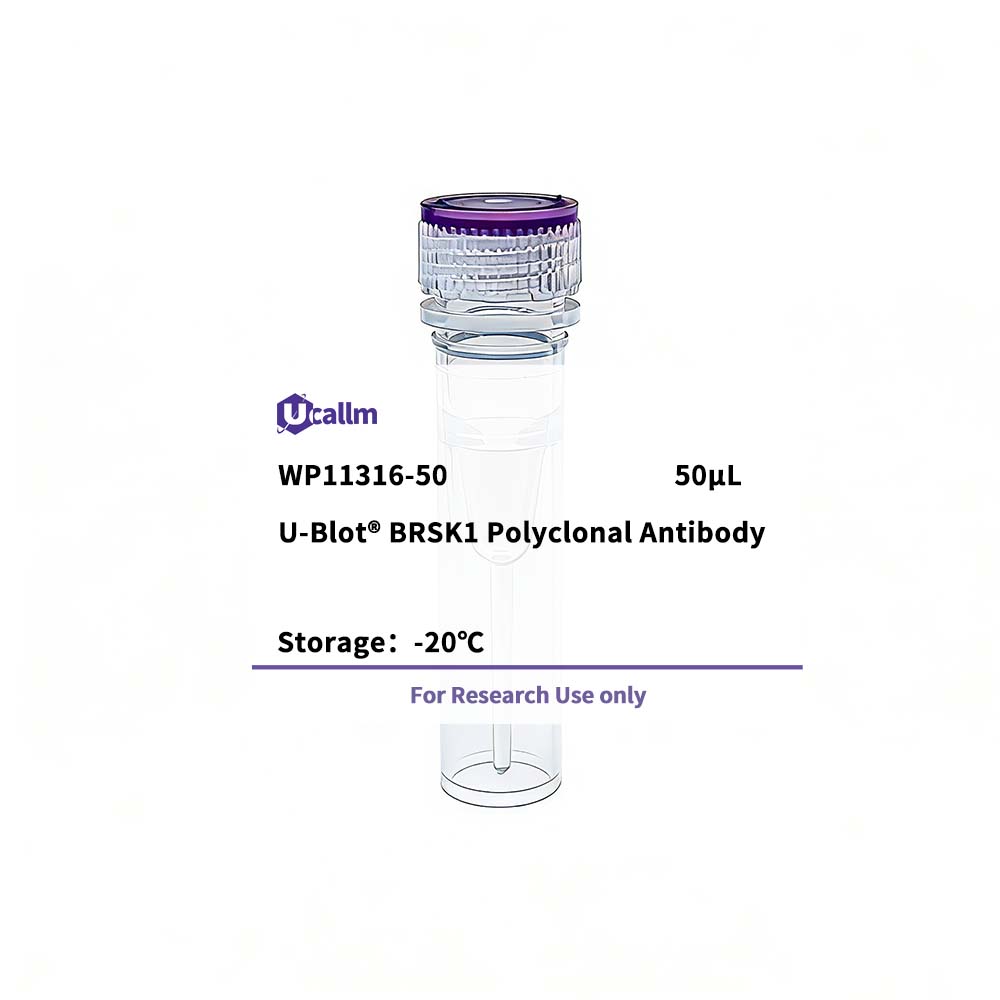
SKU: WP11316 Categories: ,

BRSK1 Polyclonal Antibody

Price range: $268.00 through $328.00

SKU: WP11316-100
Enter the quantity you would like, or drag the panel to find the quantity and price that best for you
Bulk QuoteAuthorize OEM & ODM

Product details

Background:

catalytic activity:ATP + a protein = ADP + a phosphoprotein., cofactor:Magnesium., enzyme regulation:Activated by phosphorylation on Thr-205 by STK11 in complex with STE20-related adapter-alpha (STRAD alpha) pseudo kinase and CAB39., function:Required for the polarization of forebrain neurons which endows axons and dendrites with distinct properties, possibly by locally regulating phosphorylation of microtubule-associated proteins (By similarity). May be involved in the regulation of G2/M arrest in response to UV- or methyl methane sulfonate (MMS)-induced, but not IR-induced, DNA damage. Phosphorylates WEE1 and CDC25B in vitro and CDC25C in vitro and in vivo., similarity:Belongs to the protein kinase superfamily. CAMK Ser/Thr protein kinase family. AMPK subfamily., similarity:Contains 1 protein kinase domain., similarity:Contains 1 UBA domain., subcellular location:Nuclear in the absence of DNA damage. Translocated to the nucleus in response to UV- or MMS-induced DNA damage., tissue specificity:Widely expressed, with highest levels in brain and testis. Protein levels remain constant throughout the cell cycle.,

Specifications

Size50μL/100μL
TargetBRSK1
ReactivityHuman, Mouse
ApplicationsWB, IF, ELISA
MW(Calculated)
MW(Observed)87kD
Host SpeciesRabbit
IsotypeIgG
Conjugate/ModificationUnmodified
Recommended Dilution RatioWB 1:500-1:2000; IF 1:200-1:1000; ELISA 1:5000; Not yet tested in other applications.
FormulationLiquid in PBS containing 50% glycerol, 0.5% BSA and 0.02% sodium azide.
PurificationThe antibody was affinity-purified from rabbit antiserum by affinity-chromatography using epitope-specific immunogen.
Storage-15°C to -25°C/1 year(Do not lower than -25°C)
Concentration1 mg/ml
ClonalityPolyclonal
Clone Number
ImmunogenThe antiserum was produced against synthesized peptide derived from human BRSK1. AA range:361-410
SpecificityBRSK1 Polyclonal Antibody detects endogenous levels of BRSK1 protein.
Gene NameBRSK1
Protein NameSerine/threonine-protein kinase BRSK1
Other NameBRSK1; / KIAA1811; / SAD1; / SADB; / Serine/threonine-protein kinase BRSK1; / Brain-selective kinase 1; / Brain-specific serine/threonine-protein kinase 1; / BR serine/threonine-protein kinase 1; / Serine/threonine-protein kinase SAD-B; / Synapses of Amphids Defective homolog 1; / SAD1 homolog; / hSAD1
SpeciesHuman
Gene ID84446
UniprotQ8TDC3,
Species.1Mouse
Gene ID.1381979
Uniprot.1Q5RJI5
Species.2
Gene ID.2
Uniprot.2
Cellular LocalizationCytoplasm . Nucleus . Cytoplasm, cytoskeleton, microtubule organizing center, centrosome . Cell junction, synapse . Cell junction, synapse, presynaptic active zone . Cytoplasmic vesicle, secretory vesicle, synaptic vesicle . Nuclear in the absence of DNA damage. Translocated to the nucleus in response to UV- or MMS-induced DNA damage (By similarity). .
Tissue ExpressionWidely expressed, with highest levels in brain and testis. Protein levels remain constant throughout the cell cycle.
Signaling_pathway
Research Areas
FunctionCatalytic activity:ATP + a protein = ADP + a phosphoprotein.,cofactor:Magnesium.,enzyme regulation:Activated by phosphorylation on Thr-205 by STK11 in complex with STE20-related adapter-alpha (STRAD alpha) pseudo kinase and CAB39.,Function:Required for the polarization of forebrain neurons which endows axons and dendrites with distinct properties, possibly by locally regulating phosphorylation of microtubule-associated proteins (By similarity). May be involved in the regulation of G2/M arrest in response to UV- or methyl methane sulfonate (MMS)-induced, but not IR-induced, DNA damage. Phosphorylates WEE1 and CDC25B in vitro and CDC25C in vitro and in vivo.,similarity:Belongs to the protein kinase superfamily. CAMK Ser/Thr protein kinase family. AMPK subfamily.,similarity:Contains 1 protein kinase domain.,similarity:Contains 1 UBA domain.,subcellular location:Nuclear in the absence of DNA damage. Translocated to the nucleus in response to UV- or MMS-induced DNA damage.,tissue specificity:Widely expressed, with highest levels in brain and testis. Protein levels remain constant throughout the cell cycle.,
Please login to post questions
Back to Top
Product has been added to your cart
