

BRSK1 Polyclonal Antibody
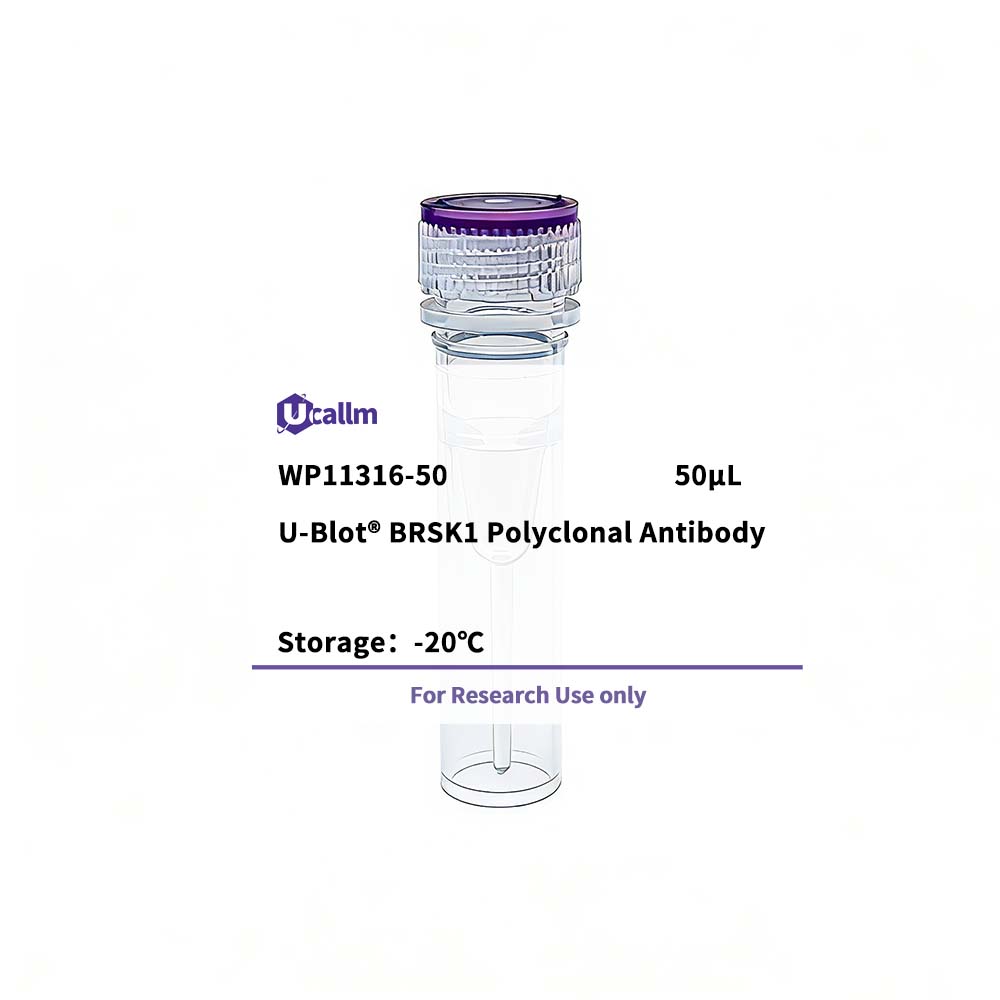
Ucallm_WP11316-50
Price range: $268.00 through $328.00
Product details
Background:
catalytic activity:ATP + a protein = ADP + a phosphoprotein., cofactor:Magnesium., enzyme regulation:Activated by phosphorylation on Thr-205 by STK11 in complex with STE20-related adapter-alpha (STRAD alpha) pseudo kinase and CAB39., function:Required for the polarization of forebrain neurons which endows axons and dendrites with distinct properties, possibly by locally regulating phosphorylation of microtubule-associated proteins (By similarity). May be involved in the regulation of G2/M arrest in response to UV- or methyl methane sulfonate (MMS)-induced, but not IR-induced, DNA damage. Phosphorylates WEE1 and CDC25B in vitro and CDC25C in vitro and in vivo., similarity:Belongs to the protein kinase superfamily. CAMK Ser/Thr protein kinase family. AMPK subfamily., similarity:Contains 1 protein kinase domain., similarity:Contains 1 UBA domain., subcellular location:Nuclear in the absence of DNA damage. Translocated to the nucleus in response to UV- or MMS-induced DNA damage., tissue specificity:Widely expressed, with highest levels in brain and testis. Protein levels remain constant throughout the cell cycle.,
Specifications
| Size | 50μL/100μL |
| Target | BRSK1 |
| Reactivity | Human, Mouse |
| Applications | WB, IF, ELISA |
| MW(Calculated) | |
| MW(Observed) | 87kD |
| Host Species | Rabbit |
| Isotype | IgG |
| Conjugate/Modification | Unmodified |
| Recommended Dilution Ratio | WB 1:500-1:2000; IF 1:200-1:1000; ELISA 1:5000; Not yet tested in other applications. |
| Formulation | Liquid in PBS containing 50% glycerol, 0.5% BSA and 0.02% sodium azide. |
| Purification | The antibody was affinity-purified from rabbit antiserum by affinity-chromatography using epitope-specific immunogen. |
| Storage | -15°C to -25°C/1 year(Do not lower than -25°C) |
| Concentration | 1 mg/ml |
| Clonality | Polyclonal |
| Clone Number | |
| Immunogen | The antiserum was produced against synthesized peptide derived from human BRSK1. AA range:361-410 |
| Specificity | BRSK1 Polyclonal Antibody detects endogenous levels of BRSK1 protein. |
| Gene Name | BRSK1 |
| Protein Name | Serine/threonine-protein kinase BRSK1 |
| Other Name | BRSK1; / KIAA1811; / SAD1; / SADB; / Serine/threonine-protein kinase BRSK1; / Brain-selective kinase 1; / Brain-specific serine/threonine-protein kinase 1; / BR serine/threonine-protein kinase 1; / Serine/threonine-protein kinase SAD-B; / Synapses of Amphids Defective homolog 1; / SAD1 homolog; / hSAD1 |
| Species | Human |
| Gene ID | 84446 |
| Uniprot | Q8TDC3, |
| Species.1 | Mouse |
| Gene ID.1 | 381979 |
| Uniprot.1 | Q5RJI5 |
| Species.2 | |
| Gene ID.2 | |
| Uniprot.2 | |
| Cellular Localization | Cytoplasm . Nucleus . Cytoplasm, cytoskeleton, microtubule organizing center, centrosome . Cell junction, synapse . Cell junction, synapse, presynaptic active zone . Cytoplasmic vesicle, secretory vesicle, synaptic vesicle . Nuclear in the absence of DNA damage. Translocated to the nucleus in response to UV- or MMS-induced DNA damage (By similarity). . |
| Tissue Expression | Widely expressed, with highest levels in brain and testis. Protein levels remain constant throughout the cell cycle. |
| Signaling_pathway | |
| Research Areas | |
| Function | Catalytic activity:ATP + a protein = ADP + a phosphoprotein.,cofactor:Magnesium.,enzyme regulation:Activated by phosphorylation on Thr-205 by STK11 in complex with STE20-related adapter-alpha (STRAD alpha) pseudo kinase and CAB39.,Function:Required for the polarization of forebrain neurons which endows axons and dendrites with distinct properties, possibly by locally regulating phosphorylation of microtubule-associated proteins (By similarity). May be involved in the regulation of G2/M arrest in response to UV- or methyl methane sulfonate (MMS)-induced, but not IR-induced, DNA damage. Phosphorylates WEE1 and CDC25B in vitro and CDC25C in vitro and in vivo.,similarity:Belongs to the protein kinase superfamily. CAMK Ser/Thr protein kinase family. AMPK subfamily.,similarity:Contains 1 protein kinase domain.,similarity:Contains 1 UBA domain.,subcellular location:Nuclear in the absence of DNA damage. Translocated to the nucleus in response to UV- or MMS-induced DNA damage.,tissue specificity:Widely expressed, with highest levels in brain and testis. Protein levels remain constant throughout the cell cycle., |
Please login to post questions
Related products





