SKU: WP11603 Categories: ,

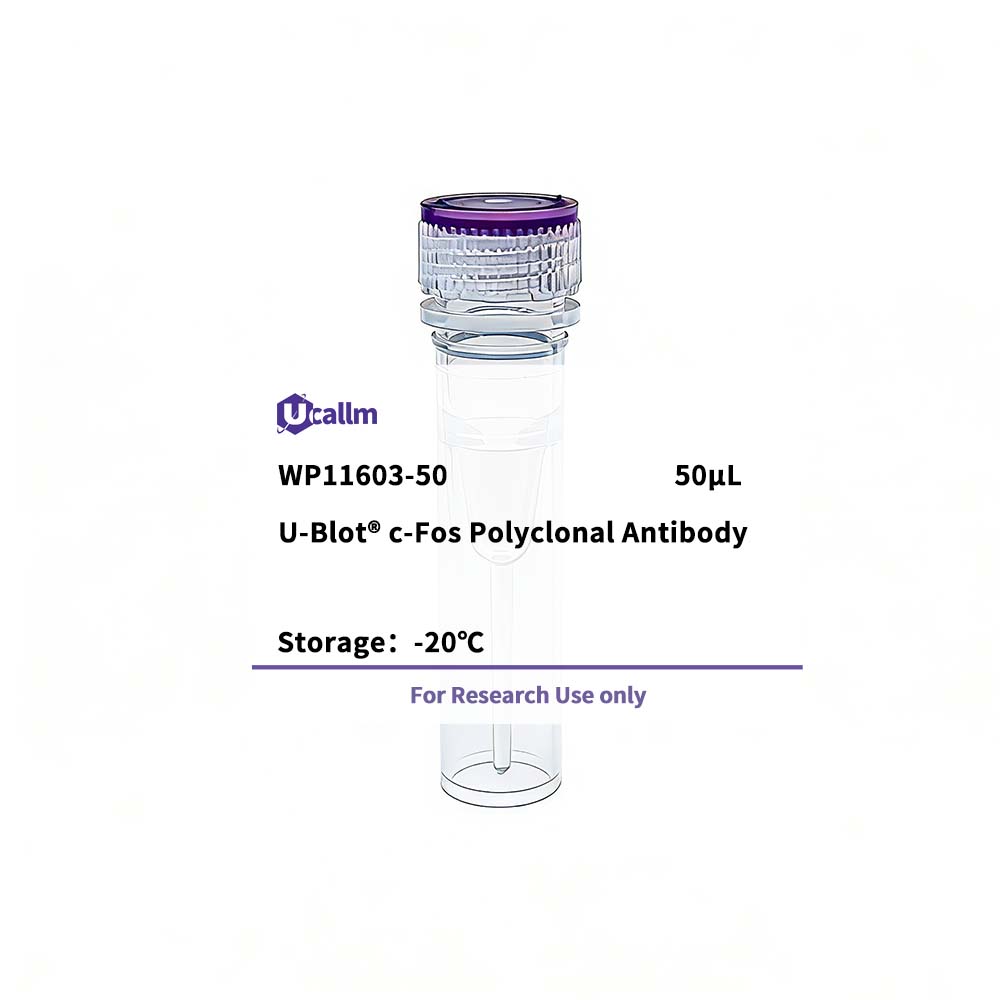
c-Fos Polyclonal Antibody

Price range: $268.00 through $328.00

SKU: WP11603-100
Enter the quantity you would like, or drag the panel to find the quantity and price that best for you
Bulk QuoteAuthorize OEM & ODM

Product details

Background:

The Fos gene family consists of 4 members: FOS, FOSB, FOSL1, and FOSL2. These genes encode leucine zipper proteins that can dimerize with proteins of the JUN family, thereby forming the transcription factor complex AP-1. As such, the FOS proteins have been implicated as regulators of cell proliferation, differentiation, and transformation. In some cases, expression of the FOS gene has also been associated with apoptotic cell death. [provided by RefSeq, Jul 2008],


Specifications

Size50μL/100μL
Targetc-Fos
ReactivityHuman, Mouse, Rat
ApplicationsWB, IHC, IF, ELISA
MW(Calculated)
MW(Observed)62kD
Host SpeciesRabbit
IsotypeIgG
Conjugate/ModificationUnmodified
Recommended Dilution RatioWB 1:500-1:2000; IHC 1:100-1:300; ELISA 1:10000; IF 1:50-200 / Note: For IHC, we suggest antigen retrieval with TE buffer pH 9.0 (Cat#WT1004)
FormulationLiquid in PBS containing 50% glycerol, 0.5% BSA and 0.02% sodium azide.
PurificationThe antibody was affinity-purified from rabbit antiserum by affinity-chromatography using epitope-specific immunogen.
Storage-15°C to -25°C/1 year(Do not lower than -25°C)
Concentration1 mg/ml
ClonalityPolyclonal
Clone Number
ImmunogenThe antiserum was produced against synthesized peptide derived from human Fos. AA range:1-50
Specificityc-Fos Polyclonal Antibody detects endogenous levels of c-Fos protein.
Gene NameFOS
Protein NameProto-oncogene c-Fos
Other NameFOS; / G0S7; / Proto-oncogene c-Fos; / Cellular oncogene fos; / G0/G1 switch regulatory protein 7
SpeciesHuman
Gene ID2353
UniprotP01100,
Species.1Mouse
Gene ID.114281
Uniprot.1P01101,
Species.2Rat
Gene ID.2140675
Uniprot.2P12841
Cellular LocalizationNucleus. Endoplasmic reticulum. Cytoplasm, cytosol. In quiescent cells, present in very small amounts in the cytosol. Following induction of cell growth, first localizes to the endoplasmic reticulum and only later to the nucleus. Localization at the endoplasmic reticulum requires dephosphorylation at Tyr-10 and Tyr-30.
Tissue ExpressionLung adenocarcinoma,Pancreas,Tongue,
Signaling_pathwayCellular Processes >> Cell growth and death >> Apoptosis;Organismal Systems >> Immune system >> Toll-like receptor signaling pathway;Organismal Systems >> Immune system >> T cell receptor signaling pathway;Organismal Systems >> Immune system >> Th1 and Th2 cell differentiation;Organismal Systems >> Immune system >> Th17 cell differentiation;Organismal Systems >> Immune system >> IL-17 signaling pathway;Organismal Systems >> Immune system >> B cell receptor signaling pathway;Organismal Systems >> Endocrine system >> Estrogen signaling pathway;Organismal Systems >> Endocrine system >> Prolactin signaling pathway;Organismal Systems >> Endocrine system >> Oxytocin signaling pathway;Organismal Systems >> Endocrine system >> Relaxin signaling pathway;Organismal Systems >> Endocrine system >> Growth hormone synthesis, secretion and action;Organismal Systems >> Nervous system >> Cholinergic synapse;Organismal Systems >> Nervous system >> Dopaminergic synapse;Organismal Systems >> Development and regeneration >> Osteoclast differentiation;Human Diseases >> Cancer: overview >> Pathways in cancer;Human Diseases >> Cancer: overview >> PD-L1 expression and PD-1 checkpoint pathway in cancer;Human Diseases >> Cancer: specific types >> Colorectal cancer;Human Diseases >> Cancer: specific types >> Breast cancer;Human Diseases >> Immune disease >> Rheumatoid arthritis;Environmental Information Processing >> Signal transduction >> MAPK signaling pathway;Environmental Information Processing >> Signal transduction >> TNF signaling pathway;Environmental Information Processing >> Signal transduction >> cAMP signaling pathway
Research Areas>>Endocrine resistance; / >>MAPK signaling pathway; / >>cAMP signaling pathway; / >>Apoptosis; / >>Osteoclast differentiation; / >>Toll-like receptor signaling pathway; / >>IL-17 signaling pathway; / >>Th1 and Th2 cell differentiation; / >>Th17 cell differentiation; / >>T cell receptor signaling pathway; / >>B cell receptor signaling pathway; / >>TNF signaling pathway; / >>Circadian entrainment; / >>Cholinergic synapse; / >>Dopaminergic synapse; / >>Estrogen signaling pathway; / >>Prolactin signaling pathway; / >>Oxytocin signaling pathway; / >>Relaxin signaling pathway; / >>Parathyroid hormone synthesis, secretion and action; / >>Non-alcoholic fatty liver disease; / >>Growth hormone synthesis, secretion and action; / >>Amphetamine addiction; / >>Pathogenic Escherichia coli infection; / >>Salmonella infection; / >>Pertussis; / >>Yersinia infection; / >>Leishmaniasis; / >>Chagas disease; / >>Hepatitis B; / >>Measles; / >>Human T-cell leukemia virus 1 infection; / >>Kaposi sarcoma-associated herpesvirus infection; / >>Human immunodeficiency virus 1 infection; / >>Coronavirus disease - COVID-19; / >>Pathways in cancer; / >>Chemical carcinogenesis - receptor activation; / >>Chemical carcinogenesis - reactive oxygen species; / >>Colorectal cancer; / >>Breast cancer; / >>Choline metabolism in cancer; / >>PD-L1 expression and PD-1 checkpoint pathway in cancer; / >>Rheumatoid arthritis; / >>Lipid and atherosclerosis; / >>Fluid shear stress and atherosclerosis
FunctionFunction:Nuclear phosphoprotein which forms a tight but non-covalently linked complex with the JUN/AP-1 transcription factor. In the heterodimer, c-fos and JUN/AP-1 basic regions each seems to interact with symmetrical DNA half sites. Has a critical function in regulating the development of cells destined to form and maintain the skeleton. It is thought to have an important role in signal transduction, cell proliferation and differentiation.,PTM:Constitutively sumoylated by SUMO1, SUMO2 and SUMO3. Desumoylated by SENP2. Sumoylation requires heterodimerization with JUN and is enhanced by mitogen stimulation. Sumoylation inhibits the AP-1 transcriptional activity and is, itself, inhibited by Ras-activated phosphorylation on Thr-232.,PTM:Phosphorylated in the C-terminal upon stimulation by nerve growth factor (NGF) and epidermal growth factor (EGF). Phosphorylated, in vitro, by MAPK and RSK1. Phosphorylation on both Ser-362 and Ser-374 by MAPK1/2 and RSK1/2 leads to protein stabilization with phosphorylation on Ser-374 being the major site for protein stabilization on NGF stimulation. Phosphorylation on Ser-362 and Ser-374 primes further phosphorylations on Thr-325 and Thr-331 through promoting docking of MAPK to the DEF domain. Phosphorylation on Thr-232, induced by HA-RAS, activates the transcriptional activity and antagonizes sumoylation. Phosphorylation on Ser-362 by RSK2 in osteoblasts contributes to osteoblast transformation.,similarity:Belongs to the bZIP family.,similarity:Belongs to the bZIP family. Fos subfamily.,similarity:Contains 1 bZIP domain.,subunit:Heterodimer with JUN. Interacts with DSIPI; this interaction inhibits the binding of active AP1 to its target DNA. Interacts with MAFB.,
Please login to post questions
Back to Top
Product has been added to your cart
