


U-Blot® c-Fos Rabbit mAb
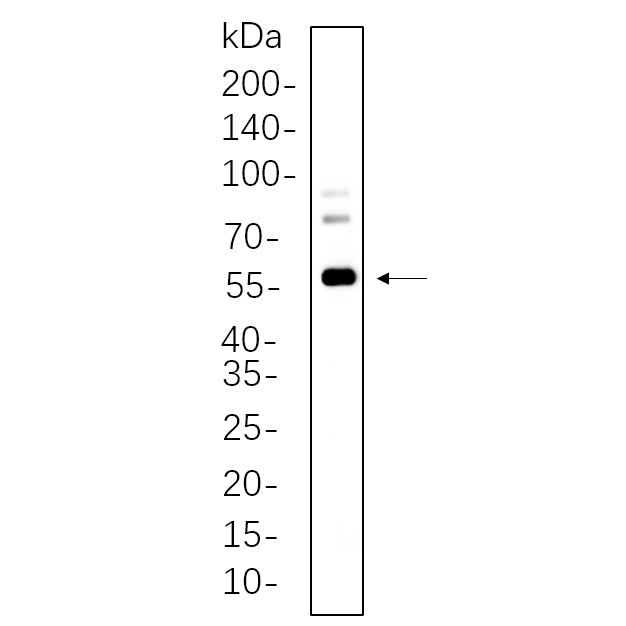
WR4263 Hela-TPA cell lysates were separated by 4-20% SDS-PAGE, and the membrane was blotted with primary antibody 1:1000. The HRP-conjugated Goat anti-Rabbit IgG(H + L) antibody was used to detect the antibody.
Price range: $268.00 through $328.00
Product details
Background:The Fos gene family consists of 4 members: FOS, FOSB, FOSL1, and FOSL2. These genes encode leucine zipper proteins that can dimerize with proteins of the JUN family, thereby forming the transcription factor complex AP-1. As such, the FOS proteins have been implicated as regulators of cell proliferation, differentiation, and transformation. In some cases, expression of the FOS gene has also been associated with apoptotic cell death. [provided by RefSeq, Jul 2008],
Specifications
| Size | 50μL/100μL |
| Target | c-Fos |
| Reactivity | Human, Mouse, Rat |
| Applications | WB, IF, IP, ELISA |
| MW(Calculated) | 41kD |
| MW(Observed) | 55kD |
| Host Species | Rabbit |
| Isotype | IgG,Kappa |
| Conjugate/Modification | Unmodified |
| Recommended Dilution Ratio | WB 1:2000-1:10000; IF 1:200-1:1000; ELISA 1:5000-1:20000; IP 1:50-1:200; |
| Formulation | PBS, 50% glycerol, 0.05% Proclin 300, 0.05%BSA |
| Purification | Recombinant Antibody expressed in animal component-free (ACF) media, purified via Protein A affinity chromatography. |
| Storage | -15°C to -25°C/1 year(Do not lower than -25°C) |
| Concentration | |
| Clonality | Monoclonal |
| Clone Number | RM0451R |
| Immunogen | The specific immunogen used to produce this antibody is proprietary information. |
| Specificity | Endogenous |
| Gene Name | FOS |
| Protein Name | Proto-oncogene c-Fos |
| Other Name | FOS; / G0S7; / Proto-oncogene c-Fos; / Cellular oncogene fos; / G0/G1 switch regulatory protein 7 |
| Species | Human |
| Gene ID | 2353 |
| Uniprot | P01100, |
| Species.1 | Mouse |
| Gene ID.1 | 14281 |
| Uniprot.1 | P01101, |
| Species.2 | Rat |
| Gene ID.2 | 140675 |
| Uniprot.2 | P12841 |
| Cellular Localization | Nucleus |
| Tissue Expression | Lung adenocarcinoma,Pancreas,Tongue, |
| Signaling_pathway | Cellular Processes >> Cell growth and death >> Apoptosis;Organismal Systems >> Immune system >> Toll-like receptor signaling pathway;Organismal Systems >> Immune system >> T cell receptor signaling pathway;Organismal Systems >> Immune system >> Th1 and Th2 cell differentiation;Organismal Systems >> Immune system >> Th17 cell differentiation;Organismal Systems >> Immune system >> IL-17 signaling pathway;Organismal Systems >> Immune system >> B cell receptor signaling pathway;Organismal Systems >> Endocrine system >> Estrogen signaling pathway;Organismal Systems >> Endocrine system >> Prolactin signaling pathway;Organismal Systems >> Endocrine system >> Oxytocin signaling pathway;Organismal Systems >> Endocrine system >> Relaxin signaling pathway;Organismal Systems >> Endocrine system >> Growth hormone synthesis, secretion and action;Organismal Systems >> Nervous system >> Cholinergic synapse;Organismal Systems >> Nervous system >> Dopaminergic synapse;Organismal Systems >> Development and regeneration >> Osteoclast differentiation;Human Diseases >> Cancer: overview >> Pathways in cancer;Human Diseases >> Cancer: overview >> PD-L1 expression and PD-1 checkpoint pathway in cancer;Human Diseases >> Cancer: specific types >> Colorectal cancer;Human Diseases >> Cancer: specific types >> Breast cancer;Human Diseases >> Immune disease >> Rheumatoid arthritis;Environmental Information Processing >> Signal transduction >> MAPK signaling pathway;Environmental Information Processing >> Signal transduction >> TNF signaling pathway;Environmental Information Processing >> Signal transduction >> cAMP signaling pathway |
| Research Areas | >>Endocrine resistance; / >>MAPK signaling pathway; / >>cAMP signaling pathway; / >>Apoptosis; / >>Osteoclast differentiation; / >>Toll-like receptor signaling pathway; / >>IL-17 signaling pathway; / >>Th1 and Th2 cell differentiation; / >>Th17 cell differentiation; / >>T cell receptor signaling pathway; / >>B cell receptor signaling pathway; / >>TNF signaling pathway; / >>Circadian entrainment; / >>Cholinergic synapse; / >>Dopaminergic synapse; / >>Estrogen signaling pathway; / >>Prolactin signaling pathway; / >>Oxytocin signaling pathway; / >>Relaxin signaling pathway; / >>Parathyroid hormone synthesis, secretion and action; / >>Non-alcoholic fatty liver disease; / >>Growth hormone synthesis, secretion and action; / >>Amphetamine addiction; / >>Pathogenic Escherichia coli infection; / >>Salmonella infection; / >>Pertussis; / >>Yersinia infection; / >>Leishmaniasis; / >>Chagas disease; / >>Hepatitis B; / >>Measles; / >>Human T-cell leukemia virus 1 infection; / >>Kaposi sarcoma-associated herpesvirus infection; / >>Human immunodeficiency virus 1 infection; / >>Coronavirus disease - COVID-19; / >>Pathways in cancer; / >>Chemical carcinogenesis - receptor activation; / >>Chemical carcinogenesis - reactive oxygen species; / >>Colorectal cancer; / >>Breast cancer; / >>Choline metabolism in cancer; / >>PD-L1 expression and PD-1 checkpoint pathway in cancer; / >>Rheumatoid arthritis; / >>Lipid and atherosclerosis; / >>Fluid shear stress and atherosclerosis |
| Function | Function:Nuclear phosphoprotein which forms a tight but non-covalently linked complex with the JUN/AP-1 transcription factor. In the heterodimer, c-fos and JUN/AP-1 basic regions each seems to interact with symmetrical DNA half sites. Has a critical function in regulating the development of cells destined to form and maintain the skeleton. It is thought to have an important role in signal transduction, cell proliferation and differentiation.,PTM:Constitutively sumoylated by SUMO1, SUMO2 and SUMO3. Desumoylated by SENP2. Sumoylation requires heterodimerization with JUN and is enhanced by mitogen stimulation. Sumoylation inhibits the AP-1 transcriptional activity and is, itself, inhibited by Ras-activated phosphorylation on Thr-232.,PTM:Phosphorylated in the C-terminal upon stimulation by nerve growth factor (NGF) and epidermal growth factor (EGF). Phosphorylated, in vitro, by MAPK and RSK1. Phosphorylation on both Ser-362 and Ser-374 by MAPK1/2 and RSK1/2 leads to protein stabilization with phosphorylation on Ser-374 being the major site for protein stabilization on NGF stimulation. Phosphorylation on Ser-362 and Ser-374 primes further phosphorylations on Thr-325 and Thr-331 through promoting docking of MAPK to the DEF domain. Phosphorylation on Thr-232, induced by HA-RAS, activates the transcriptional activity and antagonizes sumoylation. Phosphorylation on Ser-362 by RSK2 in osteoblasts contributes to osteoblast transformation.,similarity:Belongs to the bZIP family.,similarity:Belongs to the bZIP family. Fos subfamily.,similarity:Contains 1 bZIP domain.,subunit:Heterodimer with JUN. Interacts with DSIPI; this interaction inhibits the binding of active AP1 to its target DNA. Interacts with MAFB., |
Please login to post questions
Related products





