

Product details
Background:
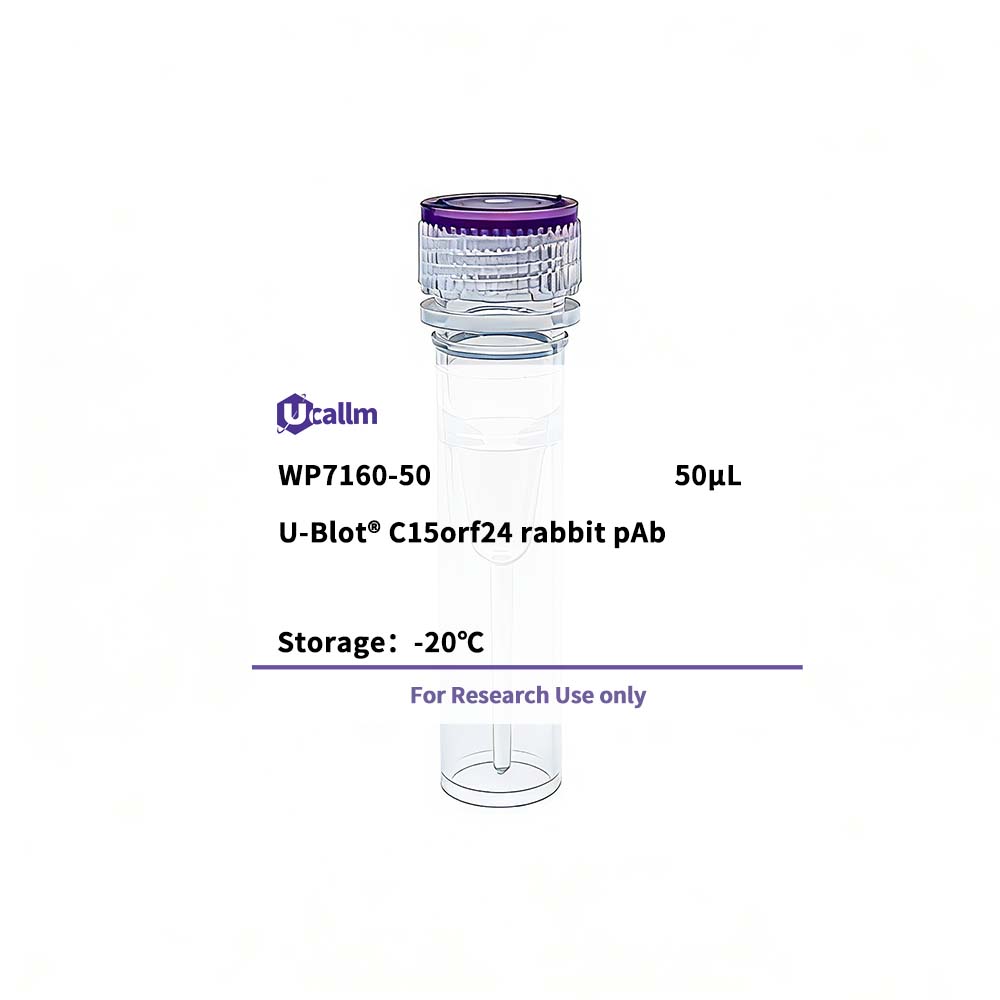
Price range: $268.00 through $328.00
Background:
| Size | 50μL/100μL |
| Target | EMC7 |
| Reactivity | Human, Mouse |
| Applications | WB |
| MW(Calculated) | 27kD |
| MW(Observed) | |
| Host Species | Rabbit |
| Isotype | IgG |
| Conjugate/Modification | Unmodified |
| Recommended Dilution Ratio | WB 1:500-2000 |
| Formulation | Liquid in PBS containing 50% glycerol, 0.5% BSA and 0.02% sodium azide. |
| Purification | The antibody was affinity-purified from rabbit antiserum by affinity-chromatography using epitope-specific immunogen. |
| Storage | -15°C to -25°C/1 year(Do not lower than -25°C) |
| Concentration | 1 mg/ml |
| Clonality | Polyclonal |
| Clone Number | |
| Immunogen | Synthesized peptide derived from human C15orf24 |
| Specificity | This antibody detects endogenous levels of C15orf24 at Human, Mouse |
| Gene Name | EMC7 C11orf3 C15orf24 HT022 UNQ905/PRO1926 |
| Protein Name | ER membrane protein complex subunit 7 |
| Other Name | |
| Species | Human |
| Gene ID | 56851 |
| Uniprot | Q9NPA0, |
| Species.1 | Mouse |
| Gene ID.1 | 73024 |
| Uniprot.1 | Q9EP72 |
| Species.2 | |
| Gene ID.2 | |
| Uniprot.2 | |
| Cellular Localization | Endoplasmic reticulum membrane; Single-pass type I membrane protein . |
| Tissue Expression | |
| Signaling_pathway | |
| Research Areas | |
| Function | Part of the endoplasmic reticulum membrane protein complex (EMC) that enables the energy-independent insertion into endoplasmic reticulum membranes of newly synthesized membrane proteins . Preferentially accommodates proteins with transmembrane domains that are weakly hydrophobic or contain destabilizing features such as charged and aromatic residues . Involved in the cotranslational insertion of multi-pass membrane proteins in which stop-transfer membrane-anchor sequences become ER membrane spanning helices . It is also required for the post-translational insertion of tail-anchored/TA proteins in endoplasmic reticulum membranes . By mediating the proper cotranslational insertion of N-terminal transmembrane domains in an N-exo topology, with translocated N-terminus in the lumen of the ER, controls the topology of multi-pass membrane proteins like the G protein-coupled receptors . By regulating the insertion of various proteins in membranes, it is indirectly involved in many cellular processes (Probable). |





