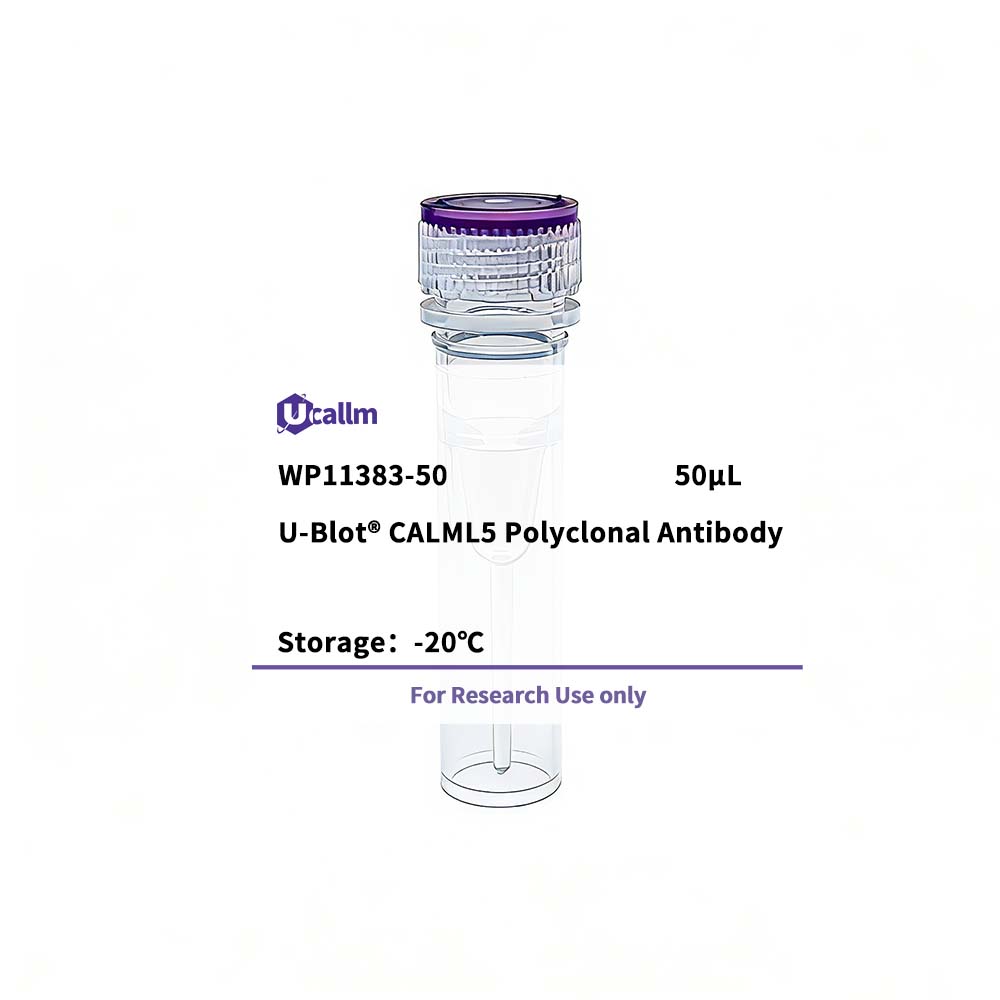
SKU: WP11383 Categories: ,

CALML5 Polyclonal Antibody

Price range: $268.00 through $328.00

SKU: WP11383-100
Enter the quantity you would like, or drag the panel to find the quantity and price that best for you
Bulk QuoteAuthorize OEM & ODM

Product details

Background:

This gene encodes a novel calcium binding protein expressed in the epidermis and related to the calmodulin family of calcium binding proteins. Functional studies with recombinant protein demonstrate it does bind calcium and undergoes a conformational change when it does so. Abundant expression is detected only in reconstructed epidermis and is restricted to differentiating keratinocytes. In addition, it can associate with transglutaminase 3, shown to be a key enzyme in the terminal differentiation of keratinocytes. [provided by RefSeq, Jul 2008],

Specifications

Size50μL/100μL
TargetCALML5
ReactivityHuman
ApplicationsIHC, IF, ELISA
MW(Calculated)16kD
MW(Observed)
Host SpeciesRabbit
IsotypeIgG
Conjugate/ModificationUnmodified
Recommended Dilution RatioIHC 1:100-1:300; ELISA 1:10000; IF 1:50-200 / Note: For IHC, we suggest antigen retrieval with TE buffer pH 9.0 (Cat#WT1004)
FormulationLiquid in PBS containing 50% glycerol, 0.5% BSA and 0.02% sodium azide.
PurificationThe antibody was affinity-purified from rabbit antiserum by affinity-chromatography using epitope-specific immunogen.
Storage-15°C to -25°C/1 year(Do not lower than -25°C)
Concentration1 mg/ml
ClonalityPolyclonal
Clone Number
ImmunogenThe antiserum was produced against synthesized peptide derived from human CALML5. AA range:96-146
SpecificityCALML5 Polyclonal Antibody detects endogenous levels of CALML5 protein.
Gene NameCALML5
Protein NameCalmodulin-like protein 5
Other NameCALML5; / CLSP; / Calmodulin-like protein 5; / Calmodulin-like skin protein
SpeciesHuman
Gene ID51806
UniprotQ9NZT1
Species.1
Gene ID.1
Uniprot.1
Species.2
Gene ID.2
Uniprot.2
Cellular Localizationextracellular exosome,
Tissue ExpressionParticularly abundant in the epidermis where its expression is directly related to keratinocyte differentiation. Very low expression in lung.
Signaling_pathwayCellular Processes >> Cell growth and death >> Cellular senescence;Organismal Systems >> Endocrine system >> Insulin signaling pathway;Organismal Systems >> Endocrine system >> Glucagon signaling pathway;Organismal Systems >> Endocrine system >> GnRH signaling pathway;Organismal Systems >> Endocrine system >> Estrogen signaling pathway;Organismal Systems >> Endocrine system >> Oxytocin signaling pathway;Organismal Systems >> Endocrine system >> Aldosterone synthesis and secretion;Organismal Systems >> Circulatory system >> Adrenergic signaling in cardiomyocytes;Organismal Systems >> Circulatory system >> Vascular smooth muscle contraction;Organismal Systems >> Nervous system >> Dopaminergic synapse;Organismal Systems >> Nervous system >> Neurotrophin signaling pathway;Organismal Systems >> Sensory system >> Inflammatory mediator regulation of TRP channels;Human Diseases >> Cancer: overview >> Pathways in cancer;Human Diseases >> Cancer: specific types >> Glioma;Human Diseases >> Neurodegenerative disease >> Alzheimer disease;Human Diseases >> Neurodegenerative disease >> Parkinson disease;Human Diseases >> Neurodegenerative disease >> Pathways of neurodegeneration - multiple diseases;Environmental Information Processing >> Signal transduction >> Ras signaling pathway;Environmental Information Processing >> Signal transduction >> Rap1 signaling pathway;Environmental Information Processing >> Signal transduction >> Apelin signaling pathway;Environmental Information Processing >> Signal transduction >> Calcium signaling pathway;Environmental Information Processing >> Signal transduction >> cAMP signaling pathway;Environmental Information Processing >> Signal transduction >> cGMP-PKG signaling pathway
Research Areas>>Ras signaling pathway; / >>Rap1 signaling pathway; / >>Calcium signaling pathway; / >>cGMP-PKG signaling pathway; / >>cAMP signaling pathway; / >>Phosphatidylinositol signaling system; / >>Oocyte meiosis; / >>Cellular senescence; / >>Adrenergic signaling in cardiomyocytes; / >>Vascular smooth muscle contraction; / >>Apelin signaling pathway; / >>C-type lectin receptor signaling pathway; / >>Circadian entrainment; / >>Long-term potentiation; / >>Neurotrophin signaling pathway; / >>Dopaminergic synapse; / >>Olfactory transduction; / >>Phototransduction; / >>Inflammatory mediator regulation of TRP channels; / >>Insulin signaling pathway; / >>GnRH signaling pathway; / >>Estrogen signaling pathway; / >>Melanogenesis; / >>Oxytocin signaling pathway; / >>Glucagon signaling pathway; / >>Renin secretion; / >>Aldosterone synthesis and secretion; / >>Salivary secretion; / >>Gastric acid secretion; / >>Alzheimer disease; / >>Parkinson disease; / >>Pathways of neurodegeneration - multiple diseases; / >>Amphetamine addiction; / >>Alcoholism; / >>Pertussis; / >>Tuberculosis; / >>Human cytomegalovirus infection; / >>Kaposi sarcoma-associated herpesvirus infection; / >>Human immunodeficiency virus 1 infection; / >>Pathways in cancer; / >>Glioma; / >>Lipid and atherosclerosis; / >>Fluid shear stress and atherosclerosis
FunctionFunction:Binds calcium. May be involved in terminal differentiation of keratinocytes.,similarity:Contains 4 EF-hand domains.,subunit:Associates with transglutaminase 3.,tissue specificity:Particularly abundant in the epidermis where its expression is directly related to keratinocyte differentiation. Very low expression in lung.,
Please login to post questions
Back to Top
Product has been added to your cart

