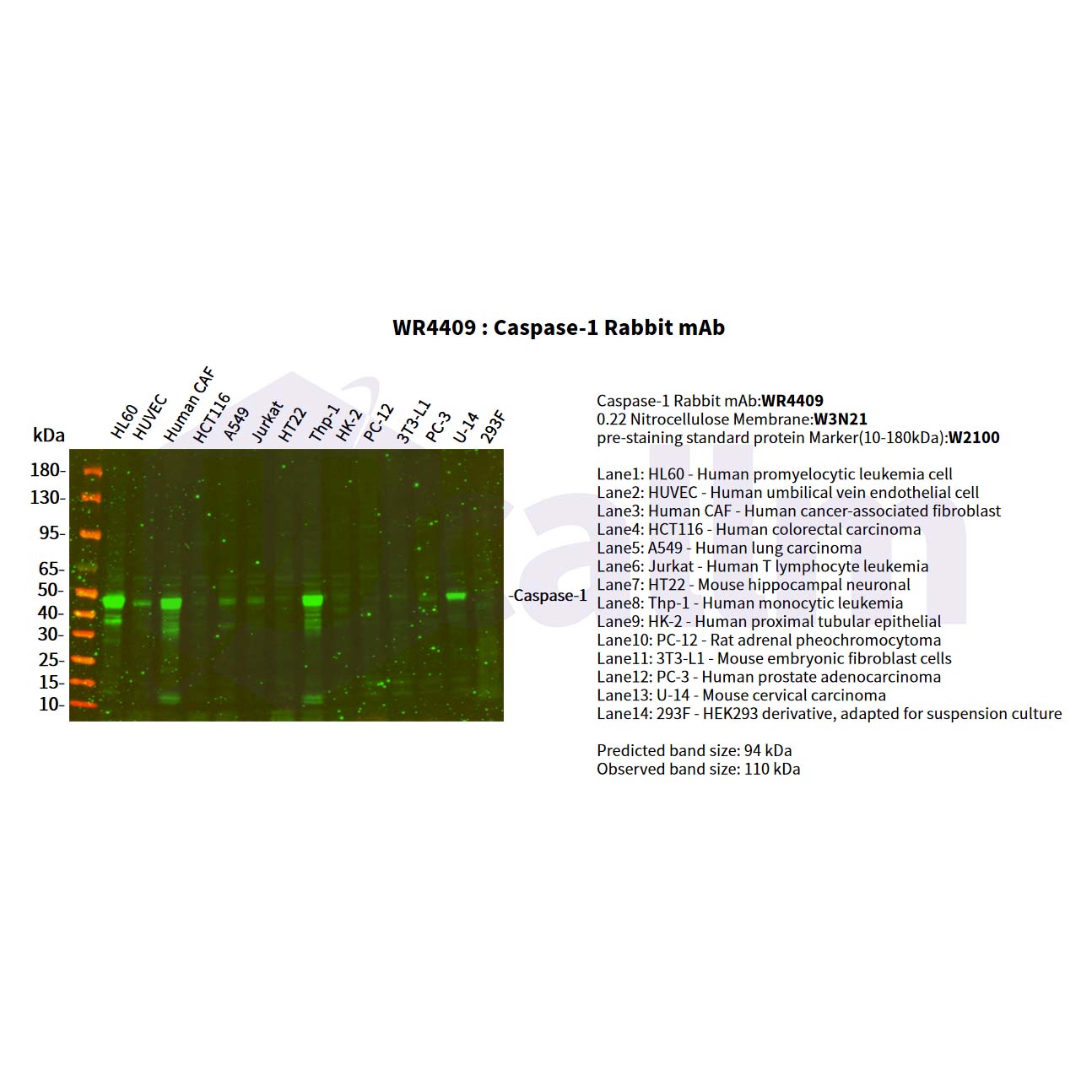
SKU: WR4409 Categories: ,

U-Blot® Caspase-1 Rabbit mAb

Price range: $268.00 through $328.00

SKU: WR4409-50
Enter the quantity you would like, or drag the panel to find the quantity and price that best for you
Bulk QuoteAuthorize OEM & ODM

Product details

Background:caspase 1(CASP1) Homo sapiens This gene encodes a protein which is a member of the cysteine-aspartic acid protease (caspase) family. Sequential activation of caspases plays a central role in the execution-phase of cell apoptosis. Caspases exist as inactive proenzymes which undergo proteolytic processing at conserved aspartic residues to produce 2 subunits, large and small, that dimerize to form the active enzyme. This gene was identified by its ability to proteolytically cleave and activate the inactive precursor of interleukin-1, a cytokine involved in the processes such as inflammation, septic shock, and wound healing. This gene has been shown to induce cell apoptosis and may function in various developmental stages. Studies of a similar gene in mouse suggest a role in the pathogenesis of Huntington disease. Alternative splicing results in transcript variants encoding distinct isoforms. [provided by RefSeq, Mar 2012],


Specifications

Size50μL/100μL
TargetCaspase-1
ReactivityHuman, Mouse, Rat
ApplicationsWB, IHC, IF, IP, ELISA
MW(Calculated)45kD
MW(Observed)45kD
Host SpeciesRabbit
IsotypeIgG,Kappa
Conjugate/ModificationUnmodified
Recommended Dilution RatioIHC 1:200-1:1000; WB 1:2000-1:10000; IF 1:200-1:1000; ELISA 1:5000-1:20000; IP 1:50-1:200; / Note: For IHC, we suggest antigen retrieval with TE buffer pH 9.0 (Cat#WT1004)
FormulationPBS, 50% glycerol, 0.05% Proclin 300, 0.05%BSA
PurificationRecombinant Antibody expressed in animal component-free (ACF) media, purified via Protein A affinity chromatography.
Storage-15°C to -25°C/1 year(Do not lower than -25°C)
Concentration
ClonalityMonoclonal
Clone NumberRM0628R
ImmunogenThe specific immunogen used to produce this antibody is proprietary information.
SpecificityEndogenous
Gene NameCASP1 IL1BC IL1BCE
Protein NameCaspase-1
Other NameCASP1; / IL1BC; / IL1BCE; / Caspase-1; / CASP-1; / Interleukin-1 beta convertase; / IL-1BC; / Interleukin-1 beta-converting enzyme; / ICE; / IL-1 beta-converting enzyme; / p45; / [Cleaved into: Caspase-1 subunit p20; / Caspase-1 subunit p10]
SpeciesHuman
Gene ID834
UniprotP29466,
Species.1Mouse
Gene ID.112362
Uniprot.1P29452,
Species.2Rat
Gene ID.2
Uniprot.2P43527
Cellular LocalizationCytoplasm
Tissue ExpressionExpressed in larger amounts in spleen and lung. Detected in liver, heart, small intestine, colon, thymus, prostate, skeletal muscle, peripheral blood leukocytes, kidney and testis. No expression in the brain.
Signaling_pathwayCellular Processes >> Cell growth and death >> Necroptosis;Organismal Systems >> Immune system >> Neutrophil extracellular trap formation;Organismal Systems >> Immune system >> NOD-like receptor signaling pathway;Organismal Systems >> Immune system >> Cytosolic DNA-sensing pathway;Human Diseases >> Neurodegenerative disease >> Amyotrophic lateral sclerosis
Research Areas
FunctionThiol protease involved in a variety of inflammatory processes by proteolytically cleaving other proteins, such as the precursors of the inflammatory cytokines interleukin-1 beta (IL1B) and interleukin 18 (IL18) as well as the pyroptosis inducer Gasdermin-D (GSDMD), into active mature peptides . Plays a key role in cell immunity as an inflammatory response initiator: once activated through formation of an inflammasome complex, it initiates a pro-inflammatory response through the cleavage of the two inflammatory cytokines IL1B and IL18, releasing the mature cytokines which are involved in a variety of inflammatory processes . Cleaves a tetrapeptide after an Asp residue at position P1 . Also initiates pyroptosis, a programmed lytic cell death pathway, through cleavage of GSDMD . In contrast to cleavage of interleukins IL1B and IL1B, recognition and cleavage of GSDMD is not strictly dependent on the consensus cleavage site but depends on an exosite interface on CASP1 that recognizes and binds the Gasdermin-D, C-terminal (GSDMD-CT) part . Upon inflammasome activation, during DNA virus infection but not RNA virus challenge, controls antiviral immunity through the cleavage of CGAS, rendering it inactive . In apoptotic cells, cleaves SPHK2 which is released from cells and remains enzymatically active extracellularly .; [Isoform Delta]: Apoptosis inactive.; [Isoform Epsilon]: Apoptosis inactive.
Please login to post questions

Back to Top
Product has been added to your cart

