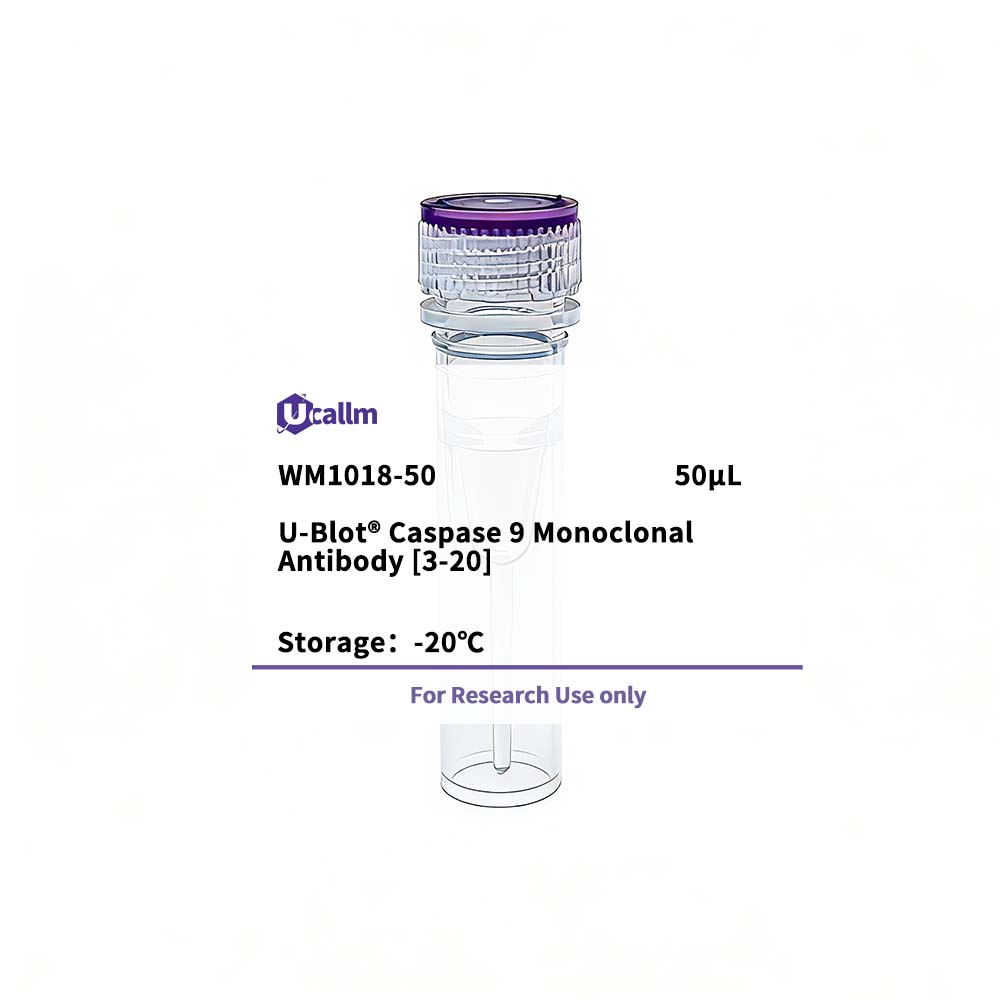
SKU: WM1018 Categories: ,

Caspase 9 Monoclonal Antibody [3-20]

Price range: $268.00 through $328.00

SKU: WM1018-50
Enter the quantity you would like, or drag the panel to find the quantity and price that best for you
Bulk QuoteAuthorize OEM & ODM

Product details

Background:
CASP9 encodes a member of the cysteine-aspartic acid protease (caspase) family. Sequential activation of caspases plays a central role in the execution-phase of cell apoptosis. Caspases exist as inactive proenzymes which undergo proteolytic processing at conserved aspartic residues to produce two subunits, large and small, that dimerize to form the active enzyme. Caspase 9 can undergo autoproteolytic processing and activation by the apoptosome, a protein complex of cytochrome c and the apoptotic peptidase activating factor 1; this step is thought to be one of the earliest in the caspase activation cascade. Caspase 9 is thought to play a central role in apoptosis and to be a tumor suppressor. Alternative splicing results in multiple transcript variants.


Specifications

Size50μL/100μL
TargetCaspase-9
ReactivityHuman, Mouse, Rat, Chicken
ApplicationsWB, IHC, IF, IP
MW(Calculated)
MW(Observed)46kD
Host SpeciesMouse
Isotype
Conjugate/ModificationUnmodified
Recommended Dilution RatioWB 1:1000-5000; IP 1:200; IF 1:200; IHC 1:50-300 / Note: For IHC, we suggest antigen retrieval with TE buffer pH 9.0 (Cat#WT1004)
FormulationPBS, pH 7.4, containing 0.5%BSA, 0.02% sodium azide as Preservative and 50% Glycerol.
PurificationThe antibody was affinity-purified from mouse ascites by affinity-chromatography using specific immunogen.
Storage-15°C to -25°C/1 year(Do not lower than -25°C)
Concentration
ClonalityMonoclonal
Clone Number3-20
ImmunogenSynthetic Peptide of Caspase 9
SpecificityThe antibody detects endogenous Caspase 9 protein.
Gene NameCASP9
Protein NameCaspase9
Other NameCASP9; / MCH6; / Caspase-9; / CASP-9; / Apoptotic protease Mch-6; / Apoptotic protease-activating factor 3; / APAF-3; / ICE-like apoptotic protease 6; / ICE-LAP6; / [Cleaved into: Caspase-9 subunit p35; / Caspase-9 subunit p10]
SpeciesHuman
Gene ID842
UniprotP55211,
Species.1
Gene ID.1
Uniprot.1
Species.2Rat
Gene ID.258918
Uniprot.2Q9JHK1
Cellular Localizationnucleus,mitochondrion,cytosol,apoptosome,
Tissue ExpressionUbiquitous, with highest expression in the heart, moderate expression in liver, skeletal muscle, and pancreas. Low levels in all other tissues. Within the heart, specifically expressed in myocytes.
Signaling_pathwayCellular Processes >> Cell growth and death >> Apoptosis;Cellular Processes >> Cell growth and death >> Apoptosis - multiple species;Cellular Processes >> Cell growth and death >> p53 signaling pathway;Organismal Systems >> Endocrine system >> Thyroid hormone signaling pathway;Human Diseases >> Cancer: overview >> Pathways in cancer;Human Diseases >> Cancer: specific types >> Colorectal cancer;Human Diseases >> Cancer: specific types >> Pancreatic cancer;Human Diseases >> Cancer: specific types >> Prostate cancer;Human Diseases >> Cancer: specific types >> Endometrial cancer;Human Diseases >> Cancer: specific types >> Small cell lung cancer;Human Diseases >> Cancer: specific types >> Non-small cell lung cancer;Human Diseases >> Neurodegenerative disease >> Alzheimer disease;Human Diseases >> Neurodegenerative disease >> Parkinson disease;Human Diseases >> Neurodegenerative disease >> Amyotrophic lateral sclerosis;Human Diseases >> Neurodegenerative disease >> Huntington disease;Human Diseases >> Neurodegenerative disease >> Prion disease;Human Diseases >> Neurodegenerative disease >> Pathways of neurodegeneration - multiple diseases;Environmental Information Processing >> Signal transduction >> VEGF signaling pathway;Environmental Information Processing >> Signal transduction >> PI3K-Akt signaling pathway
Research Areas>>Platinum drug resistance; / >>p53 signaling pathway; / >>PI3K-Akt signaling pathway; / >>Apoptosis; / >>Apoptosis - multiple species; / >>VEGF signaling pathway; / >>Thyroid hormone signaling pathway; / >>Alzheimer disease; / >>Parkinson disease; / >>Amyotrophic lateral sclerosis; / >>Huntington disease; / >>Prion disease; / >>Pathways of neurodegeneration - multiple diseases; / >>Pathogenic Escherichia coli infection; / >>Legionellosis; / >>Toxoplasmosis; / >>Tuberculosis; / >>Hepatitis C; / >>Hepatitis B; / >>Measles; / >>Human cytomegalovirus infection; / >>Influenza A; / >>Kaposi sarcoma-associated herpesvirus infection; / >>Herpes simplex virus 1 infection; / >>Epstein-Barr virus infection; / >>Human immunodeficiency virus 1 infection; / >>Pathways in cancer; / >>Colorectal cancer; / >>Pancreatic cancer; / >>Endometrial cancer; / >>Prostate cancer; / >>Small cell lung cancer; / >>Non-small cell lung cancer; / >>Viral myocarditis; / >>Lipid and atherosclerosis
FunctionCatalytic activity:Strict requirement for an Asp residue at position P1 and with a marked preference for His at position P2. It has a preferred cleavage sequence of Leu-Gly-His-Asp-|-Xaa.,Function:Involved in the activation cascade of caspases responsible for apoptosis execution. Binding of caspase-9 to Apaf-1 leads to activation of the protease which then cleaves and activates caspase-3. Proteolytically cleaves poly(ADP-ribose) polymerase (PARP).,Function:Isoform 2 lacks activity is an dominant-negative inhibitor of caspase-9.,online information:Caspase-9 entry,PTM:Cleavages at Asp-315 by granzyme B and at Asp-330 by caspase-3 generate the two active subunits. Caspase-8 and -10 can also be involved in these processing events.,similarity:Belongs to the peptidase C14A family.,similarity:Contains 1 CARD domain.,subunit:Heterotetramer that consists of two anti-parallel arranged heterodimers, each one formed by a 35 kDa (p35) and a 10 kDa (p10) subunit. Caspase-9 and APAF1 bind to each other via their respective NH2-terminal CED-3 homologous domains in the presence of cytochrome C and ATP. Interacts with the inhibitors BIRC2, BIRC4, BIRC5 and BIRC7.,tissue specificity:Ubiquitous, with highest expression in the heart, moderate expression in liver, skeletal muscle, and pancreas. Low levels in all other tissues.,
Please login to post questions
Back to Top
Product has been added to your cart

