


Cathepsin?G Polyclonal Antibody
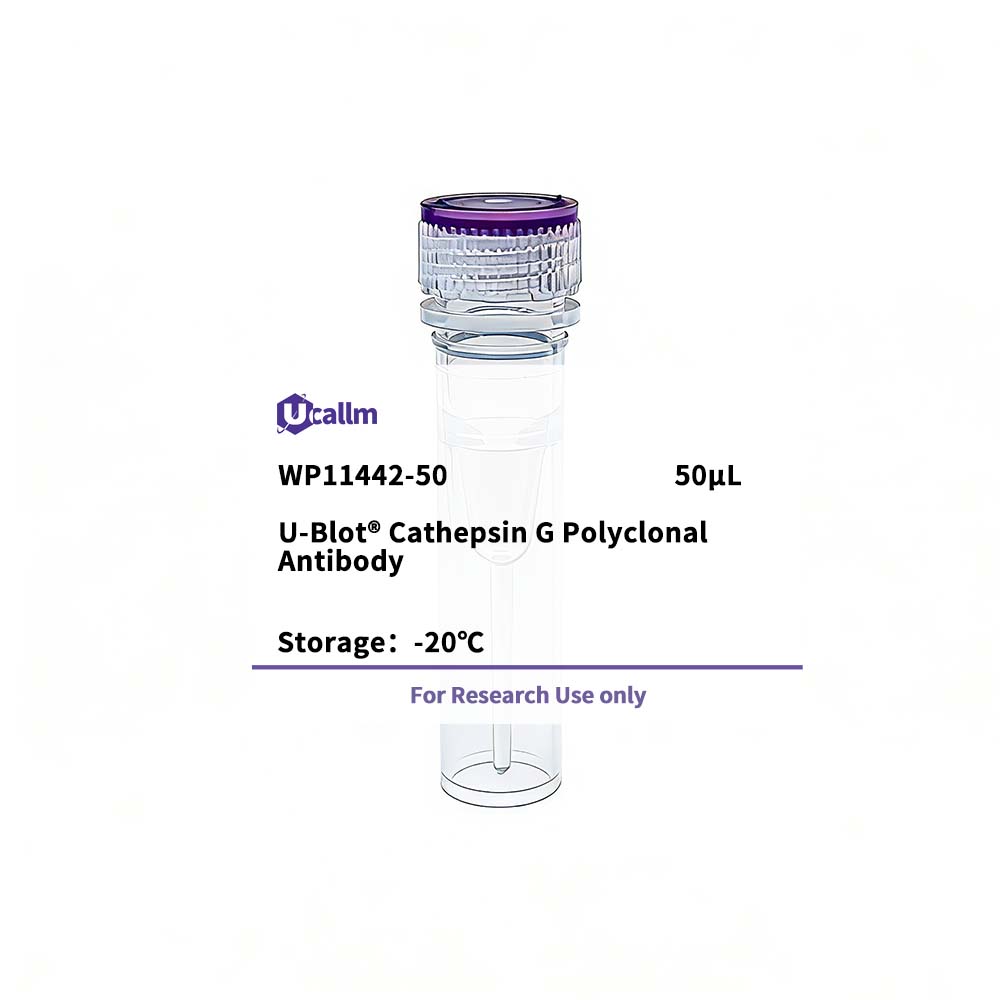
Ucallm_WP11442-50
Price range: $268.00 through $328.00
Product details
Background:
The protein encoded by this gene, a member of the peptidase S1 protein family, is found in azurophil granules of neutrophilic polymorphonuclear leukocytes. The encoded protease has a specificity similar to that of chymotrypsin C, and may participate in the killing and digestion of engulfed pathogens, and in connective tissue remodeling at sites of inflammation. In addition, the encoded protein is antimicrobial, with bacteriocidal activity against S. aureus and N. gonorrhoeae. Transcript variants utilizing alternative polyadenylation signals exist for this gene. [provided by RefSeq, Sep 2014],
Specifications
| Size | 50μL/100μL |
| Target | Cathepsin G |
| Reactivity | Human, Mouse, Rat |
| Applications | WB, ELISA |
| MW(Calculated) | |
| MW(Observed) | 22kD |
| Host Species | Rabbit |
| Isotype | IgG |
| Conjugate/Modification | Unmodified |
| Recommended Dilution Ratio | WB 1:500-1:2000; ELISA 1:40000; Not yet tested in other applications. |
| Formulation | Liquid in PBS containing 50% glycerol, 0.5% BSA and 0.02% sodium azide. |
| Purification | The antibody was affinity-purified from rabbit antiserum by affinity-chromatography using epitope-specific immunogen. |
| Storage | -15°C to -25°C/1 year(Do not lower than -25°C) |
| Concentration | 1 mg/ml |
| Clonality | Polyclonal |
| Clone Number | |
| Immunogen | The antiserum was produced against synthesized peptide derived from human Cathepsin G. AA range:67-116 |
| Specificity | Cathepsin G Polyclonal Antibody detects endogenous levels of Cathepsin G protein. |
| Gene Name | CTSG |
| Protein Name | Cathepsin G |
| Other Name | CTSG; / Cathepsin G; / CG |
| Species | Human |
| Gene ID | 1511 |
| Uniprot | P08311, |
| Species.1 | Mouse |
| Gene ID.1 | 13035 |
| Uniprot.1 | P28293, |
| Species.2 | Rat |
| Gene ID.2 | |
| Uniprot.2 | P17977 |
| Cellular Localization | Cell membrane; Peripheral membrane protein . Cytoplasmic granule . Secreted . Cytoplasm, cytosol . Lysosome . Nucleus . Secreted by activated neutrophils (PubMed:3390156). Detected in synovial fluid (PubMed:32144329). Localizes to lysosomes in B cells where it is not endogenously synthesized but is internalized from the cell membrane (PubMed:15100291). Localizes to the nucleus during apoptosis (PubMed:11259672). . |
| Tissue Expression | Expressed in neutrophils (at protein level) (PubMed:3799965). Expressed in B cells (PubMed:15100291). |
| Signaling_pathway | Cellular Processes >> Transport and catabolism >> Lysosome;Organismal Systems >> Immune system >> Neutrophil extracellular trap formation;Organismal Systems >> Endocrine system >> Renin-angiotensin system;Human Diseases >> Immune disease >> Systemic lupus erythematosus |
| Research Areas | >>Neuroactive ligand-receptor interaction; / >>Lysosome; / >>Neutrophil extracellular trap formation; / >>Renin-angiotensin system; / >>Amoebiasis; / >>Systemic lupus erythematosus |
| Function | Catalytic activity:Specificity similar to chymotrypsin C.,enzyme regulation:Inhibited by soybean trypsin inhibitor, benzamidine, the synthetic peptide R13K, Z-Gly-Leu-Phe-CH2Cl and phenylmethylsulfonyl fluoride. Inhibited by LPS from P.aeruginosa but not by LPS from S.minnesota.,Function:Serine protease with trypsin- and chymotrypsin-like specificity. Has antibacterial activity against the Gram-nagative bacterium P.aeruginosa, antibacterial activity is inhibited by LPS from P.aeruginosa, Z-Gly-Leu-Phe-CH2Cl and phenylmethylsulfonyl fluoride.,similarity:Belongs to the peptidase S1 family.,similarity:Contains 1 peptidase S1 domain., |
Please login to post questions
Related products





