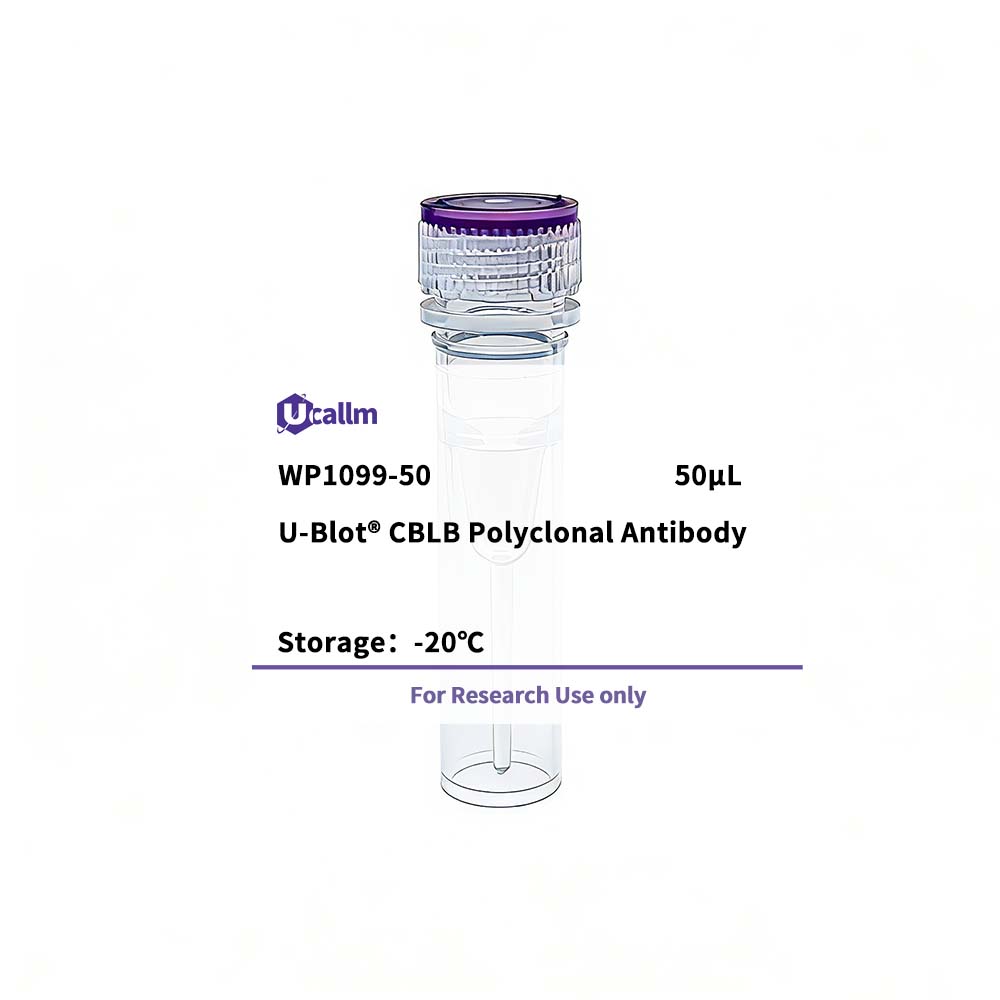
SKU: WP1099 Categories: ,

CBLB Polyclonal Antibody

Price range: $268.00 through $328.00

SKU: WP1099-100
Enter the quantity you would like, or drag the panel to find the quantity and price that best for you
Bulk QuoteAuthorize OEM & ODM

Product details

Background:

domain:The N-terminus is composed of the phosphotyrosine binding (PTB) domain, a short linker region and the RING-type zinc finger. The PTB domain, which is also called TKB (tyrosine kinase binding) domain, is composed of three different subdomains: a four-helix bundle (4H), a calcium-binding EF hand and a divergent SH2 domain., domain:The RING-type zinc finger domain mediates binding to an E2 ubiquitin-conjugating enzyme., domain:The UBA domain interacts with poly-ubiquitinated proteins., function:E3 ubiquitin-protein ligase which accepts ubiquitin from specific E2 ubiquitin-conjugating enzymes, and transfers it to substrates, generally promoting their degradation by the proteasome. Negatively regulates TCR (T-cell receptor), BCR (B-cell receptor) and FCER1 (high affinity immunoglobulin epsilon receptor) signal transduction pathways. In naive T-cells, inhibits VAV1 activation upon TCR engagement and imposes a requirement for CD28 costimulation for proliferation and IL-2 production. Also acts by promoting PIK3R1/p85 ubiquitination, which impairs its recruitment to the TCR and subsequent activation. In activated T-cells, inhibits PLCG1 activation and calcium mobilization upon restimulation and promotes anergy. In B-cells, acts by ubiquitinating SYK and promoting its proteasomal degradation. May also be involved in EGFR ubiquitination and internalization., miscellaneous:This protein has one functional calcium-binding site., pathway:Protein modification; protein ubiquitination., PTM:Auto-ubiquitinated upon EGF-mediated cell activation or upon T-cell costimulation by CD28; which promotes proteasomal degradation., PTM:Phosphorylated on tyrosine residues upon TCR or BCR activation, and upon various types of cell stimulation., sequence caution:Translated as Arg., similarity:Contains 1 CBL N-terminal domain., similarity:Contains 1 RING-type zinc finger., similarity:Contains 1 SH2 domain., similarity:Contains 1 UBA domain., similarity:Contains 2 EF-hand-like domains., subcellular location:Upon EGF stimulation, associates with endocytic vesicles., subunit:Interacts with SH3 domain-containing proteins LCK, CRK and SORBS1. Interacts with LCP2 and ZAP70. May interact with CBL (By similarity). Interacts with SH3 domain-containing proteins VAV1, FYN, FGR, PLCG1, GRB2, CRKL, PIK3R1 and SH3KBP1/CIN85. Identified in heterotrimeric complexes with SH3KBP1/CIN85, CD2AP and ARHGEF7, where one CBLB peptide binds two copies of the other protein. Interacts with poly-ubiquitinated proteins. Dimerization is required for the binding of poly-ubiquitin, but not for the binding of mono-ubiquitin., tissue specificity:Expressed in placenta, heart, lung, kidney, spleen, ovary and testis, as well as fetal brain and liver and hematopoietic cell lines, but not in adult brain, liver, pancreas, salivary gland, or skeletal muscle. Present in lymphocytes (at protein level).,

Specifications

Size50μL/100μL
TargetCBLB
ReactivityHuman, Mouse, Rat
ApplicationsWB, ELISA
MW(Calculated)
MW(Observed)108kD
Host SpeciesRabbit
IsotypeIgG
Conjugate/ModificationUnmodified
Recommended Dilution RatioWB 1:500-2000; ELISA 1:5000-20000
FormulationLiquid in PBS containing 50% glycerol,0.5% BSA and 0.02% sodium azide.
PurificationThe antibody was affinity-purified from rabbit antiserum by affinity-chromatography using epitope-specific immunogen.
Storage-15°C to -25°C/1 year(Do not lower than -25°C)
Concentration1 mg/ml
ClonalityPolyclonal
Clone Number
ImmunogenSynthesized peptide derived from part region of human protein
SpecificityCBLB Polyclonal Antibody detects endogenous levels of protein.
Gene NameCBLB RNF56 Nbla00127
Protein NameE3 ubiquitin-protein ligase CBL-B (Casitas B-lineage lymphoma proto-oncogene b) (RING finger protein 56) (SH3-binding protein CBL-B) (Signal transduction protein CBL-B)
Other Name
SpeciesHuman
Gene ID868
UniprotQ13191,
Species.1Mouse
Gene ID.1
Uniprot.1Q3TTA7,
Species.2Rat
Gene ID.2
Uniprot.2Q8K4S7
Cellular LocalizationCytoplasm . Upon EGF stimulation, associates with endocytic vesicles.
Tissue ExpressionExpressed in placenta, heart, lung, kidney, spleen, ovary and testis, as well as fetal brain and liver and hematopoietic cell lines, but not in adult brain, liver, pancreas, salivary gland, or skeletal muscle. Present in lymphocytes (at protein level).
Signaling_pathwayOrganismal Systems >> Immune system >> T cell receptor signaling pathway;Organismal Systems >> Endocrine system >> Insulin signaling pathway;Environmental Information Processing >> Signal transduction >> ErbB signaling pathway;Genetic Information Processing >> Folding, sorting and degradation >> Ubiquitin mediated proteolysis
Research Areas>>ErbB signaling pathway; / >>Ubiquitin mediated proteolysis; / >>Endocytosis; / >>C-type lectin receptor signaling pathway; / >>T cell receptor signaling pathway; / >>Insulin signaling pathway; / >>Measles
FunctionDomain:The N-terminus is composed of the phosphotyrosine binding (PTB) domain, a short linker region and the RING-type zinc finger. The PTB domain, which is also called TKB (tyrosine kinase binding) domain, is composed of three different subdomains: a four-helix bundle (4H), a calcium-binding EF hand and a divergent SH2 domain.,Domain:The RING-type zinc finger domain mediates binding to an E2 ubiquitin-conjugating enzyme.,Domain:The UBA domain interacts with poly-ubiquitinated proteins.,Function:E3 ubiquitin-protein ligase which accepts ubiquitin from specific E2 ubiquitin-conjugating enzymes, and transfers it to substrates, generally promoting their degradation by the proteasome. Negatively regulates TCR (T-cell receptor), BCR (B-cell receptor) and FCER1 (high affinity immunoglobulin epsilon receptor) signal transduction pathways. In naive T-cells, inhibits VAV1 activation upon TCR engagement and imposes a requirement for CD28 costimulation for proliferation and IL-2 production. Also acts by promoting PIK3R1/p85 ubiquitination, which impairs its recruitment to the TCR and subsequent activation. In activated T-cells, inhibits PLCG1 activation and calcium mobilization upon restimulation and promotes anergy. In B-cells, acts by ubiquitinating SYK and promoting its proteasomal degradation. May also be involved in EGFR ubiquitination and internalization.,miscellaneous:This protein has one functional calcium-binding site.,pathway:Protein modification; protein ubiquitination.,PTM:Auto-ubiquitinated upon EGF-mediated cell activation or upon T-cell costimulation by CD28; which promotes proteasomal degradation.,PTM:Phosphorylated on tyrosine residues upon TCR or BCR activation, and upon various types of cell stimulation.,sequence Caution:Translated as Arg.,similarity:Contains 1 CBL N-terminal domain.,similarity:Contains 1 RING-type zinc finger.,similarity:Contains 1 SH2 domain.,similarity:Contains 1 UBA domain.,similarity:Contains 2 EF-hand-like domains.,subcellular location:Upon EGF stimulation, associates with endocytic vesicles.,subunit:Interacts with SH3 domain-containing proteins LCK, CRK and SORBS1. Interacts with LCP2 and ZAP70. May interact with CBL (By similarity). Interacts with SH3 domain-containing proteins VAV1, FYN, FGR, PLCG1, GRB2, CRKL, PIK3R1 and SH3KBP1/CIN85. Identified in heterotrimeric complexes with SH3KBP1/CIN85, CD2AP and ARHGEF7, where one CBLB peptide binds two copies of the other protein. Interacts with poly-ubiquitinated proteins. Dimerization is required for the binding of poly-ubiquitin, but not for the binding of mono-ubiquitin.,tissue specificity:Expressed in placenta, heart, lung, kidney, spleen, ovary and testis, as well as fetal brain and liver and hematopoietic cell lines, but not in adult brain, liver, pancreas, salivary gland, or skeletal muscle. Present in lymphocytes (at protein level).,

Please login to post questions
Back to Top
Product has been added to your cart

