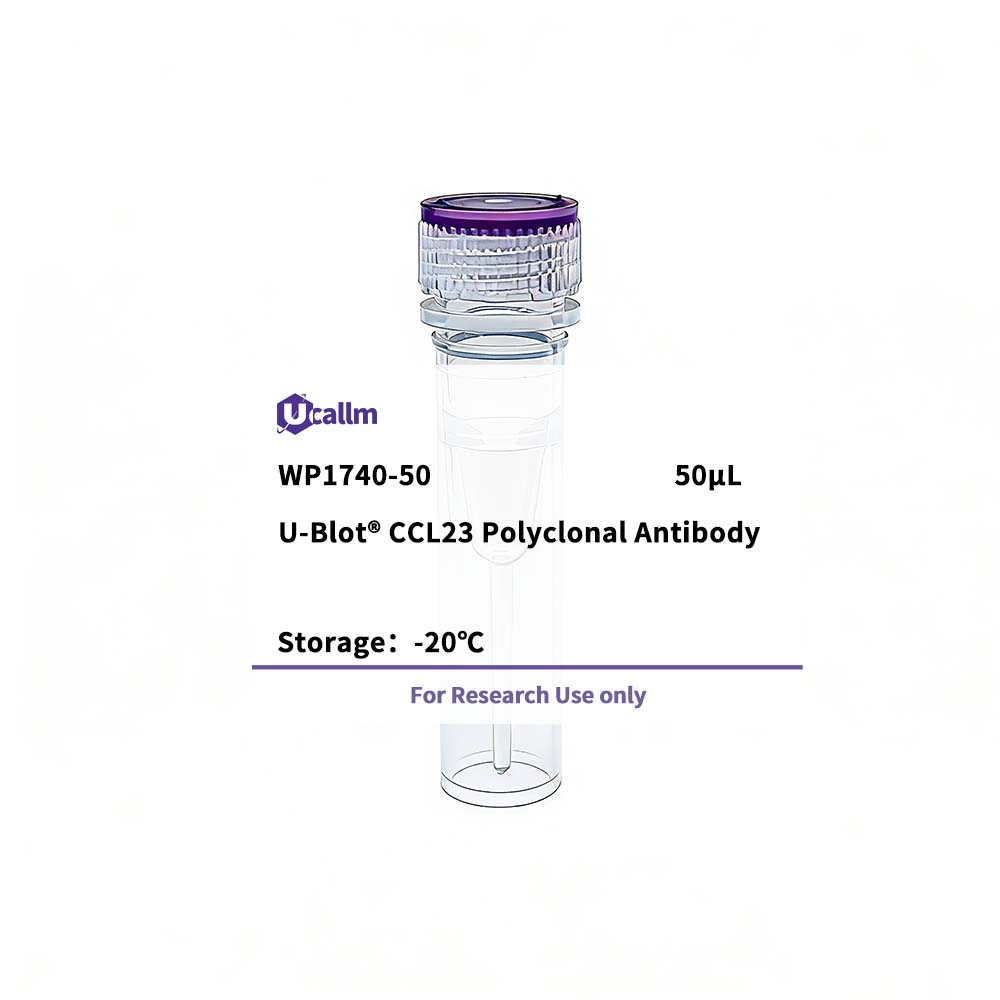
SKU: WP1740 Categories: ,

CCL23 Polyclonal Antibody

Price range: $268.00 through $328.00

SKU: WP1740-100
Enter the quantity you would like, or drag the panel to find the quantity and price that best for you
Bulk QuoteAuthorize OEM & ODM

Product details

Background:

This gene is one of several chemokine genes clustered on the q-arm of chromosome 17. Chemokines form a superfamily of secreted proteins involved in immunoregulatory and inflammatory processes. The superfamily is divided into four subfamilies based on the arrangement of the N-terminal cysteine residues of the mature peptide. This chemokine, a member of the CC subfamily, displays chemotactic activity on resting T lymphocytes and monocytes, lower activity on neutrophils and no activity on activated T lymphocytes. The protein is also a strong suppressor of colony formation by a multipotential hematopoietic progenitor cell line. In addition, the product of this gene is a potent agonist of the chemokine (C-C motif) receptor 1. Alternative splicing results in multiple transcript variants that encode different isoforms. [provided by RefSeq, Jul 2013],


Specifications

Size50μL/100μL
TargetCCL23
ReactivityHuman
ApplicationsWB, ELISA
MW(Calculated)
MW(Observed)13kD
Host SpeciesRabbit
IsotypeIgG
Conjugate/ModificationUnmodified
Recommended Dilution RatioWB 1:500-2000; ELISA 1:5000-20000
FormulationLiquid in PBS containing 50% glycerol,0.5% BSA and 0.02% sodium azide.
PurificationThe antibody was affinity-purified from rabbit antiserum by affinity-chromatography using epitope-specific immunogen.
Storage-15°C to -25°C/1 year(Do not lower than -25°C)
Concentration1 mg/ml
ClonalityPolyclonal
Clone Number
ImmunogenSynthesized peptide derived from human protein . at AA range: 40-120
SpecificityCCL23 Polyclonal Antibody detects endogenous levels of protein.
Gene NameCCL23 MIP3 MPIF1 SCYA23
Protein NameC-C motif chemokine 23 (CK-beta-8) (CKB-8) (Macrophage inflammatory protein 3) (MIP-3) (Myeloid progenitor inhibitory factor 1) (MPIF-1) (Small-inducible cytokine A23) [Cleaved into: CCL23(19-99); CCL23(22-99); CCL23(27-99); CCL23(30-99)]
Other Name
SpeciesHuman
Gene ID6368
UniprotP55773
Species.1
Gene ID.1
Uniprot.1
Species.2
Gene ID.2
Uniprot.2
Cellular LocalizationSecreted.
Tissue ExpressionHigh levels in adult lung, liver, skeletal muscle and pancreas. Moderate levels in fetal liver, adult bone marrow and placenta. The short form is the major species and the longer form was detected only in very low abundance. CCL23(19-99), CCL23(22-99), CCL23(27-99), CCL23(30-99) are found in high levels in synovial fluids from rheumatoid patients.
Signaling_pathwayOrganismal Systems >> Immune system >> Chemokine signaling pathway;Environmental Information Processing >> Signaling molecules and interaction >> Cytokine-cytokine receptor interaction;Environmental Information Processing >> Signaling molecules and interaction >> Viral protein interaction with cytokine and cytokine receptor
Research Areas>>Cytokine-cytokine receptor interaction; / >>Viral protein interaction with cytokine and cytokine receptor; / >>Chemokine signaling pathway
FunctionFunction:Shows chemotactic activity for monocytes, resting T-lymphocytes, and neutrophils, but not for activated lymphocytes. Inhibits proliferation of myeloid progenitor cells in colony formation assays. This protein can bind heparin. Binds CCR1. CCL23(19-99), CCL23(22-99), CCL23(27-99), CCL23(30-99) are more potent chemoattractants than the small-inducible cytokine A23.,online information:CCL23 entry,similarity:Belongs to the intercrine beta (chemokine CC) family.,tissue specificity:High levels in adult lung, liver, skeletal muscle and pancreas. Moderate levels in fetal liver, adult bone marrow and placenta. The short form is the major species and the longer form was detected only in very low abundance. CCL23(19-99), CCL23(22-99), CCL23(27-99), CCL23(30-99) are found in high levels in synovial fluids from rheumatoid patients.,
Please login to post questions
Back to Top
Product has been added to your cart

