


CCNI Polyclonal Antibody
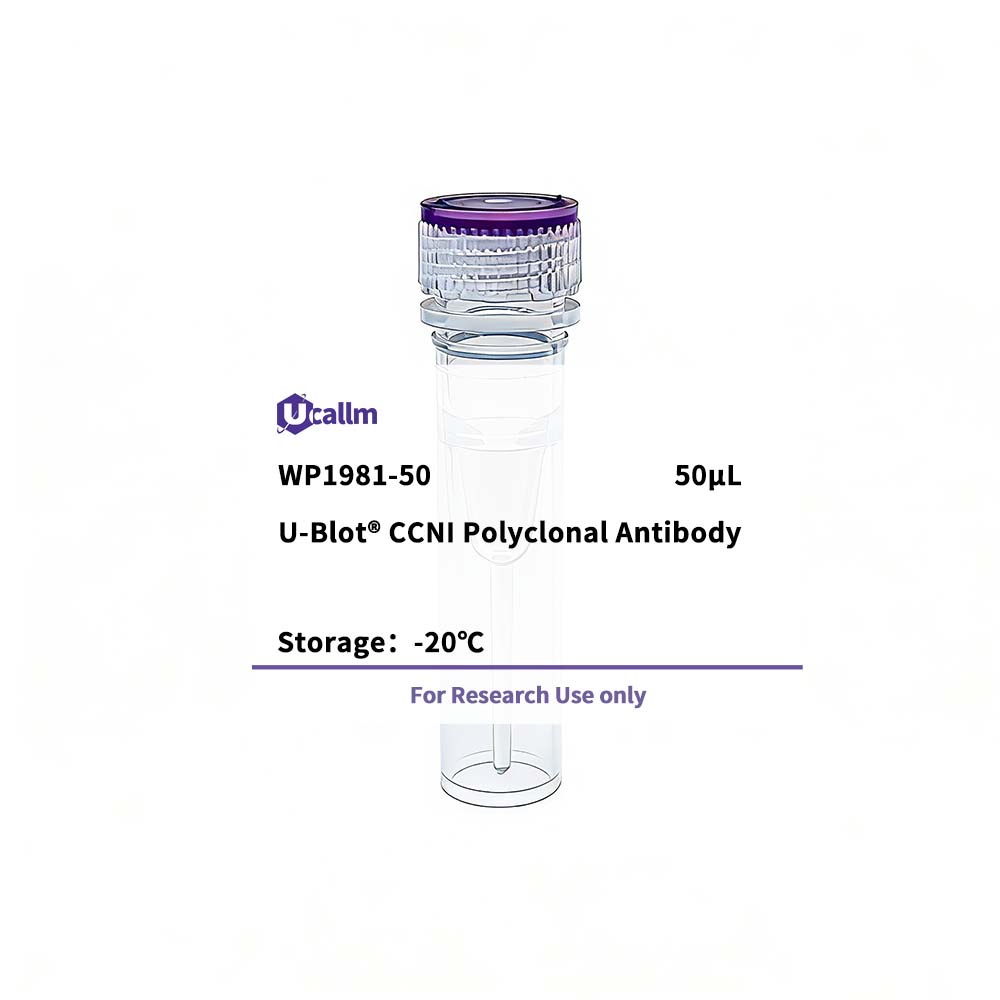
Ucallm_WP1981-50
Price range: $268.00 through $328.00
Product details
Background:
The protein encoded by this gene belongs to the highly conserved cyclin family, whose members are characterized by a dramatic periodicity in protein abundance through the cell cycle. Cyclins function as regulators of CDK kinases. Different cyclins exhibit distinct expression and degradation patterns which contribute to the temporal coordination of each mitotic event. This cyclin shows the highest similarity with cyclin G. The transcript of this gene was found to be expressed constantly during cell cycle progression. The function of this cyclin has not yet been determined. [provided by RefSeq, Jul 2008],
Specifications
| Size | 50μL/100μL |
| Target | CCNI |
| Reactivity | Human, Mouse |
| Applications | WB, ELISA |
| MW(Calculated) | |
| MW(Observed) | 41kD |
| Host Species | Rabbit |
| Isotype | IgG |
| Conjugate/Modification | Unmodified |
| Recommended Dilution Ratio | WB 1:500-2000; ELISA 1:5000-20000 |
| Formulation | Liquid in PBS containing 50% glycerol,0.5% BSA and 0.02% sodium azide. |
| Purification | The antibody was affinity-purified from rabbit antiserum by affinity-chromatography using epitope-specific immunogen. |
| Storage | -15°C to -25°C/1 year(Do not lower than -25°C) |
| Concentration | 1 mg/ml |
| Clonality | Polyclonal |
| Clone Number | |
| Immunogen | Synthesized peptide derived from human protein . at AA range: 30-110 |
| Specificity | CCNI Polyclonal Antibody detects endogenous levels of protein. |
| Gene Name | CCNI |
| Protein Name | Cyclin-I |
| Other Name | |
| Species | Human |
| Gene ID | 10983 |
| Uniprot | Q14094, |
| Species.1 | Mouse |
| Gene ID.1 | |
| Uniprot.1 | Q9Z2V9 |
| Species.2 | |
| Gene ID.2 | |
| Uniprot.2 | |
| Cellular Localization | Nucleus membrane . |
| Tissue Expression | Highest levels in adult heart, brain and skeletal muscle. Lower levels in adult placenta, lung, kidney and pancreas. Also high levels in fetal brain and lower levels in fetal lung, liver and kidney. Also abundant in testis and thyroid. |
| Signaling_pathway | |
| Research Areas | |
| Function | developmental stage:Expression is independent of the cell cycle in lung fibroblasts.,similarity:Belongs to the cyclin family.,tissue specificity:Highest levels in adult heart, brain and skeletal muscle. Lower levels in adult placenta, lung, kidney and pancreas. Also high levels in fetal brain and lower levels in fetal lung, liver and kidney. Also abundant in testis and thyroid., |
Please login to post questions
Related products


