

CD123 Polyclonal Antibody
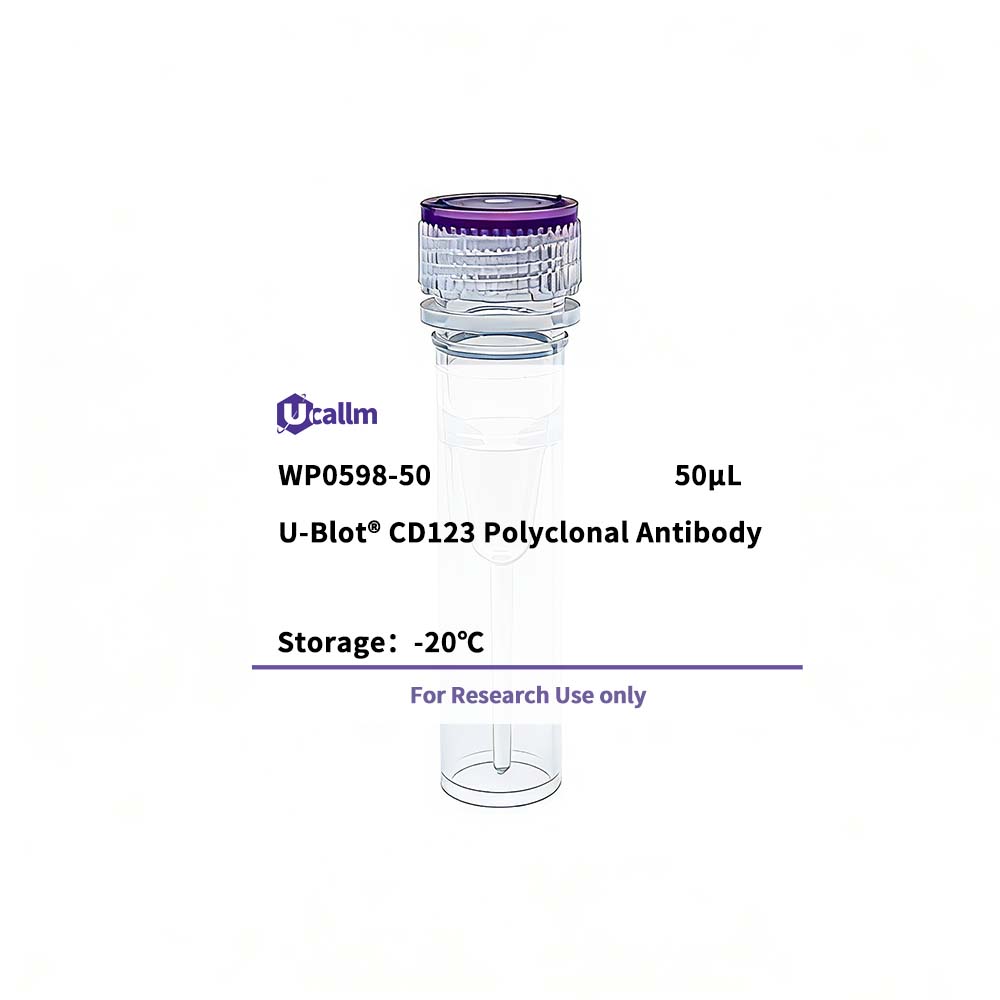
Ucallm_WP0598-50
Price range: $268.00 through $328.00
Product details
Background:
function:Required for S phase entry of the cell cycle., PTM:Phosphorylated., similarity:Belongs to the CDC123 family., tissue specificity:Widely expressed. Expressed in spleen, thymus, prostate, testis, ovary, small intestine, colon and leukocytes with the highest expression in testis.,
Specifications
| Size | 50μL/100μL |
| Target | CD123 |
| Reactivity | Human, Mouse, Rat |
| Applications | WB, ELISA |
| MW(Calculated) | |
| MW(Observed) | 36kD |
| Host Species | Rabbit |
| Isotype | IgG |
| Conjugate/Modification | Unmodified |
| Recommended Dilution Ratio | WB 1:500-2000; ELISA 1:5000-20000 |
| Formulation | Liquid in PBS containing 50% glycerol,0.5% BSA and 0.02% sodium azide. |
| Purification | The antibody was affinity-purified from rabbit antiserum by affinity-chromatography using epitope-specific immunogen. |
| Storage | -15°C to -25°C/1 year(Do not lower than -25°C) |
| Concentration | 1 mg/ml |
| Clonality | Polyclonal |
| Clone Number | |
| Immunogen | Synthesized peptide derived from human protein . at AA range: 270-350 |
| Specificity | CD123 Polyclonal Antibody detects endogenous levels of protein. |
| Gene Name | CDC123 C10orf7 D123 |
| Protein Name | Cell division cycle protein 123 homolog (Protein D123) (HT-1080) (PZ32) |
| Other Name | |
| Species | Human |
| Gene ID | 8872 |
| Uniprot | O75794, |
| Species.1 | Mouse |
| Gene ID.1 | |
| Uniprot.1 | Q8CII2, |
| Species.2 | Rat |
| Gene ID.2 | |
| Uniprot.2 | Q62834 |
| Cellular Localization | Cytoplasm . |
| Tissue Expression | Widely expressed. Expressed in spleen, thymus, prostate, testis, ovary, small intestine, colon and leukocytes with the highest expression in testis. |
| Signaling_pathway | |
| Research Areas | |
| Function | Function:Required for S phase entry of the cell cycle.,PTM:Phosphorylated.,similarity:Belongs to the CDC123 family.,tissue specificity:Widely expressed. Expressed in spleen, thymus, prostate, testis, ovary, small intestine, colon and leukocytes with the highest expression in testis., |
Please login to post questions
Related products





