SKU: WM1682 Categories: ,

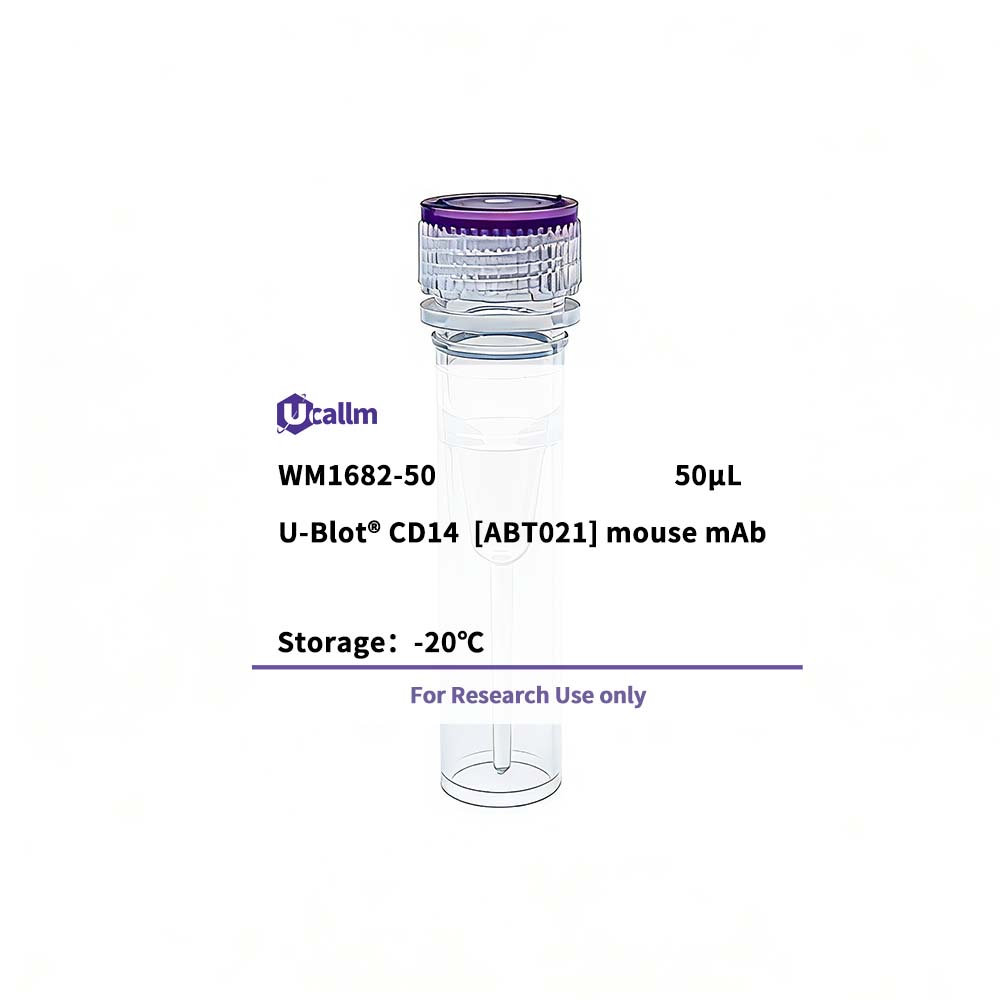
CD14 [ABT021] mouse mAb

Price range: $268.00 through $328.00

SKU: WM1682-50
Enter the quantity you would like, or drag the panel to find the quantity and price that best for you
Bulk QuoteAuthorize OEM & ODM

Product details

Background:
The protein encoded by this gene is a surface antigen that is preferentially expressed on monocytes/macrophages. It cooperates with other proteins to mediate the innate immune response to bacterial lipopolysaccharide. Alternative splicing results in multiple transcript variants encoding the same protein. [provided by RefSeq, Mar 2010],

Specifications

Size50μL/100μL
TargetCD14
ReactivityHuman
ApplicationsIHC, IF, ELISA
MW(Calculated)40kD
MW(Observed)40kD
Host SpeciesMouse
IsotypeIgG2b,Kappa
Conjugate/ModificationUnmodified
Recommended Dilution RatioIHC 1:50-200; IF 1:50-200; ELISA 1:500-5000 / Note: For IHC, we suggest antigen retrieval with TE buffer pH 9.0 (Cat#WT1004)
FormulationPBS, 50% glycerol, 0.05% Proclin 300, 0.05%BSA
PurificationThe antibody was affinity-purified from ascites by affinity-chromatography using specific immunogen.
Storage-15°C to -25°C/1 year(Do not lower than -25°C)
Concentration
ClonalityMonoclonal
Clone NumberRMM021
ImmunogenSynthesized peptide derived from human CD14 AA range: 1-100
SpecificityThe antibody can specifically recognize human CD14 protein.
Gene NameCD14
Protein NameCD14
Other NameMonocyte differentiation antigen CD14; / Myeloid cell-specific leucine-rich glycoprotein; / CD antigen CD14; / [Cleaved into: Monocyte differentiation antigen CD14, urinary form; / Monocyte differentiation antigen CD14, membrane-bound form]
SpeciesHuman
Gene ID929
UniprotP08571
Species.1
Gene ID.1
Uniprot.1
Species.2
Gene ID.2
Uniprot.2
Cellular LocalizationMembranous, Cytoplasmic
Tissue ExpressionDetected on macrophages (at protein level) (PubMed:1698311). Expressed strongly on the surface of monocytes and weakly on the surface of granulocytes; also expressed by most tissue macrophages.
Signaling_pathwayCellular Processes >> Transport and catabolism >> Phagosome;Organismal Systems >> Immune system >> Hematopoietic cell lineage;Organismal Systems >> Immune system >> Toll-like receptor signaling pathway;Human Diseases >> Cancer: overview >> Transcriptional misregulation in cancer;Human Diseases >> Cancer: specific types >> Acute myeloid leukemia;Environmental Information Processing >> Signal transduction >> MAPK signaling pathway;Environmental Information Processing >> Signal transduction >> NF-kappa B signaling pathway
Research Areas>>MAPK signaling pathway; / >>NF-kappa B signaling pathway; / >>Phagosome; / >>Toll-like receptor signaling pathway; / >>Hematopoietic cell lineage; / >>Alcoholic liver disease; / >>Shigellosis; / >>Salmonella infection; / >>Pertussis; / >>Legionellosis; / >>Amoebiasis; / >>Tuberculosis; / >>Transcriptional misregulation in cancer; / >>Acute myeloid leukemia; / >>Lipid and atherosclerosis
FunctionFunction:Cooperates with MD-2 and TLR4 to mediate the innate immune response to bacterial lipopolysaccharide (LPS). Acts via MyD88, TIRAP and TRAF6, leading to NF-kappa-B activation, cytokine secretion and the inflammatory response. Up-regulates cell surface molecules, including adhesion molecules.,online information:CD14 entry,similarity:Contains 11 LRR (leucine-rich) repeats.,subunit:Belongs to the lipopolysaccharide (LPS) receptor, a multi-protein complex containing at least CD14, MD-2 and TLR4.,tissue specificity:Expressed strongly on the surface of monocytes and weakly on the surface of granulocytes; also expressed by most tissue macrophages.,
Please login to post questions
Back to Top
Product has been added to your cart

