

CD26 Polyclonal Antibody
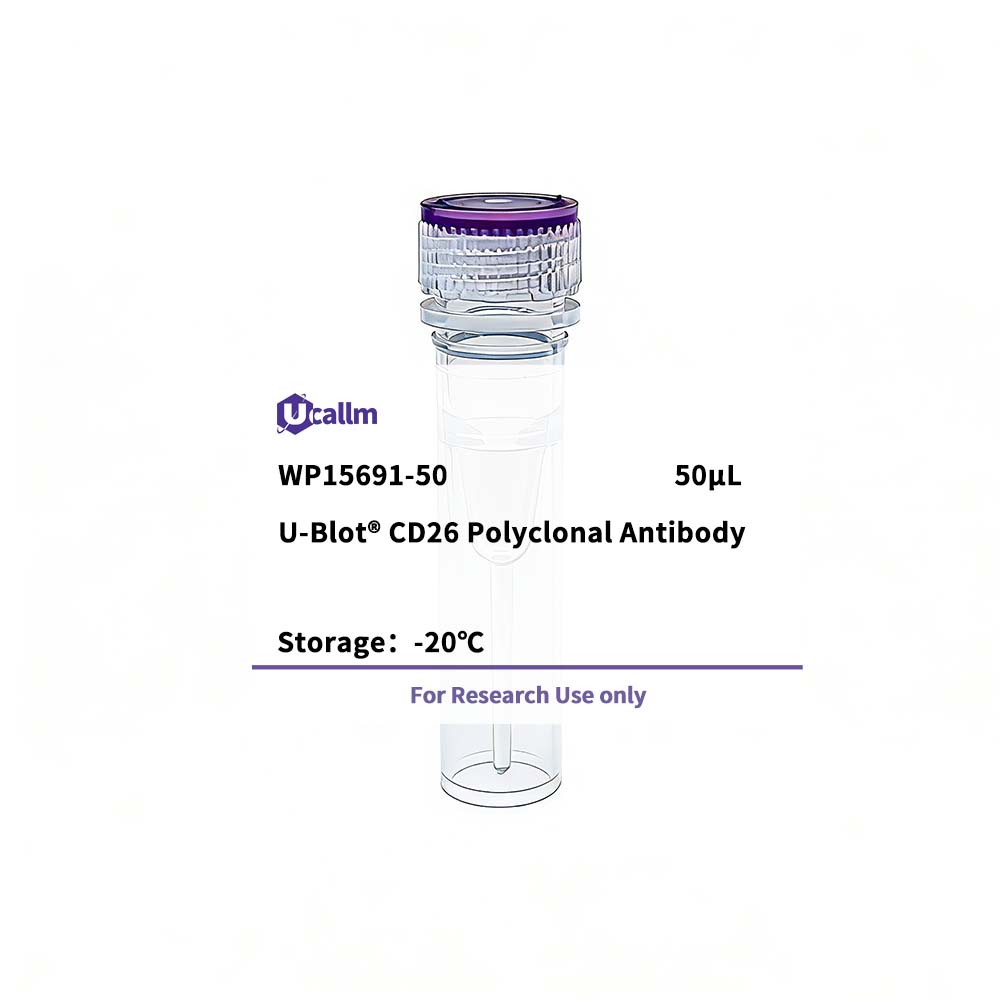
Ucallm_WP15691-50
Price range: $268.00 through $328.00
Product details
Background:
The protein encoded by this gene is identical to adenosine deaminase complexing protein-2, and to the T-cell activation antigen CD26. It is an intrinsic membrane glycoprotein and a serine exopeptidase that cleaves X-proline dipeptides from the N-terminus of polypeptides. [provided by RefSeq, Jul 2008],
Specifications
| Size | 50μL/100μL |
| Target | CD26 |
| Reactivity | Human, Mouse, Rat |
| Applications | WB, IHC, IF, ELISA |
| MW(Calculated) | |
| MW(Observed) | 105kD |
| Host Species | Rabbit |
| Isotype | IgG |
| Conjugate/Modification | Unmodified |
| Recommended Dilution Ratio | WB 1:500-1:2000; IHC: 1:100-1:300; ELISA 1:10000; IF 1:50-200 / Note: For IHC, we suggest antigen retrieval with TE buffer pH 9.0 (Cat#WT1004) |
| Formulation | Liquid in PBS containing 50% glycerol, 0.5% BSA and 0.02% sodium azide. |
| Purification | The antibody was affinity-purified from rabbit antiserum by affinity-chromatography using epitope-specific immunogen. |
| Storage | -15°C to -25°C/1 year(Do not lower than -25°C) |
| Concentration | 1 mg/ml |
| Clonality | Polyclonal |
| Clone Number | |
| Immunogen | The antiserum was produced against synthesized peptide derived from the Internal region of human DPP4. AA range:350-400 |
| Specificity | CD26 Polyclonal Antibody detects endogenous levels of CD26 protein. |
| Gene Name | DPP4 ADCP2 CD26 |
| Protein Name | Dipeptidyl peptidase 4 (ADABP) (Adenosine deaminase complexing protein 2) (ADCP-2) (Dipeptidyl peptidase IV) (DPP IV) (T-cell activation antigen CD26) (TP103) (CD antigen CD26) |
| Other Name | DPP4; / ADCP2; / CD26; / Dipeptidyl peptidase 4; / ADABP; / Adenosine deaminase complexing protein 2; / ADCP-2; / Dipeptidyl peptidase IV; / DPP IV; / T-cell activation antigen CD26; / TP103; / CD26 |
| Species | Human |
| Gene ID | 1803 |
| Uniprot | P27487, |
| Species.1 | Mouse |
| Gene ID.1 | |
| Uniprot.1 | P28843 |
| Species.2 | |
| Gene ID.2 | |
| Uniprot.2 | |
| Cellular Localization | [Dipeptidyl peptidase 4 soluble form]: Secreted . Detected in the serum and the seminal fluid. .; Cell membrane; Single-pass type II membrane protein. Apical cell membrane; Single-pass type II membrane protein. Cell projection, invadopodium membrane; Single-pass type II membrane protein. Cell projection, lamellipodium membrane; Single-pass type II membrane protein. Cell junction . Membrane raft . Translocated to the apical membrane through the concerted action of N- and O-Glycans and its association with lipid microdomains containing cholesterol and sphingolipids (PubMed:11773049). Redistributed to membrane rafts in T-cell in an interleukin-12-dependent activation (PubMed:12676959). Its interaction with CAV1 is necessary for its translocation to membrane rafts (PubMed:17287217). Colocalized with PTPRC in membrane rafts (PubMed:12676959). Colocalized with FAP in invadopodia and lamellipodia of migratory activated endothelial cells in collagenous matrix. Colocalized with FAP on endothelial cells of capillary-like microvessels but not large vessels within invasive breast ductal carcinoma (PubMed:16651416). Colocalized with ADA at the cell junction in lymphocyte-epithelial cell adhesion (PubMed:11772392). Colocalized with IGF2R in internalized cytoplasmic vesicles adjacent to the cell surface (PubMed:10900005). . |
| Tissue Expression | Expressed specifically in lymphatic vessels but not in blood vessels in the skin, small intestine, esophagus, ovary, breast and prostate glands. Not detected in lymphatic vessels in the lung, kidney, uterus, liver and stomach (at protein level). Expressed in the poorly differentiated crypt cells of the small intestine as well as in the mature villous cells. Expressed at very low levels in the colon. |
| Signaling_pathway | |
| Research Areas | >>Protein digestion and absorption |
| Function | Catalytic activity:Release of an N-terminal dipeptide, Xaa-Yaa-|-Zaa-, from a polypeptide, preferentially when Yaa is Pro, provided Zaa is neither Pro nor hydroxyproline.,Function:Removes N-terminal dipeptides sequentially from polypeptides having unsubstituted N-termini provided that the penultimate residue is proline. Plays a role in T-cell activation.,online information:Dipeptidyl peptidase-4 entry,PTM:The soluble form (SDPP) derives from the membrane form (MDPP) by proteolytic processing.,similarity:Belongs to the peptidase S9B family. DPPIV subfamily.,subunit:Homodimer or heterodimer with Seprase (FAP).,tissue specificity:Expressed in the poorly differentiated crypt cells of the small intestine as well as in the mature villous cells. Expressed at very low levels in the colon., |
Please login to post questions
Related products




