SKU: WM1291 Categories: ,

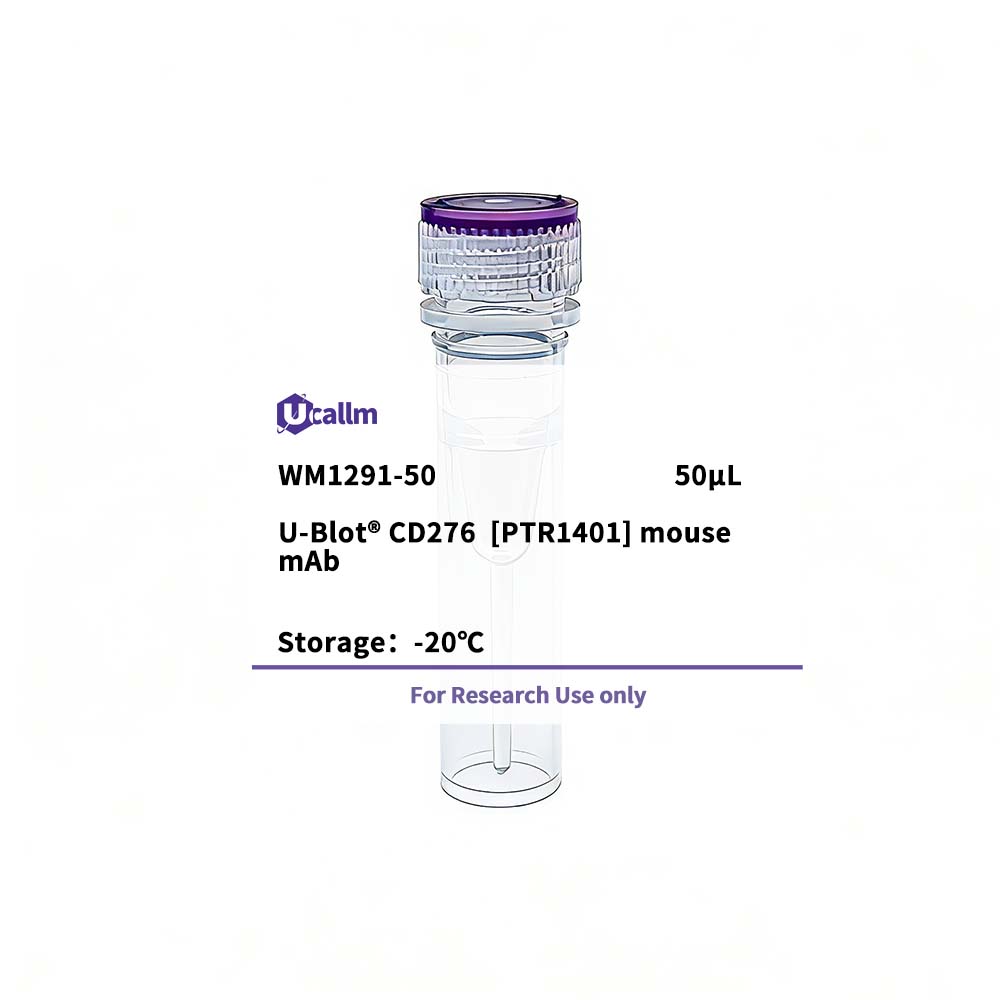
CD276 [PTR1401] mouse mAb

Price range: $268.00 through $328.00

SKU: WM1291-50
Enter the quantity you would like, or drag the panel to find the quantity and price that best for you
Bulk QuoteAuthorize OEM & ODM

Product details

Background:
The protein encoded by this gene belongs to the immunoglobulin superfamily, and thought to participate in the regulation of T-cell-mediated immune response. Studies show that while the transcript of this gene is ubiquitously expressed in normal tissues and solid tumors, the protein is preferentially expressed only in tumor tissues. Additionally, it was observed that the 3' UTR of this transcript contains a target site for miR29 microRNA, and there is an inverse correlation between the expression of this protein and miR29 levels, suggesting regulation of expression of this gene product by miR29. Alternatively spliced transcript variants encoding different isoforms have been found for this gene. [provided by RefSeq, Sep 2011],


Specifications

Size50μL/100μL
TargetCD276
ReactivityHuman, Mouse, Rat
ApplicationsWB, IF, ELISA
MW(Calculated)57kD
MW(Observed)110kD
Host SpeciesMouse
IsotypeIgG1,kappa
Conjugate/ModificationUnmodified
Recommended Dilution RatioWB 1:500-2000; IF 1:100-500; ELISA 1:1000-5000;
FormulationPBS, 50% glycerol, 0.05% Proclin 300, 0.05%BSA
PurificationThe antibody was affinity-purified from ascites by affinity-chromatography using specific immunogen.
Storage-15°C to -25°C/1 year(Do not lower than -25°C)
Concentration
ClonalityMonoclonal
Clone NumberRMMR1401
ImmunogenAA range: 100-200
SpecificityThis antibody detects endogenous levels of CD276 protein.
Gene NameCD276
Protein NameCD276 antigen
Other NameCD276; / B7H3; / PSEC0249; / CD276 antigen; / 4Ig-B7-H3; / B7 homolog 3; / B7-H3; / Costimulatory molecule; / CD276
SpeciesHuman
Gene ID80381
UniprotQ5ZPR3,
Species.1Mouse
Gene ID.1102657
Uniprot.1Q8VE98,
Species.2Rat
Gene ID.2315716
Uniprot.2Q7TPB4
Cellular LocalizationMembrane
Tissue ExpressionUbiquitous but not detectable in peripheral blood lymphocytes or granulocytes. Weakly expressed in resting monocytes. Expressed in dendritic cells derived from monocytes. Expressed in epithelial cells of sinonasal tissue. Expressed in extravillous trophoblast cells and Hofbauer cells of the first trimester placenta and term placenta.
Signaling_pathwayEnvironmental Information Processing >> Signaling molecules and interaction >> Cell adhesion molecules
Research Areas>>Cell adhesion molecules
FunctionFunction:May participate in the regulation of T-cell-mediated immune response. May play a protective role in tumor cells by inhibiting natural-killer mediated cell lysis as well as a role of marker for detection of neuroblastoma cells. May be involved in the development of acute and chronic transplant rejection and in the regulation of lymphocytic activity at mucosal surfaces. Could also play a key role in providing the placenta and fetus with a suitable immunological environment throughout pregnancy. Both isoform 1 and isoform 2 appear to be redundant in their ability to modulate CD4 T-cell responses. Isoform 2 is shown to enhance the induction of cytotoxic T-cells and selectively stimulates interferon gamma production in the presence of T-cell receptor signaling.,induction:By LPS in monocytes and by ionomycin in T and B lymphocytes. Up-regulated in cells mediating rejection of human transplants.,miscellaneous:B7-H3 locus underwent genomic duplication leading to tandemly repeated immunoglobulin-like V and C domains (VC domains). The dominantly expressed human B7-H3 isoform contains tandemly duplicated VC domains. In contrast, mouse B7-H3 transcript contains only one single VC domain form due to an exon structure corresponding to V domain-(pseudoexon C)-(pseudoexon V)-C domain. This duplication appearing in primates is suggested to be very recent supporting a model of multiple independent emergence of tandem VC repeats within human and monkey species.,similarity:Belongs to the immunoglobulin superfamily. BTN/MOG family.,similarity:Contains 2 Ig-like C2-type (immunoglobulin-like) domains.,similarity:Contains 2 Ig-like V-type (immunoglobulin-like) domains.,subunit:Interacts with TREML2 and this interaction enhances T-cell activation.,tissue specificity:Ubiquitous but not detectable in peripheral blood lymphocytes or granulocytes. Weakly expressed in resting monocytes. Expressed in dendritic cells derived from monocytes. Expressed in epithelial cells of sinonasal tissue. Expressed in extravillous trophoblast cells and Hofbauer cells of the first trimester placenta and term placenta.,
Please login to post questions
Back to Top
Product has been added to your cart

