


CD40 [PTR1379] recombinant mouse mAb
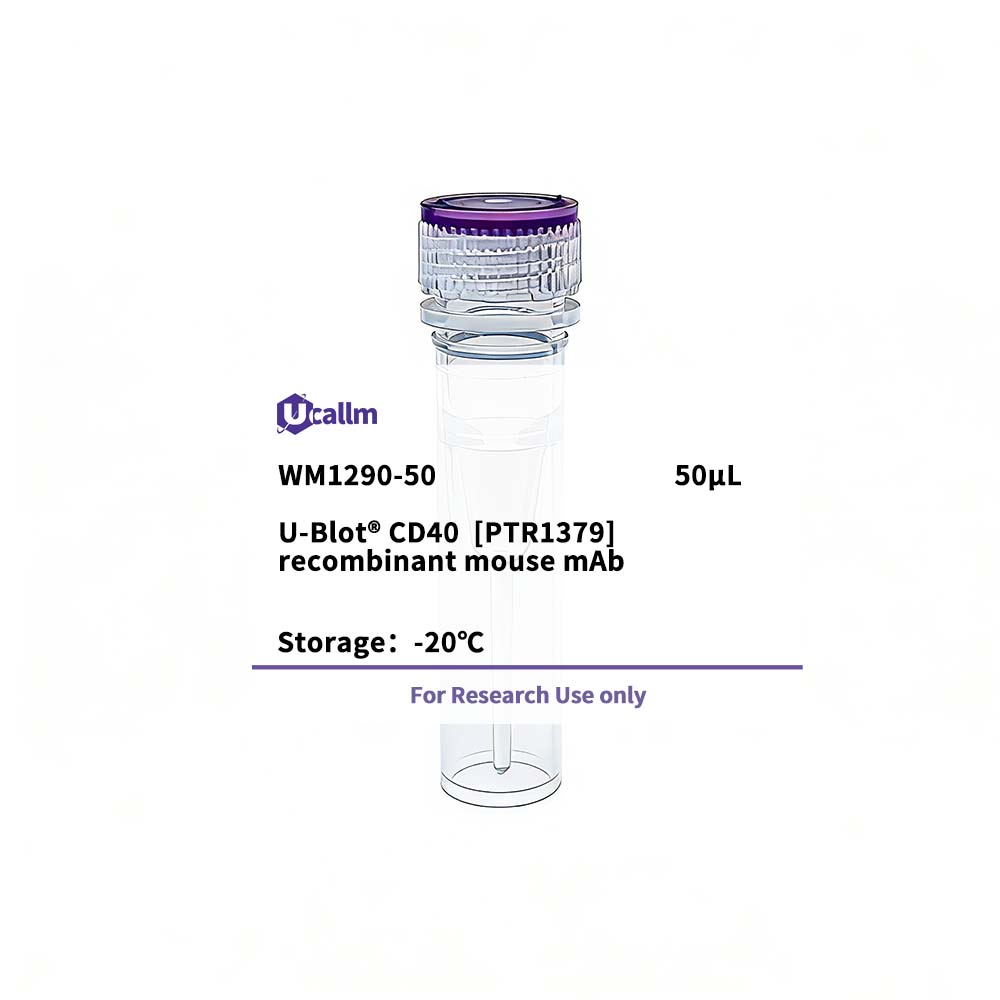
Ucallm_WM1290-50
Price range: $268.00 through $328.00
Product details
Background:
This gene is a member of the TNF-receptor superfamily. The encoded protein is a receptor on antigen-presenting cells of the immune system and is essential for mediating a broad variety of immune and inflammatory responses including T cell-dependent immunoglobulin class switching, memory B cell development, and germinal center formation. AT-hook transcription factor AKNA is reported to coordinately regulate the expression of this receptor and its ligand, which may be important for homotypic cell interactions. Adaptor protein TNFR2 interacts with this receptor and serves as a mediator of the signal transduction. The interaction of this receptor and its ligand is found to be necessary for amyloid-beta-induced microglial activation, and thus is thought to be an early event in Alzheimer disease pathogenesis. Mutations affecting this gene are the cause of autosomal recessive hyper-IgM immunodeficiency type 3 (HIG
Specifications
| Size | 50μL/100μL |
| Target | CD14 |
| Reactivity | Human |
| Applications | FC, ELISA |
| MW(Calculated) | 30kD |
| MW(Observed) | |
| Host Species | Mouse |
| Isotype | IgG2a,Kappa |
| Conjugate/Modification | Unmodified |
| Recommended Dilution Ratio | ELISA 1:5000-100000; Flow Cyt 1-2μg/Test |
| Formulation | Phosphate-buffered solution |
| Purification | Recombinant Expression and Affinity purified |
| Storage | -15°C to -25°C/1 year(Avoid freeze / thaw cycles) |
| Concentration | Please check the information on the tube |
| Clonality | Monoclonal |
| Clone Number | RMMR1374 |
| Immunogen | Purified recombinant human CD40. |
| Specificity | This recombinant monoclonal antibody can detects endogenous levels of CD40 protein. |
| Gene Name | CD40 |
| Protein Name | Tumor necrosis factor receptor superfamily member 5 |
| Other Name | CD40; / TNFRSF5; / Tumor necrosis factor receptor superfamily member 5; / B-cell surface antigen CD40; / Bp50; / CD40L receptor; / CDw40; / CD antigen CD40 |
| Species | Human |
| Gene ID | 929 |
| Uniprot | P25942, |
| Species.1 | Mouse |
| Gene ID.1 | 21939 |
| Uniprot.1 | P27512 |
| Species.2 | |
| Gene ID.2 | |
| Uniprot.2 | |
| Cellular Localization | [Isoform I]: Cell membrane; Single-pass type I membrane protein.; [Isoform II]: Secreted. |
| Tissue Expression | Detected on macrophages (at protein level) (PubMed:1698311). Expressed strongly on the surface of monocytes and weakly on the surface of granulocytes; also expressed by most tissue macrophages. |
| Signaling_pathway | Cellular Processes >> Transport and catabolism >> Phagosome;Organismal Systems >> Immune system >> Hematopoietic cell lineage;Organismal Systems >> Immune system >> Toll-like receptor signaling pathway;Human Diseases >> Cancer: overview >> Transcriptional misregulation in cancer;Human Diseases >> Cancer: specific types >> Acute myeloid leukemia;Environmental Information Processing >> Signal transduction >> MAPK signaling pathway;Environmental Information Processing >> Signal transduction >> NF-kappa B signaling pathway |
| Research Areas | |
| Function | Alternative products:Additional isoforms seem to exist,Disease:Defects in CD40 are the cause of hyper-IgM immunodeficiency type 3 (HIGM3) [MIM:606843]. HIGM3 is an autosomal recessive disorder which includes an inability of B cells to undergo isotype switching, one of the final differentiation steps in the humoral immune system, an inability to mount an antibody-specific immune response, and a lack of germinal center formation.,Function:Receptor for TNFSF5/CD40LG.,online information:CD40 entry,online information:CD40 mutation db,similarity:Contains 4 TNFR-Cys repeats.,subunit:Monomer and homodimer. The variant form found in the bladder carcinoma cell line Hu549 does not form homodimers. Interacts with TRAF1, TRAF2, TRAF3, TRAF5 and TRAF6.,tissue specificity:B-cells and in primary carcinomas., |
Please login to post questions
Related products



