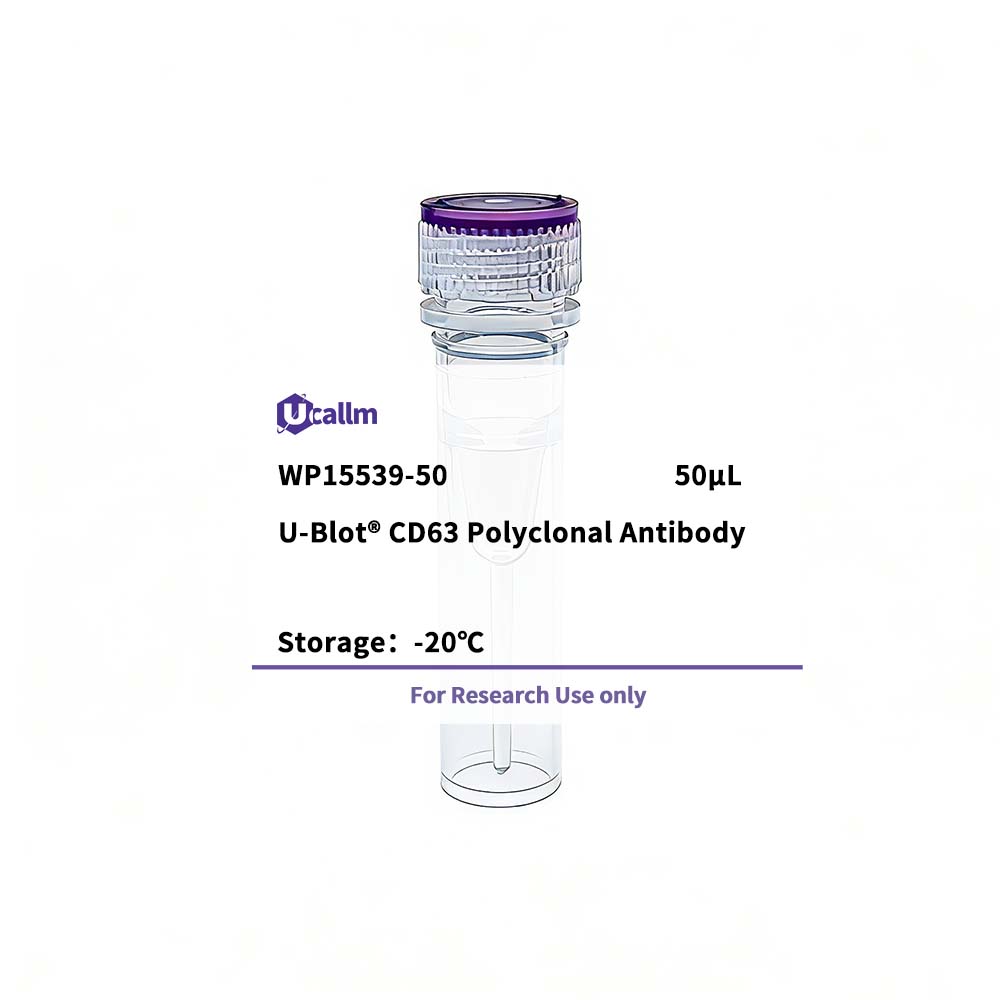
SKU: WP15539 Categories: ,

CD63 Polyclonal Antibody

Price range: $268.00 through $328.00

SKU: WP15539-100
Enter the quantity you would like, or drag the panel to find the quantity and price that best for you
Bulk QuoteAuthorize OEM & ODM

Product details

Background:

The protein encoded by this gene is a member of the transmembrane 4 superfamily, also known as the tetraspanin family. Most of these members are cell-surface proteins that are characterized by the presence of four hydrophobic domains. The proteins mediate signal transduction events that play a role in the regulation of cell development, activation, growth and motility. The encoded protein is a cell surface glycoprotein that is known to complex with integrins. It may function as a blood platelet activation marker. Deficiency of this protein is associated with Hermansky-Pudlak syndrome. Also this gene has been associated with tumor progression. Alternative splicing results in multiple transcript variants encoding different protein isoforms. [provided by RefSeq, Apr 2012],

Specifications

Size50μL/100μL
TargetCD63
ReactivityHuman, Mouse, Rat
ApplicationsIF, WB, IHC, ELISA
MW(Calculated)
MW(Observed)26,35-65(kD
Host SpeciesRabbit
IsotypeIgG
Conjugate/ModificationUnmodified
Recommended Dilution RatioIF 1:50-200; WB 1:500-1:2000; IHC: 1:100-1:300; ELISA 1:20000; Not yet tested in other applications; / Note: For IHC, we suggest antigen retrieval with TE buffer pH 9.0 (Cat#WT1004)
FormulationLiquid in PBS containing 50% glycerol, 0.5% BSA and 0.02% sodium azide.
PurificationThe antibody was affinity-purified from rabbit antiserum by affinity-chromatography using epitope-specific immunogen.
Storage-15°C to -25°C/1 year(Do not lower than -25°C)
Concentration1 mg/ml
ClonalityPolyclonal
Clone Number
ImmunogenThe antiserum was produced against synthesized peptide derived from the Internal region of human CD63. AA range:121-170
SpecificityCD63 Polyclonal Antibody detects endogenous levels of CD63 protein.
Gene NameCD63 MLA1 TSPAN30
Protein NameCD63 antigen (Granulophysin) (Lysosomal-associated membrane protein 3) (LAMP-3) (Melanoma-associated antigen ME491) (OMA81H) (Ocular melanoma-associated antigen) (Tetraspanin-30) (Tspan-30) (CD antigen CD63)
Other NameCD63; / MLA1; / TSPAN30; / CD63 antigen; / Granulophysin; / Lysosomal-associated membrane protein 3; / LAMP-3; / Melanoma-associated antigen ME491; / OMA81H; / Ocular melanoma-associated antigen; / Tetraspanin-30; / Tspan-30; / CD63
SpeciesHuman
Gene ID967
UniprotP08962,
Species.1Mouse
Gene ID.1
Uniprot.1P41731
Species.2
Gene ID.2
Uniprot.2
Cellular LocalizationCell membrane; Multi-pass membrane protein . Lysosome membrane; Multi-pass membrane protein . Late endosome membrane; Multi-pass membrane protein . Endosome, multivesicular body . Melanosome . Secreted, extracellular exosome . Cell surface . Also found in Weibel-Palade bodies of endothelial cells (PubMed:10793155). Located in platelet dense granules (PubMed:7682577). Detected in a subset of pre-melanosomes. Detected on intralumenal vesicles (ILVs) within multivesicular bodies (PubMed:21962903). .
Tissue ExpressionDetected in platelets (at protein level). Dysplastic nevi, radial growth phase primary melanomas, hematopoietic cells, tissue macrophages.
Signaling_pathwayCellular Processes >> Transport and catabolism >> Lysosome
Research Areas>>Lysosome; / >>Proteoglycans in cancer
FunctionFunction:This antigen is associated with early stages of melanoma tumor progression. May play a role in growth regulation.,miscellaneous:Lack of expression of CD63 in platelets has been observed in a patient with Hermansky-Pudlak syndrome (HPS). Hermansky-Pudlak syndrome (HPS) is a genetically heterogeneous, rare, autosomal recessive disorder characterized by oculocutaneous albinism, bleeding due to platelet storage pool deficiency, and lysosomal storage defects. This syndrome results from defects of diverse cytoplasmic organelles including melanosomes, platelet dense granules and lysosomes. Ceroid storage in the lungs is associated with pulmonary fibrosis, a common cause of premature death in individuals with HPS.,similarity:Belongs to the tetraspanin (TM4SF) family.,subcellular location:Also found in Weibel-Palade bodies of endothelial cells. Located in platelet dense granules.,tissue specificity:Dysplastic nevi, radial growth phase primary melanomas, hematopoietic cells, tissue macrophages.,
Please login to post questions
Back to Top
Product has been added to your cart

