SKU: WR5154 Categories: ,

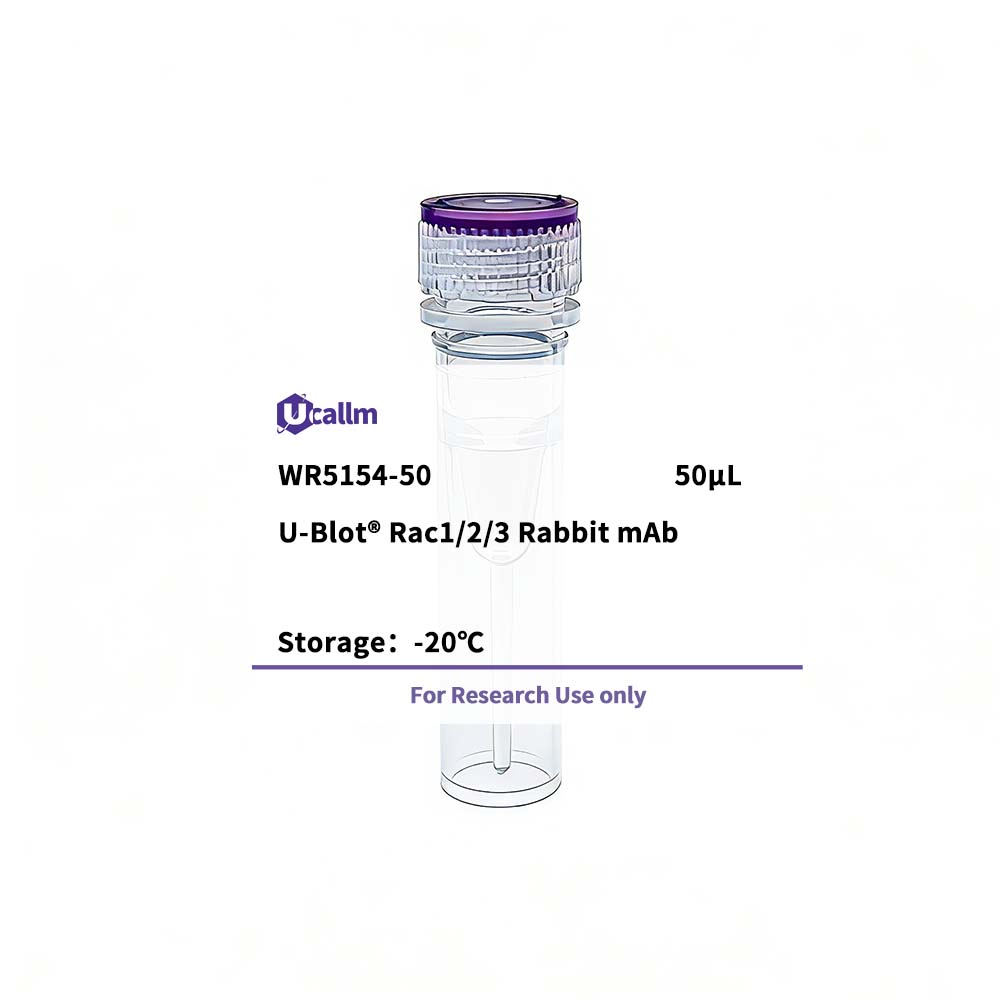
U-Blot® Rac1/2/3 Rabbit mAb

Price range: $268.00 through $328.00

SKU: WR5154-50
Enter the quantity you would like, or drag the panel to find the quantity and price that best for you
Bulk QuoteAuthorize OEM & ODM

Product details

Background:The protein encoded by this gene is a GTPase which belongs to the RAS superfamily of small GTP-binding proteins. Members of this superfamily appear to regulate a diverse array of cellular events, including the control of cell growth, cytoskeletal reorganization, and the activation of protein kinases. Two transcript variants encoding different isoforms have been found for this gene. [provided by RefSeq, Mar 2009],

Specifications

Size50μL/100μL
TargetRac1/2/3
ReactivityHuman, Mouse, Rat
ApplicationsWB, IHC, IF, ELISA
MW(Calculated)21kD
MW(Observed)21kD
Host SpeciesRabbit
IsotypeIgG,Kappa
Conjugate/ModificationUnmodified
Recommended Dilution RatioIHC 1:200-1:1000; WB 1:2000-1:10000; IF 1:200-1:1000; ELISA 1:5000-1:20000; / Note: For IHC, we suggest antigen retrieval with TE buffer pH 9.0 (Cat#WT1004)
FormulationPBS, 50% glycerol, 0.05% Proclin 300, 0.05%BSA
PurificationRecombinant Antibody expressed in animal component-free (ACF) media, purified via Protein A affinity chromatography.
Storage-15°C to -25°C/1 year(Do not lower than -25°C)
Concentration
ClonalityMonoclonal
Clone NumberRM1388R
ImmunogenThe specific immunogen used to produce this antibody is proprietary information.
SpecificityEndogenous
Gene NameRac1/2/3
Protein NameRas-related C3 botulinum toxin substrate 1/Ras-related C3 botulinum toxin substrate 2/Ras-related C3 botulinum toxin substrate 3
Other NameRAC1; / TC25; / MIG5; / Ras-related C3 botulinum toxin substrate 1; / Cell migration-inducing gene 5 protein; / Ras-like protein TC25; / p21-Rac1; / RAC2; / Ras-related C3 botulinum toxin substrate 2; / GX; / Small G protein; / p21-Rac2; / RAC3; / Ras-related C3 botulinum toxin substrate 3
SpeciesHuman
Gene ID5879;5880;5881
UniprotP63000;P15153;P60763,
Species.1Mouse
Gene ID.119353;19354;170758,
Uniprot.1
Species.2Rat
Gene ID.2363875;64465
Uniprot.2Q6RUV5;Q8CFN2
Cellular LocalizationCell membrane; Lipid-anchor; Cytoplasmic side . Melanosome . Cytoplasm . Cell projection, lamellipodium . Cell projection, dendrite . Cell junction, synapse . Nucleus . Inner surface of plasma membrane possibly with attachment requiring prenylation of the C-terminal cysteine (PubMed:1903399). Identified by mass spectrometry in melanosome fractions from stage I to stage IV (PubMed:17081065). Found in the ruffled border (a late endosomal-like compartment in the plasma membrane) of bone-resorbing osteoclasts. Localizes to the lamellipodium in a SH3RF1-dependent manner (By similarity). In macrophages, cytoplasmic location increases upon CSF1 stimulation (By similarity). Activation by GTP-binding promotes nuclear localization (PubMed:12551911). .
Tissue ExpressionIsoform B is predominantly identified in skin and epithelial tissues from the intestinal tract. Its expression is elevated in colorectal tumors at various stages of neoplastic progression, as compared to their respective adjacent tissues.
Signaling_pathwayCellular Processes >> Transport and catabolism >> Phagosome;Cellular Processes >> Cellular community - eukaryotes >> Focal adhesion;Cellular Processes >> Cellular community - eukaryotes >> Adherens junction;Cellular Processes >> Cellular community - eukaryotes >> Tight junction;Cellular Processes >> Cell motility >> Regulation of actin cytoskeleton;Organismal Systems >> Immune system >> Neutrophil extracellular trap formation;Organismal Systems >> Immune system >> Toll-like receptor signaling pathway;Organismal Systems >> Immune system >> Natural killer cell mediated cytotoxicity;Organismal Systems >> Immune system >> B cell receptor signaling pathway;Organismal Systems >> Immune system >> Fc epsilon RI signaling pathway;Organismal Systems >> Immune system >> Fc gamma R-mediated phagocytosis;Organismal Systems >> Immune system >> Leukocyte transendothelial migration;Organismal Systems >> Immune system >> Chemokine signaling pathway;Organismal Systems >> Nervous system >> Neurotrophin signaling pathway;Organismal Systems >> Development and regeneration >> Osteoclast differentiation;Human Diseases >> Cancer: overview >> Pathways in cancer;Human Diseases >> Cancer: specific types >> Colorectal cancer;Human Diseases >> Cancer: specific types >> Pancreatic cancer;Human Diseases >> Cancer: specific types >> Renal cell carcinoma;Human Diseases >> Neurodegenerative disease >> Amyotrophic lateral sclerosis;Human Diseases >> Neurodegenerative disease >> Prion disease;Human Diseases >> Neurodegenerative disease >> Pathways of neurodegeneration - multiple diseases;Environmental Information Processing >> Signal transduction >> MAPK signaling pathway;Environmental Information Processing >> Signal transduction >> Ras signaling pathway;Environmental Information Processing >> Signal transduction >> Rap1 signaling pathway;Environmental Information Processing >> Signal transduction >> Wnt signaling pathway;Environmental Information Processing >> Signal transduction >> VEGF signaling pathway;Environmental Information Processing >> Signal transduction >> Sphingolipid signaling pathway;Environmental Information Processing >> Signal transduction >> cAMP signaling pathway;Environmental Information Processing >> Signal transduction >> PI3K-Akt signaling pathway
Research Areas>>MAPK signaling pathway; / >>Ras signaling pathway; / >>Rap1 signaling pathway; / >>cAMP signaling pathway; / >>Chemokine signaling pathway; / >>Sphingolipid signaling pathway; / >>Phagosome; / >>PI3K-Akt signaling pathway; / >>Wnt signaling pathway; / >>Axon guidance; / >>VEGF signaling pathway; / >>Osteoclast differentiation; / >>Focal adhesion; / >>Adherens junction; / >>Tight junction; / >>Neutrophil extracellular trap formation; / >>Toll-like receptor signaling pathway; / >>Natural killer cell mediated cytotoxicity; / >>B cell receptor signaling pathway; / >>Fc epsilon RI signaling pathway; / >>Fc gamma R-mediated phagocytosis; / >>Leukocyte transendothelial migration; / >>Neurotrophin signaling pathway; / >>Regulation of actin cytoskeleton; / >>Non-alcoholic fatty liver disease; / >>AGE-RAGE signaling pathway in diabetic complications; / >>Pancreatic secretion; / >>Amyotrophic lateral sclerosis; / >>Prion disease; / >>Pathways of neurodegeneration - multiple diseases; / >>Bacterial invasion of epithelial cells; / >>Epithelial cell signaling in Helicobacter pylori infection; / >>Pathogenic Escherichia coli infection; / >>Shigellosis; / >>Salmonella infection; / >>Yersinia infection; / >>Human cytomegalovirus infection; / >>Kaposi sarcoma-associated herpesvirus infection; / >>Epstein-Barr virus infection; / >>Human immunodeficiency virus 1 infection; / >>Pathways in cancer; / >>Viral carcinogenesis; / >>Proteoglycans in cancer; / >>Chemical carcinogenesis - reactive oxygen species; / >>Colorectal cancer; / >>Renal cell carcinoma; / >>Pancreatic cancer; / >>Choline metabolism in cancer; / >>Diabetic cardiomyopathy; / >>Viral myocarditis; / >>Lipid and atherosclerosis; / >>Fluid shear stress and atherosclerosis
FunctionDomain:The effector region mediates interaction with DEF6.,enzyme regulation:Regulated by guanine nucleotide exchange factors (GEFs) which promote the exchange of bound GDP for free GTP, GTPase activating proteins (GAPs) which increase the GTP hydrolysis activity, and GDP dissociation inhibitors which inhibit the dissociation of the nucleotide from the GTPase.,Function:Isoform B has an accelerated GEF-independent GDP/GTP exchange and an impaired GTP hydrolysis, which is restored partially by GTPase-activating proteins. It is able to bind to the GTPase-binding domain of PAK but not full-length PAK in a GTP-dependent manner, suggesting that the insertion does not completely abolish effector interaction.,Function:Plasma membrane-associated small GTPase which cycles between active GTP-bound and inactive GDP-bound states. In its active state, binds to a variety of effector proteins to regulate cellular responses such as secretory processes, phagocytosis of apoptotic cells, epithelial cell polarization and growth-factor induced formation of membrane ruffles.,similarity:Belongs to the small GTPase superfamily. Rho family.,subcellular location:Inner surface of plasma membrane possibly with attachment requiring prenylation of the C-terminal cysteine (By similarity). Identified by mass spectrometry in melanosome fractions from stage I to stage IV.,subunit:Interacts with the GEF proteins PREX1, RASGRF2, DOCK1, DOCK2 and DOCK7, which promote the exchange between GDP and GTP, and therefore activate it. Interacts with PARD6A, PARD6B and PARD6G in a GTP-dependent manner. Part of a quaternary complex containing PARD3, some PARD6 protein (PARD6A, PARD6B or PARD6G) and some atypical PKC protein (PRKCI or PRKCZ), which plays a central role in epithelial cell polarization. Found in a trimeric complex composed of DOCK1 and ELMO1, which plays a central role in phagocytosis of apoptotic cells. Interacts with RALBP1 via its effector domain. Interacts with PLXNB1. Part of a complex with MAP2K3, MAP3K3, CCM2 and DEF6. Interacts with BAIAP2, BAIAP2L1, CYFIP1/SRA-1 and DEF6. Interacts with Y.pseudotuberculosis YPKA and PLCB2. Interacts with NOXA1. Interacts with ARHGEF2. Interacts with NISCH.,tissue specificity:Isoform B is predominantly identified in skin and epithelial tissues from the intestinal tract. The expression of isoform B is elevated in colorectal tumors at various stages of neoplastic progression, as compared to their respective adjacent tissues.,
Please login to post questions
Back to Top
Product has been added to your cart


