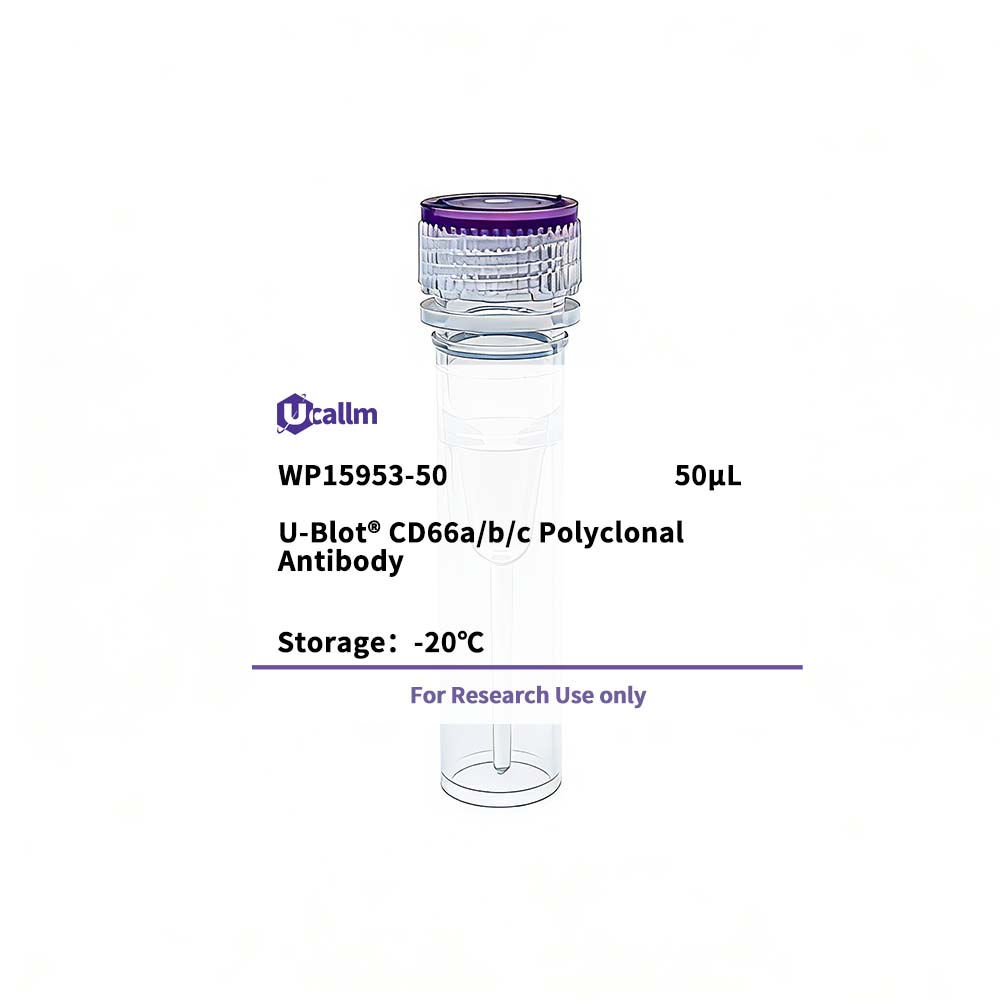
SKU: WP15953 Categories: ,

CD66a/b/c Polyclonal Antibody

Price range: $268.00 through $328.00

SKU: WP15953-100
Enter the quantity you would like, or drag the panel to find the quantity and price that best for you
Bulk QuoteAuthorize OEM & ODM

Product details

Background:

This gene encodes a member of the carcinoembryonic antigen (CEA) gene family, which belongs to the immunoglobulin superfamily. Two subgroups of the CEA family, the CEA cell adhesion molecules and the pregnancy-specific glycoproteins, are located within a 1.2 Mb cluster on the long arm of chromosome 19. Eleven pseudogenes of the CEA cell adhesion molecule subgroup are also found in the cluster. The encoded protein was originally described in bile ducts of liver as biliary glycoprotein. Subsequently, it was found to be a cell-cell adhesion molecule detected on leukocytes, epithelia, and endothelia. The encoded protein mediates cell adhesion via homophilic as well as heterophilic binding to other proteins of the subgroup. Multiple cellular activities have been attributed to the encoded protein, including roles in the differentiation and arrangement of tissue thre

Specifications

Size50μL/100μL
TargetCD66a/b/c
ReactivityHuman, Mouse, Rat
ApplicationsIHC, IF, ELISA
MW(Calculated)
MW(Observed)
Host SpeciesRabbit
IsotypeIgG
Conjugate/ModificationUnmodified
Recommended Dilution RatioIHC 1:50-200; ELISA 1:10000-20000; IF 1:50-200 / Note: For IHC, we suggest antigen retrieval with TE buffer pH 9.0 (Cat#WT1004)
FormulationLiquid in PBS containing 50% glycerol, 0.5% BSA and 0.02% sodium azide.
PurificationThe antibody was affinity-purified from rabbit antiserum by affinity-chromatography using epitope-specific immunogen.
Storage-15°C to -25°C/1 year(Do not lower than -25°C)
Concentration1 mg/ml
ClonalityPolyclonal
Clone Number
ImmunogenSynthetic peptide from human protein at AA range: 130-190
SpecificityThe antibody detects endogenous CD66a/b/c
Gene NameCEACAM1/CEACAM6/CEACAM8
Protein NameCarcinoembryonic antigen-related cell adhesion molecule 1/6/8 (CD antigen CD66a/b/c)
Other Name
SpeciesHuman
Gene ID634;4680;1088
UniprotP13688;P40199;P31997
Species.1
Gene ID.1
Uniprot.1
Species.2
Gene ID.2
Uniprot.2
Cellular Localization[Isoform 1]: Cell membrane; Single-pass type I membrane protein . Lateral cell membrane . Apical cell membrane . Basal cell membrane . Cell junction . Cell junction, adherens junction . Canalicular domain of hepatocyte plasma membranes. Found as a mixture of monomer, dimer and oligomer in the plasma membrane. Occurs predominantly as cis-dimers and/or small cis-oligomers in the cell junction regions. Found as dimer in the solution. Predominantly localized to the lateral cell membranes. .; [Isoform 2]: Secreted .; [Isoform 3]: Secreted .; [Isoform 4]: Secreted .; [Isoform 5]: Cell membrane; Single-pass type I membrane protein.; [Isoform 6]: Cell membrane; Single-pass type I membrane protein.; [Isoform 7]: Cell membrane; Single-pass type I membrane protein.; [Isoform 8]: Cell membrane; Single-pass type I membrane protein . Cytoplasmic vesicle, secretory vesicle membrane . Lateral cell membrane . Apical cell membrane . Basal cell membrane . Cell junction . Cell junction, adherens junction . Predominantly localized to the lateral cell membranes. Found as a mixture of monomer, dimer and oligomer in the plasma membrane. Occurs predominantly as cis-dimers and/or small cis-oligomers in the cell junction regions (By similarity). Co-localizes with ANXA2 in secretory vesicles and with S100A10/p11 at the plasma membrane (PubMed:14522961). .; Cell projection, microvillus membrane; Single-pass type I membrane protein . Apical cell membrane; Single-pass type I membrane protein . Localized to the apical glycocalyx surface (PubMed:10436421). Colocalizes with CEACAM20 at the apical brush border of intestinal cells. .
Tissue ExpressionExpressed in columnar epithelial cells of the colon (at protein level) (PubMed:10436421). The predominant forms expressed by T cells are those containing a long cytoplasmic domain (PubMed:18424730). Expressed in granulocytes and lymphocytes. Leukocytes only express isoforms 6 and isoform 1 (PubMed:11994468).
Signaling_pathway
Research Areas
FunctionDisease:Increased serum levels of BGP-1 are found in individuals suffering from hepatic disorders.,Disease:Loss or reduced expression is a major event in colorectal carcinogenesis.,similarity:Belongs to the immunoglobulin superfamily. CEA family.,similarity:Contains 1 Ig-like V-type (immunoglobulin-like) domain.,similarity:Contains 3 Ig-like C2-type (immunoglobulin-like) domains.,
Please login to post questions
Back to Top
Product has been added to your cart