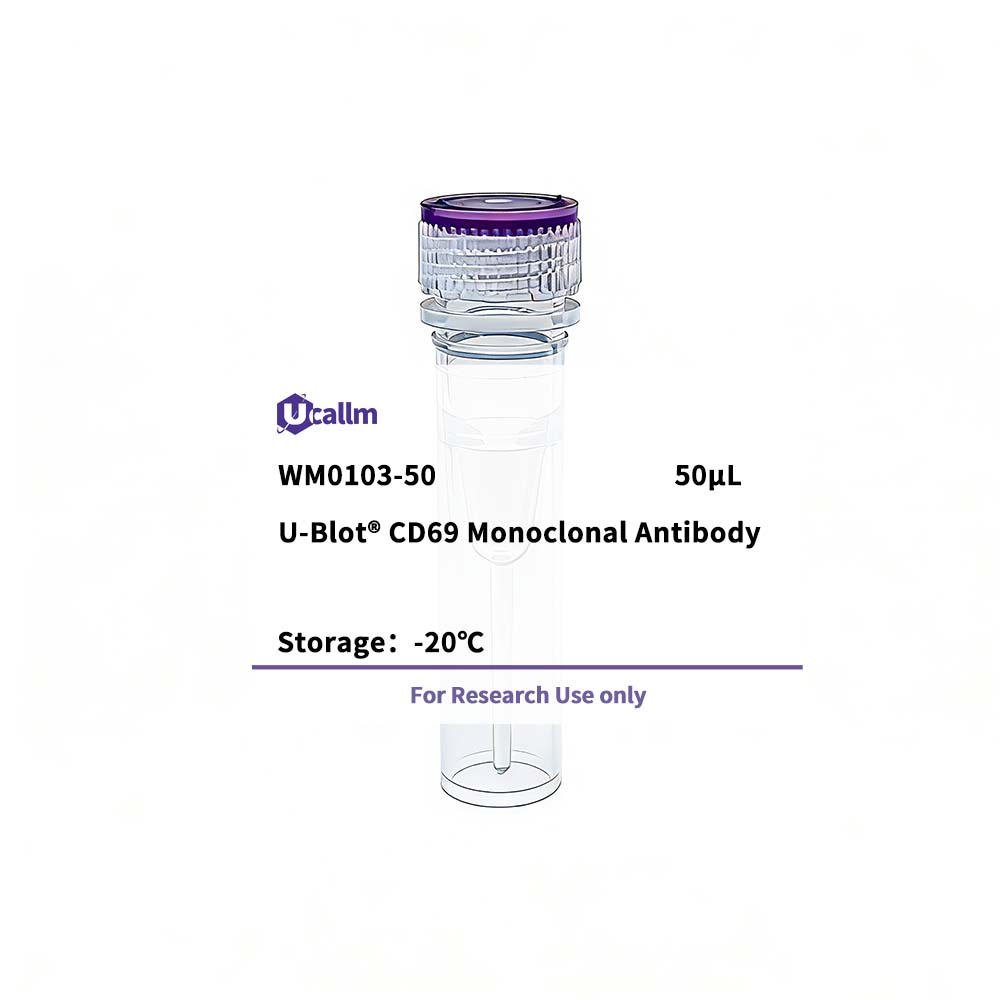
SKU: WM0103 Categories: ,

CD69 Monoclonal Antibody

Price range: $268.00 through $328.00

SKU: WM0103-50
Enter the quantity you would like, or drag the panel to find the quantity and price that best for you
Bulk QuoteAuthorize OEM & ODM

Product details

Background:
This gene encodes a member of the calcium dependent lectin superfamily of type II transmembrane receptors. Expression of the encoded protein is induced upon activation of T lymphocytes, and may play a role in proliferation. Furthermore, the protein may act to transmit signals in natural killer cells and platelets. [provided by RefSeq, Aug 2011],


Specifications

Size50μL/100μL
TargetCD69
ReactivityHuman
ApplicationsWB, IHC, IF, FC, ELISA
MW(Calculated)23kD
MW(Observed)
Host SpeciesMouse
Isotype
Conjugate/ModificationUnmodified
Recommended Dilution RatioWB 1:500-1:2000; IHC 1:200-1:1000; Flow Cyt 1:200-1:400; ELISA 1:10000; IF 1:50-200 / Note: For IHC, we suggest antigen retrieval with TE buffer pH 9.0 (Cat#WT1004)
FormulationLiquid in PBS containing 50% glycerol, 0.5% BSA and 0.02% sodium azide.
PurificationAffinity purification
Storage-15°C to -25°C/1 year(Do not lower than -25°C)
Concentration
ClonalityMonoclonal
Clone Number15H4
ImmunogenPurified recombinant fragment of human CD69 expressed in E. Coli.
SpecificityCD69 Monoclonal Antibody detects endogenous levels of CD69 protein.
Gene NameCD69
Protein NameEarly activation antigen CD69
Other NameCD69; / CLEC2C; / Early activation antigen CD69; / Activation inducer molecule; / AIM; / BL-AC/P26; / C-type lectin domain family 2 member C; / EA1; / Early T-cell activation antigen p60; / GP32/28; / Leukocyte surface antigen Leu-23; / MLR-3; / CD antigen CD69
SpeciesHuman
Gene ID969
UniprotQ07108,
Species.1Mouse
Gene ID.1
Uniprot.1P37217
Species.2
Gene ID.2
Uniprot.2
Cellular LocalizationMembrane; Single-pass type II membrane protein.
Tissue ExpressionExpressed on the surface of activated T-cells, B-cells, natural killer cells, neutrophils, eosinophils, epidermal Langerhans cells and platelets.
Signaling_pathway
Research Areas
Functiondevelopmental stage:Earliest inducible cell surface glycoprotein acquired during lymphoid activation.,Function:Involved in lymphocyte proliferation and functions as a signal transmitting receptor in lymphocytes, natural killer (NK) cells, and platelets.,induction:By antigens, mitogens or activators of PKC on the surface of T and B-lymphocytes. By interaction of IL-2 with the p75 IL-2R on the surface of NK cells.,online information:CD69,PTM:Constitutive Ser/Thr phosphorylation in both mature thymocytes and activated T-lymphocytes.,similarity:Contains 1 C-type lectin domain.,subunit:Homodimer; disulfide-linked.,tissue specificity:Expressed on the surface of activated T-cells, B-cells, natural killer cells, neutrophils, eosinophils, epidermal Langerhans cells and platelets.,
Please login to post questions
Back to Top
Product has been added to your cart
