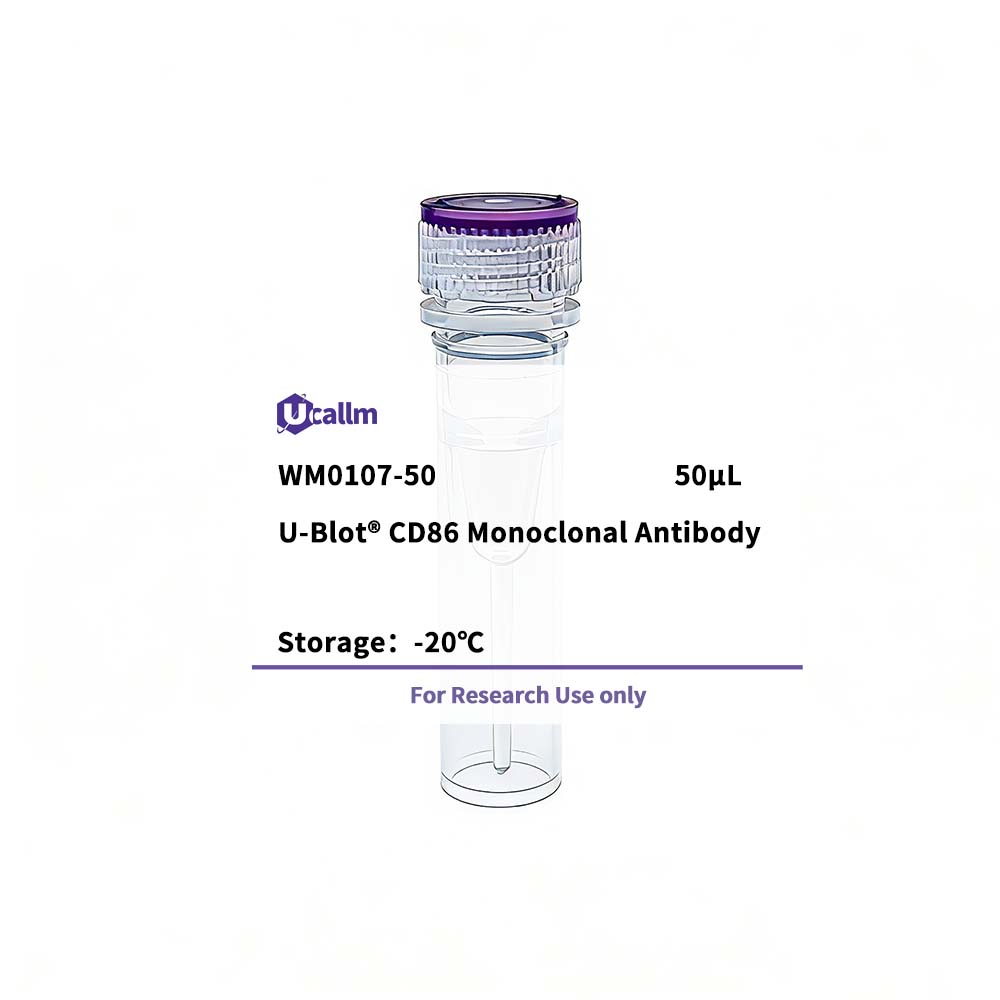
SKU: WM0107 Categories: ,

CD86 Monoclonal Antibody

Price range: $268.00 through $328.00

SKU: WM0107-50
Enter the quantity you would like, or drag the panel to find the quantity and price that best for you
Bulk QuoteAuthorize OEM & ODM

Product details

Background:
This gene encodes a type I membrane protein that is a member of the immunoglobulin superfamily. This protein is expressed by antigen-presenting cells, and it is the ligand for two proteins at the cell surface of T cells, CD28 antigen and cytotoxic T-lymphocyte-associated protein 4. Binding of this protein with CD28 antigen is a costimulatory signal for activation of the T-cell. Binding of this protein with cytotoxic T-lymphocyte-associated protein 4 negatively regulates T-cell activation and diminishes the immune response. Alternative splicing results in several transcript variants encoding different isoforms.[provided by RefSeq, May 2011],


Specifications

Size50μL/100μL
TargetCD86
ReactivityHuman
ApplicationsWB, ELISA
MW(Calculated)60-80kD
MW(Observed)
Host SpeciesMouse
Isotype
Conjugate/ModificationUnmodified
Recommended Dilution RatioWB 1:500-1:2000; ELISA 1:10000; Not yet tested in other applications.
FormulationLiquid in PBS containing 50% glycerol, 0.5% BSA and 0.02% sodium azide.
PurificationAffinity purification
Storage-15°C to -25°C/1 year(Do not lower than -25°C)
Concentration
ClonalityMonoclonal
Clone Number7E3
ImmunogenPurified recombinant fragment of human CD86 expressed in E. Coli.
SpecificityCD86 Monoclonal Antibody detects endogenous levels of CD86 protein.
Gene NameCD86
Protein NameT-lymphocyte activation antigen CD86
Other NameCD86; / CD28LG2; / T-lymphocyte activation antigen CD86; / Activation B7-2 antigen; / B70; / BU63; / CTLA-4 counter-receptor B7.2; / FUN-1; / CD antigen CD86
SpeciesHuman
Gene ID942
UniprotP42081,
Species.1Mouse
Gene ID.1
Uniprot.1P42082
Species.2
Gene ID.2
Uniprot.2
Cellular LocalizationCell membrane; Single-pass type I membrane protein.
Tissue ExpressionExpressed by activated B-lymphocytes and monocytes.
Signaling_pathwayOrganismal Systems >> Immune system >> Toll-like receptor signaling pathway;Organismal Systems >> Immune system >> Intestinal immune network for IgA production;Human Diseases >> Cancer: overview >> Transcriptional misregulation in cancer;Human Diseases >> Immune disease >> Systemic lupus erythematosus;Human Diseases >> Immune disease >> Rheumatoid arthritis;Human Diseases >> Immune disease >> Autoimmune thyroid disease;Human Diseases >> Immune disease >> Allograft rejection;Human Diseases >> Immune disease >> Graft-versus-host disease;Environmental Information Processing >> Signaling molecules and interaction >> Cell adhesion molecules
Research Areas>>Cell adhesion molecules; / >>Toll-like receptor signaling pathway; / >>Intestinal immune network for IgA production; / >>Type I diabetes mellitus; / >>Kaposi sarcoma-associated herpesvirus infection; / >>Transcriptional misregulation in cancer; / >>Autoimmune thyroid disease; / >>Systemic lupus erythematosus; / >>Rheumatoid arthritis; / >>Allograft rejection; / >>Graft-versus-host disease; / >>Viral myocarditis
FunctionFunction:Receptor involved in the costimulatory signal essential for T-lymphocyte proliferation and interleukin-2 production, by binding CD28 or CTLA-4. May play a critical role in the early events of T-cell activation and costimulation of naive T-cells, such as deciding between immunity and anergy that is made by T-cells within 24 hours after activation. Isoform 2 interferes with the formation of CD86 clusters, and thus acts as a negative regulator of T-cell activation.,online information:CD86 entry,PTM:Polyubiquitinated; which is promoted by MARCH8 and results in endocytosis and lysosomal degradation.,similarity:Contains 1 Ig-like C2-type (immunoglobulin-like) domain.,similarity:Contains 1 Ig-like V-type (immunoglobulin-like) domain.,subunit:Interacts with MARCH8. Interacts with human herpesvirus 8 MIR2 protein (Probable). Interacts with adenovirus subgroup B fiber proteins and acts as a receptor for these viruses.,tissue specificity:Expressed by activated B-lymphocytes and monocytes.,
Please login to post questions
Back to Top
Product has been added to your cart
