SKU: WR4443 Categories: ,

U-Blot® Cdc25C Rabbit mAb

Price range: $268.00 through $328.00

SKU: WR4443-50
Enter the quantity you would like, or drag the panel to find the quantity and price that best for you
Bulk QuoteAuthorize OEM & ODM

Product details

Background:cell division cycle 25C(CDC25C) Homo sapiens This gene encodes a conserved protein that plays a key role in the regulation of cell division. The encoded protein directs dephosphorylation of cyclin B-bound CDC2 and triggers entry into mitosis. It also suppresses p53-induced growth arrest. Multiple alternatively spliced transcript variants of this gene have been described. [provided by RefSeq, Dec 2015],

Specifications

Size50μL/100μL
TargetCdc25C
ReactivityHuman, Mouse, Rat
ApplicationsWB, IHC, IF, IP, ELISA
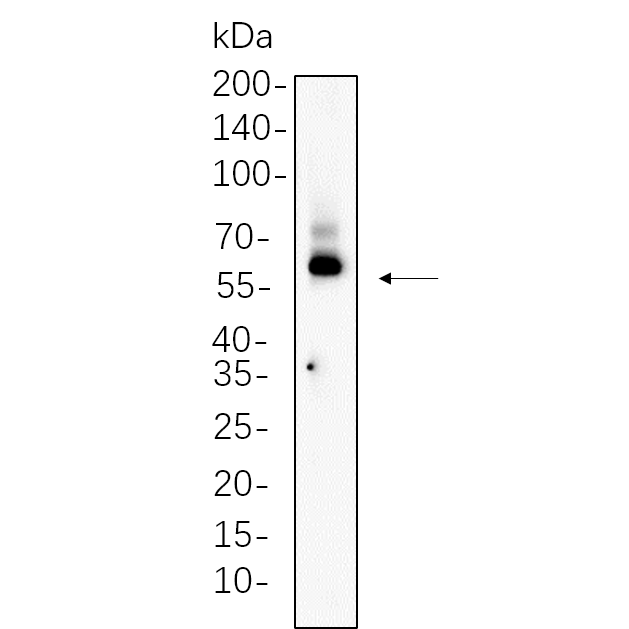
MW(Calculated)53kD
MW(Observed)60kD
Host SpeciesRabbit
IsotypeIgG,Kappa
Conjugate/ModificationUnmodified
Recommended Dilution RatioIHC 1:1000-1:4000; WB 1:2000-1:10000; IF 1:200-1:1000; ELISA 1:5000-1:20000; IP 1:50-1:200; / Note: For IHC, we suggest antigen retrieval with TE buffer pH 9.0 (Cat#WT1004)
FormulationPBS, 50% glycerol, 0.05% Proclin 300, 0.05%BSA
PurificationRecombinant Antibody expressed in animal component-free (ACF) media, purified via Protein A affinity chromatography.
Storage-15°C to -25°C/1 year(Do not lower than -25°C)
Concentration
ClonalityMonoclonal
Clone NumberRM0669R
ImmunogenThe specific immunogen used to produce this antibody is proprietary information.
SpecificityEndogenous
Gene NameCDC25C
Protein NameM-phase inducer phosphatase 3
Other NameCDC25C; / M-phase inducer phosphatase 3; / Dual specificity phosphatase Cdc25C
SpeciesHuman
Gene ID6932
UniprotP30307,
Species.1Mouse
Gene ID.1
Uniprot.1P48967
Species.2
Gene ID.2
Uniprot.2
Cellular LocalizationNucleus
Tissue ExpressionPredominantly expressed in T-cells. Also detected in proliferating intestinal epithelial cells and in the basal epithelial cells of mammary gland epithelium.
Signaling_pathwayCellular Processes >> Cellular community - eukaryotes >> Adherens junction;Cellular Processes >> Cellular community - eukaryotes >> Signaling pathways regulating pluripotency of stem cells;Human Diseases >> Cancer: overview >> Pathways in cancer;Human Diseases >> Cancer: specific types >> Colorectal cancer;Human Diseases >> Cancer: specific types >> Hepatocellular carcinoma;Human Diseases >> Cancer: specific types >> Gastric cancer;Human Diseases >> Cancer: specific types >> Thyroid cancer;Human Diseases >> Cancer: specific types >> Acute myeloid leukemia;Human Diseases >> Cancer: specific types >> Basal cell carcinoma;Human Diseases >> Cancer: specific types >> Prostate cancer;Human Diseases >> Cancer: specific types >> Endometrial cancer;Human Diseases >> Cancer: specific types >> Breast cancer;Environmental Information Processing >> Signal transduction >> Wnt signaling pathway;Environmental Information Processing >> Signal transduction >> Hippo signaling pathway
Research Areas>>Wnt signaling pathway; / >>Hippo signaling pathway; / >>Adherens junction; / >>Signaling pathways regulating pluripotency of stem cells; / >>Melanogenesis; / >>Cushing syndrome; / >>Alcoholic liver disease; / >>Salmonella infection; / >>Human papillomavirus infection; / >>Kaposi sarcoma-associated herpesvirus infection; / >>Pathways in cancer; / >>Colorectal cancer; / >>Endometrial cancer; / >>Prostate cancer; / >>Thyroid cancer; / >>Basal cell carcinoma; / >>Acute myeloid leukemia; / >>Breast cancer; / >>Hepatocellular carcinoma; / >>Gastric cancer; / >>Arrhythmogenic right ventricular cardiomyopathy
FunctionCatalytic activity:Protein tyrosine phosphate + H(2)O = protein tyrosine + phosphate.,developmental stage:Expressed predominantly in G2 phase.,Function:Functions as a dosage-dependent inducer in mitotic control. It is a tyrosine protein phosphatase required for progression of the cell cycle. It directly dephosphorylates CDC2 and activate its kinase activity.,PTM:Phosphorylated by CHK1 on Ser-216. This phosphorylation creates a binding site for 14-3-3 protein and inhibits the phosphatase.,similarity:Belongs to the MPI phosphatase family.,similarity:Contains 1 rhodanese domain.,subunit:Interacts with HIV-1 Vpr, thereby inactivating CDC25C phosphatase activity.,
Please login to post questions

Back to Top
Product has been added to your cart

