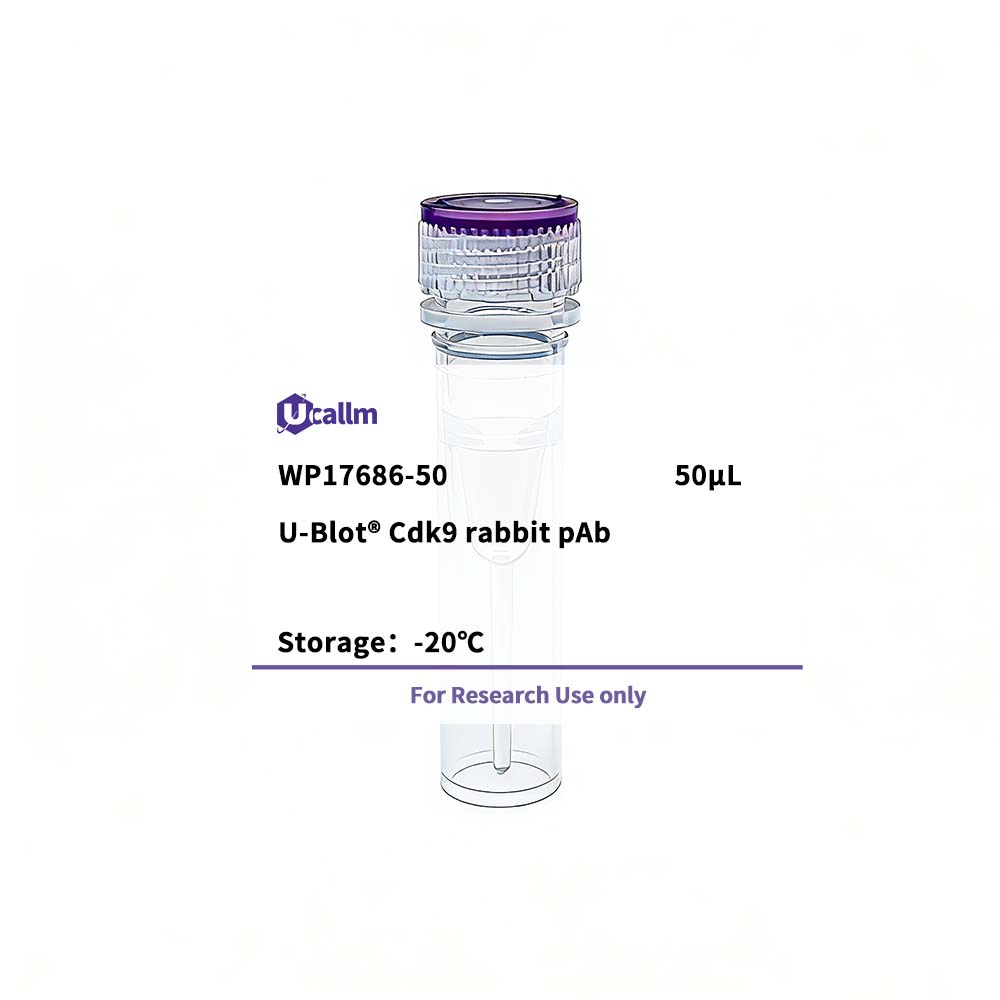
SKU: WP17686 Categories: ,

Cdk9 rabbit pAb

Price range: $268.00 through $328.00

SKU: WP17686-100
Enter the quantity you would like, or drag the panel to find the quantity and price that best for you
Bulk QuoteAuthorize OEM & ODM

Product details

Background:

cyclin dependent kinase 9(CDK9) Homo sapiens The protein encoded by this gene is a member of the cyclin-dependent protein kinase (CDK) family. CDK family members are highly similar to the gene products of S. cerevisiae cdc28, and S. pombe cdc2, and known as important cell cycle regulators. This kinase was found to be a component of the multiprotein complex TAK/P-TEFb, which is an elongation factor for RNA polymerase II-directed transcription and functions by phosphorylating the C-terminal domain of the largest subunit of RNA polymerase II. This protein forms a complex with and is regulated by its regulatory subunit cyclin T or cyclin K. HIV-1 Tat protein was found to interact with this protein and cyclin T, which suggested a possible involvement of this protein in AIDS. [provided by RefSeq, Jul 2008],

Specifications

Size50μL/100μL
TargetCdk9
ReactivityHuman, Mouse, Rat
ApplicationsWB, ELISA
MW(Calculated)41kD
MW(Observed)
Host SpeciesRabbit
IsotypeIgG
Conjugate/ModificationUnmodified
Recommended Dilution RatioWB 1:1000-2000; ELISA 1:5000-20000
FormulationLiquid in PBS containing 50% glycerol, 0.5% BSA and 0.02% sodium azide.
PurificationThe antibody was affinity-purified from rabbit antiserum by affinity-chromatography using epitope-specific immunogen.
Storage-15°C to -25°C/1 year(Do not lower than -25°C)
Concentration1 mg/ml
ClonalityPolyclonal
Clone Number
ImmunogenSynthesized peptide derived from human Cdk9
SpecificityThis antibody detects endogenous levels of Human Cdk9
Gene NameCDK9 CDC2L4 TAK
Protein NameCdk9
Other NameCyclin-dependent kinase 9; / EC 2.7.11.23; / C-2K; / Cell division cycle 2-like protein kinase 4; / Cell division protein kinase 9; / Serine/threonine-protein kinase PITALRE; / Tat-associated kinase complex catalytic subunit
SpeciesHuman
Gene ID1025
UniprotP50750,
Species.1Mouse
Gene ID.1107951
Uniprot.1Q99J95,
Species.2Rat
Gene ID.2362110
Uniprot.2Q641Z4
Cellular LocalizationNucleus. Cytoplasm. Nucleus, PML body. Accumulates on chromatin in response to replication stress. Complexed with CCNT1 in nuclear speckles, but uncomplexed form in the cytoplasm. The translocation from nucleus to cytoplasm is XPO1/CRM1-dependent. Associates with PML body when acetylated.
Tissue ExpressionUbiquitous.
Signaling_pathwayHuman Diseases >> Cancer: overview >> Transcriptional misregulation in cancer
Research Areas>>Viral life cycle - HIV-1; / >>Transcriptional misregulation in cancer
FunctionCatalytic activity:ATP + [DNA-directed RNA polymerase] = ADP + [DNA-directed RNA polymerase] phosphate.,Catalytic activity:ATP + a protein = ADP + a phosphoprotein.,Function:Member of the cyclin-dependent kinase pair (CDK9/cyclin-T) complex, also called positive transcription elongation factor b (P-TEFb), which facilitates the transition from abortive to production elongation by phosphorylating the CTD (C-terminal domain) of the large subunit of RNA polymerase II (RNAP II), SUPT5H and RDBP. The CDK9/cyclin-K complex has also a kinase activity toward CTD of RNAP II and can substitute for P-TEFb in vitro.,similarity:Belongs to the protein kinase superfamily. CMGC Ser/Thr protein kinase family. CDC2/CDKX subfamily.,similarity:Contains 1 protein kinase domain.,subunit:Associates with CCNT1/cyclin-T1 to form P-TEFb. P-TEFb forms a complex with AFF4/AF5Q31. Also associates with CCNK/cyclin-K. Component of a complex which is at least composed of HTATSF1/Tat-SF1, P-TEFb complex, RNA pol II, SUPT5H, and NCL/nucleolin. Component of the 7SK snRNP complex at least composed of P-TEFb (composed of CDK9 and CCNT1/cyclin-T1), HEXIM1, HEXIM2, BCDIN3, SART3 proteins and 7SK and U6 snRNAs.,tissue specificity:Ubiquitous.,
Please login to post questions
Back to Top
Product has been added to your cart
