

Cerebellin 1 Polyclonal Antibody
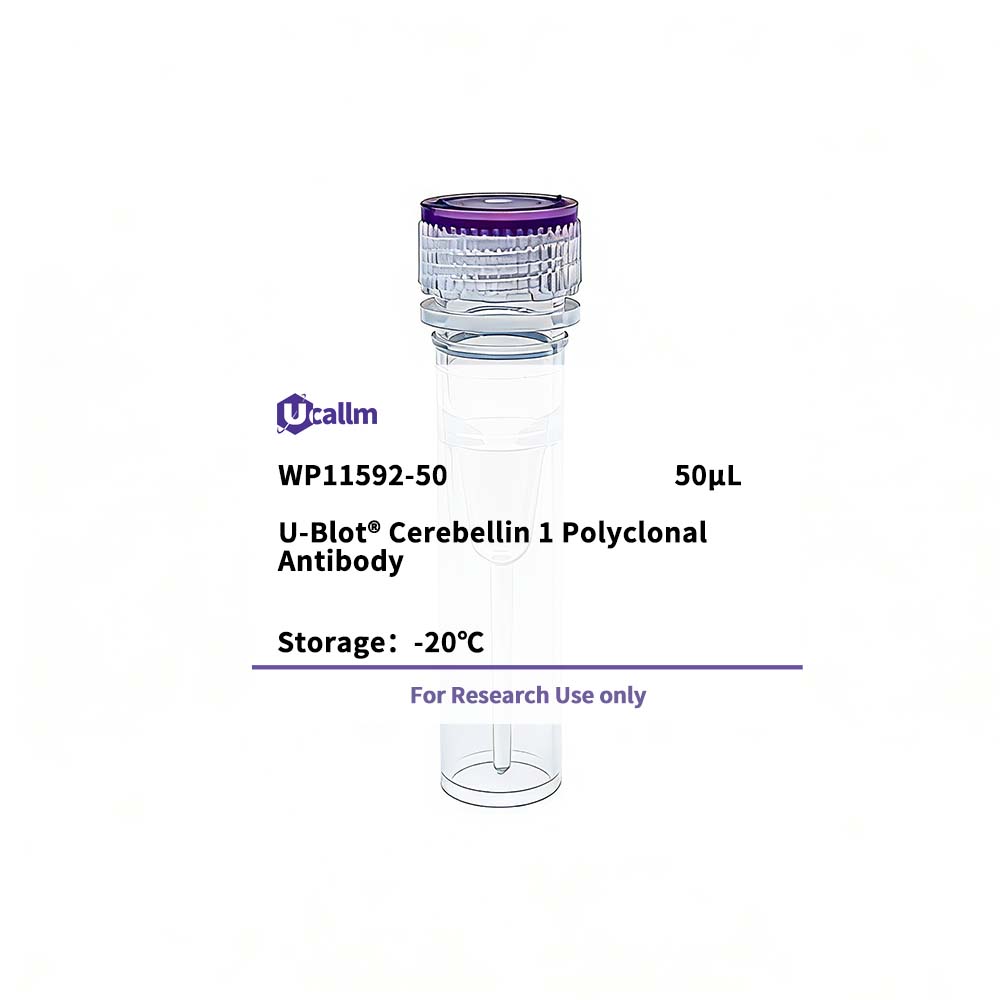
Ucallm_WP11592-50
Price range: $268.00 through $328.00
Product details
Background:
This gene encodes a cerebellum-specific precursor protein, precerebellin, with similarity to the globular (non-collagen-like) domain of complement component C1qB. Precerebellin is processed to give rise to several derivatives, including the hexadecapeptide, cerebellin, which is highly enriched in postsynaptic structures of Purkinje cells. Cerebellin has also been found in human and rat adrenals, where it has been shown to enhance the secretory activity of this gland. [provided by RefSeq, Aug 2008],
Specifications
| Size | 50μL/100μL |
| Target | Cerebellin 1 |
| Reactivity | Human, Mouse, Rat |
| Applications | WB, ELISA |
| MW(Calculated) | |
| MW(Observed) | 25kD |
| Host Species | Rabbit |
| Isotype | IgG |
| Conjugate/Modification | Unmodified |
| Recommended Dilution Ratio | WB 1:500-1:2000; ELISA 1:10000; Not yet tested in other applications. |
| Formulation | Liquid in PBS containing 50% glycerol, 0.5% BSA and 0.02% sodium azide. |
| Purification | The antibody was affinity-purified from rabbit antiserum by affinity-chromatography using epitope-specific immunogen. |
| Storage | -15°C to -25°C/1 year(Do not lower than -25°C) |
| Concentration | 1 mg/ml |
| Clonality | Polyclonal |
| Clone Number | |
| Immunogen | The antiserum was produced against synthesized peptide derived from human CBLN1. AA range:131-180 |
| Specificity | Cerebellin 1 Polyclonal Antibody detects endogenous levels of Cerebellin 1 protein. |
| Gene Name | CBLN1 |
| Protein Name | Cerebellin-1 |
| Other Name | CBLN1; / Cerebellin-1; / Precerebellin |
| Species | Human |
| Gene ID | 869 |
| Uniprot | P23435, |
| Species.1 | Mouse |
| Gene ID.1 | 12404 |
| Uniprot.1 | Q9R171, |
| Species.2 | Rat |
| Gene ID.2 | 498922 |
| Uniprot.2 | P63182 |
| Cellular Localization | Secreted . Cell junction, synapse, postsynaptic cell membrane . |
| Tissue Expression | In the Purkinje cells postsynaptic structures. In the cerebellum, cerebellin is much less abundant than [des-Ser1]-cerebellin. |
| Signaling_pathway | |
| Research Areas | |
| Function | developmental stage:Low at birth, the cerebellin concentration increases between day 5 and 15, and reaches peak values between day 21 and 56.,Function:Cerebellin exerts neuromodulatory functions. Directly stimulates norepinephrine release via the adenylate cyclase/PKA-dependent signaling pathway; and indirectly enhances adrenocortical secretion in vivo, through a paracrine mechanism involving medullary catecholamine release.,Function:Cerebellin-1 is required for synapse integrity and synaptic plasticity. Required for the ER export and secretion of CBLN3.,PTM:The proteolytic processing to yield cerebellin seems to occur either prior to the secretion by presynaptic neurons and subsequent oligomerization or in some other location after release of the mature protein.,similarity:Contains 1 C1q domain.,subcellular location:Might be bound to, or associated with, a membrane.,subunit:Homohexamer; disulfide-linked homotrimers. The trimers are assembled via the globular C1q domains. The trimers associate via N-terminal cysteine residues to form disulfide-linked hexamers. Probably forms a heteomeric complex with CBLN3. May interact with CBLN2 and CBLN4.,tissue specificity:In the Purkinje cells postsynaptic structures. In the cerebellum, cerebellin is much less abundant than [des-Ser1]-cerebellin., |
Please login to post questions
Related products





