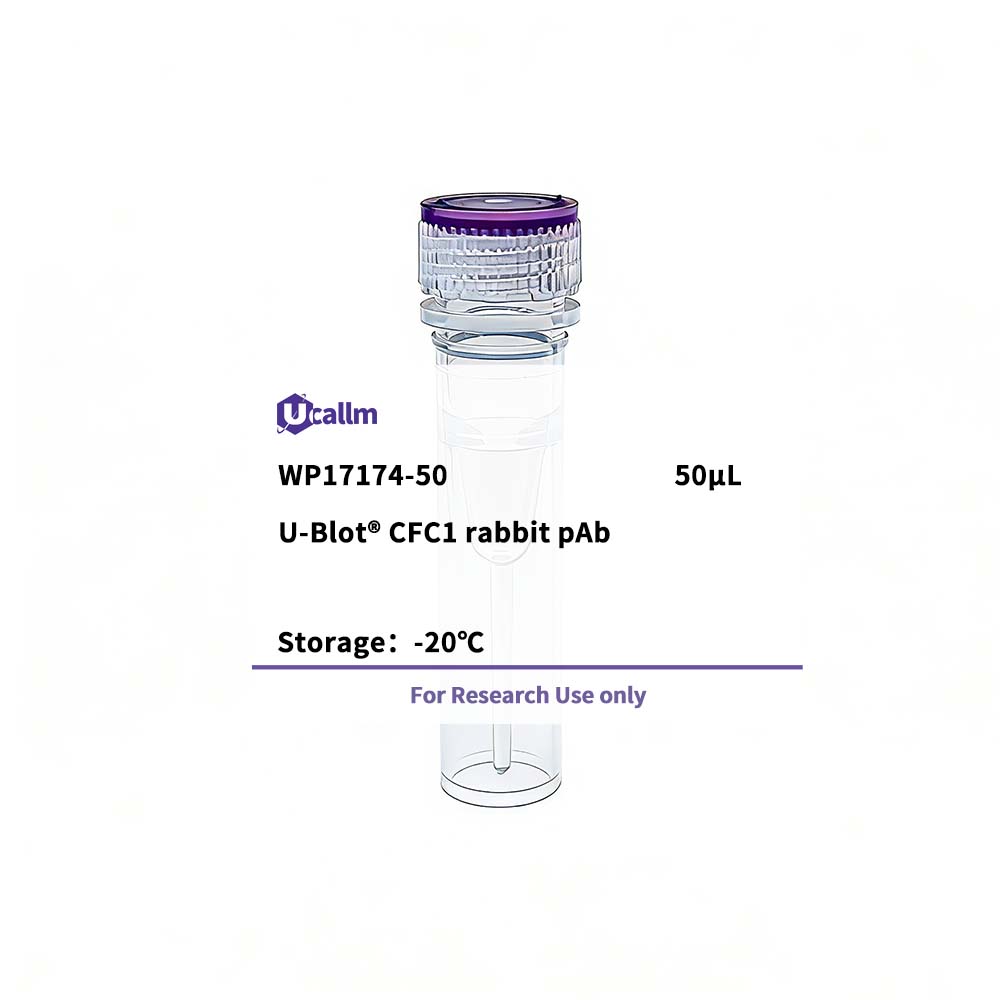
SKU: WP17174 Categories: ,

CFC1 rabbit pAb

Price range: $268.00 through $328.00

SKU: WP17174-100
Enter the quantity you would like, or drag the panel to find the quantity and price that best for you
Bulk QuoteAuthorize OEM & ODM

Product details

Background:

This gene encodes a member of the epidermal growth factor (EGF)- Cripto, Frl-1, and Cryptic (CFC) family, which are involved in signalling during embryonic development. Proteins in this family share a variant EGF-like motif, a conserved cysteine-rich domain, and a C-terminal hydrophobic region. The protein encoded by this gene is necessary for patterning the left-right embryonic axis. Mutations in this gene are associated with defects in organ development, including autosomal visceral heterotaxy and congenital heart disease. Alternatively spliced transcript variants encoding multiple isoforms have been observed for this gene. [provided by RefSeq, Jul 2012],


Specifications

Size50μL/100μL
TargetCFC1
ReactivityHuman, Mouse
ApplicationsWB
MW(Calculated)25kD
MW(Observed)
Host SpeciesRabbit
IsotypeIgG
Conjugate/ModificationUnmodified
Recommended Dilution RatioWB 1:500-2000
FormulationLiquid in PBS containing 50% glycerol, 0.5% BSA and 0.02% sodium azide.
PurificationThe antibody was affinity-purified from rabbit antiserum by affinity-chromatography using epitope-specific immunogen.
Storage-15°C to -25°C/1 year(Do not lower than -25°C)
Concentration1 mg/ml
ClonalityPolyclonal
Clone Number
ImmunogenSynthesized peptide derived from human CFC1 AA range: 129-179
SpecificityThis antibody detects endogenous levels of CFC1 at Human/Mouse
Gene NameCFC1
Protein NameCFC1
Other Name
SpeciesHuman
Gene ID55997
UniprotP0CG37,
Species.1Mouse
Gene ID.112627
Uniprot.1P97766
Species.2
Gene ID.2
Uniprot.2
Cellular LocalizationCell membrane; Lipid-anchor, GPI-anchor . Secreted . Does not exhibit a typical GPI-signal sequence. The C-ter hydrophilic extension of the GPI-signal sequence reduces the efficiency of processing and could lead to the production of an secreted unprocessed form. This extension is found only in primates.
Tissue Expression
Signaling_pathway
Research Areas
FunctionDisease:Defects in CFC1 are a cause of conotruncal heart malformations (CTHM) [MIM:217095]. CTHM consist of cardiac outflow tract defects, such as tetralogy of Fallot, pulmonary atresia, double-outlet right ventricle, truncus arteriosus communis, and aortic arch anomalies.,Disease:Defects in CFC1 are a cause of transposition of the great arteries, dextro-looped (DTGA) [MIM:608808]. The more common form of DTGA, consists of complete inversion of the great vessels, so that the aorta incorrectly arises from the right ventricle and the pulmonary artery incorrectly arises from the left ventricle. This creates completely separate pulmonary and systemic circulatory systems, an arrangement that is incompatible with life. Patients often have atrial and/or ventricular septal defects or other types of shunting that allow some mixing between the circulations in order to support life minimally, but surgical intervention is always required.,Disease:Defects in CFC1 are a cause of visceral heterotaxy (HTX2) [MIM:605376]. HTX2 is an autosomal form of visceral heterotaxy (HTX). HTX is characterized by a variable group of congenital anomalies that include complex cardiac malformations and situs inversus or situs ambiguus.,Function:Involved in the correct establishment of the left-right axis. May play a role in mesoderm and/or neural patterning during gastrulation.,PTM:N-glycosylated.,similarity:Contains 1 EGF-like domain.,
Please login to post questions
Back to Top
Product has been added to your cart
